If you cannot pay the HIEEC entry fee by card, or your school prefers to handle payment, you have two distinct paths: a personal fee waiver or a school group invoice. A fee waiver replaces the online submission form with an email request. A group invoice keeps the individual submission form but changes who pays. The critical difference is whether the student ever submits the online form at all.
What the Entry Fee Covers
The Harvard International Economics Essay Contest (HIEEC) charges $25 USD for students at U.S. schools and $35 USD for students at schools outside the United States. This covers one anonymous essay of up to 1,500 words, judged by trained readers against a 20-point rubric. An optional $20 feedback add-on provides rubric scores and short written comments after results are released. Payment is normally by card at the time of online submission.
| Item | Cost | How to Arrange |
|---|---|---|
| Base entry (U.S. school) | $25 | Card via online form |
| Base entry (non-U.S. school) | $35 | Card via online form |
| Written feedback add-on | $20 | Selected during online submission |
| Fee waiver | $0 | Email competitions@thehuea.org instead of using form |
| School group payment | Same base fee | Each student submits own form; school emails for invoice |
Fee Waiver: When You Cannot Pay at All
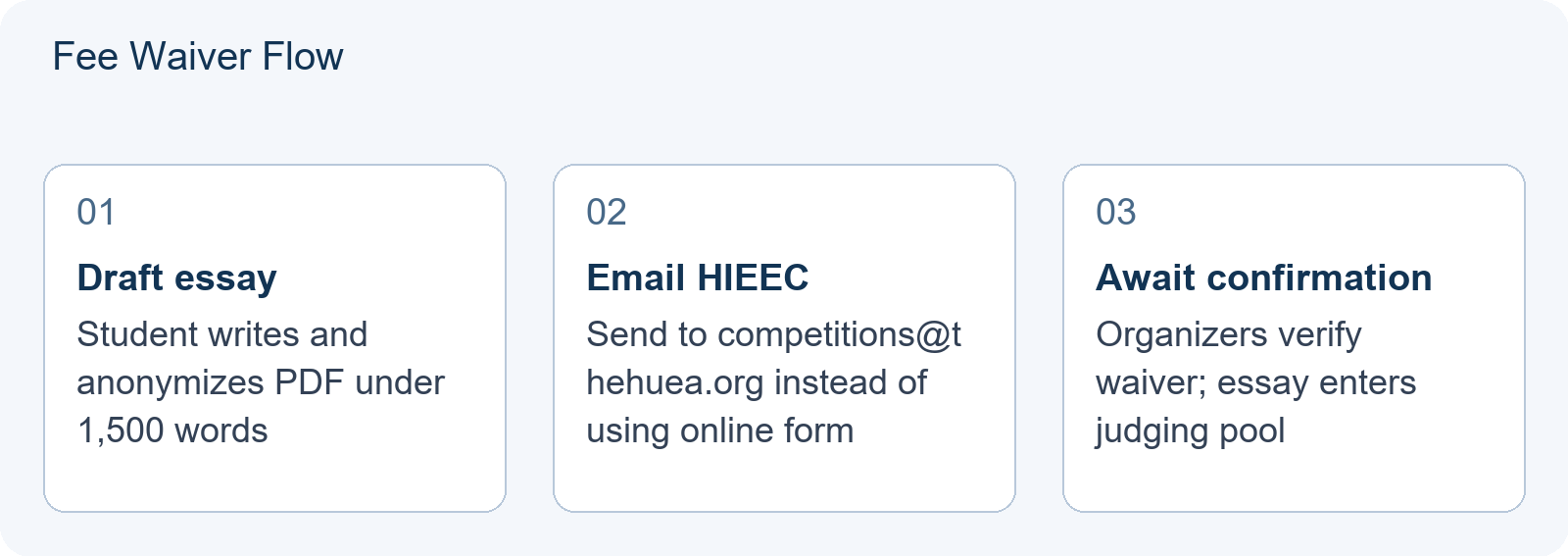
For students who genuinely cannot pay the entry fee, HIEEC offers a fee waiver. The process is explicit in the official instructions: you must email competitions@thehuea.org instead of submitting the form. This means you do not touch the online submission system at all. Your email serves as your entry mechanism.
What to include in your fee-waiver email is not specified in the public rules, but standard practice for such requests includes: a clear subject line (e.g., “HIEEC 2026–27 Fee Waiver Request”), your name, school, grade division (9–10 or 11–12), the prompt you have chosen, and your essay attached as a PDF that follows all formatting rules—especially the anonymity requirement (no name or school in the document). The source does not state whether the feedback add-on is available with a fee waiver, so students should ask directly if they want it.
The fee waiver is the only path that bypasses the online form entirely. If you submit the form and then email for a refund, you have created a duplicate process that may delay your entry.
School Group Payment: When the School Pays, Not the Student
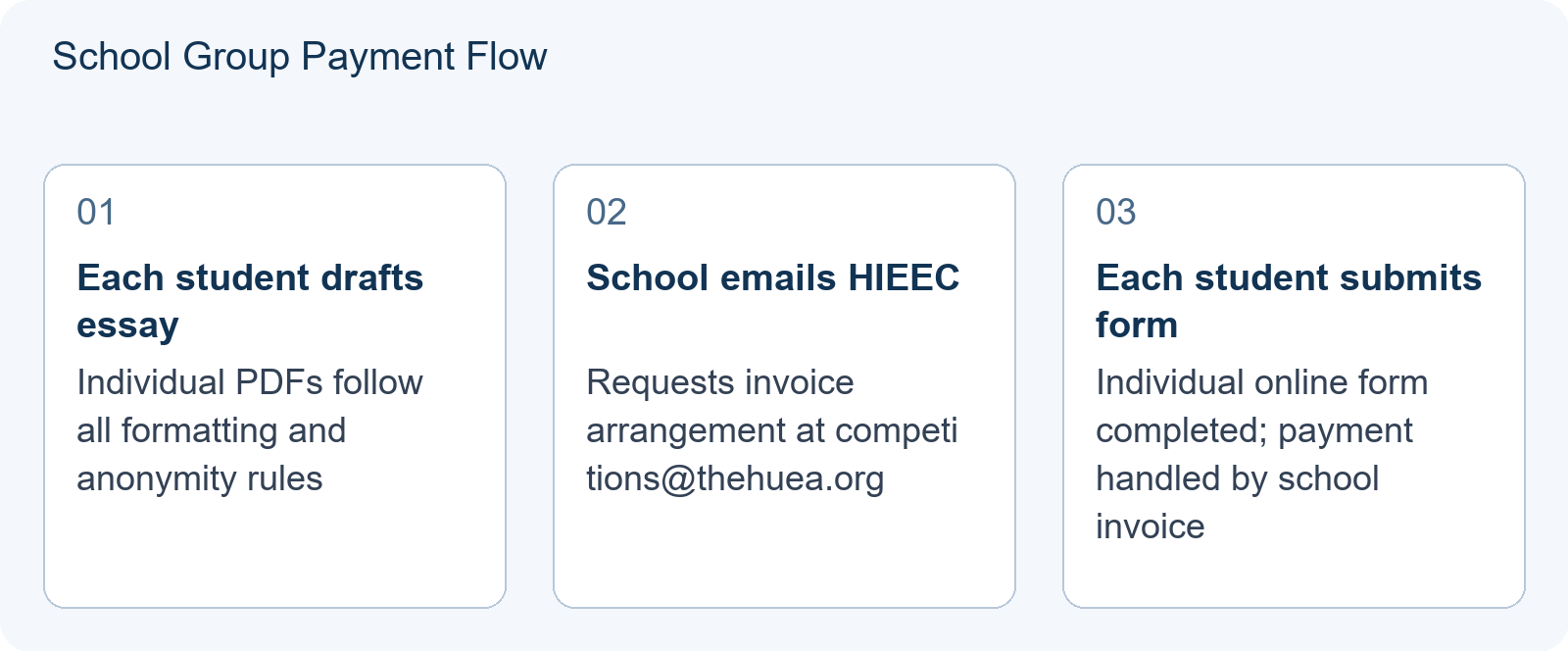
Schools that want to pay for multiple students—whether five or fifty—can arrange group payment, typically by invoice. However, the official rule is clear: “Each student submits their own form and payment. If your school would like to pay for a group (e.g., by invoice) please email us at competitions@thehuea.org.”
This means the process is not a single consolidated submission. Each student still completes the individual online form. The difference is that instead of entering personal card details, the school coordinates payment separately. The source does not specify whether the school receives a single invoice to pay in bulk, or whether each student receives an individual invoice forwarded by the school. Either way, the student’s responsibility remains submitting their own form with their own essay.
Side-by-Side: Fee Waiver vs. Group Payment
| Aspect | Fee Waiver | School Group Payment |
|---|---|---|
| Who pays | HIEEC waives the fee | School pays via invoice |
| Student uses online form | No—email instead | Yes—each student submits own form |
| Contact method | Email competitions@thehuea.org | School emails competitions@thehuea.org |
| Essay submission | Attached to email or as directed | Uploaded through individual online form |
| Anonymity rule | Still applies—no name/school in PDF | Still applies—no name/school in PDF |
| Deadline | Same: January 5, 2027, 11:59 pm ET | Same: January 5, 2027, 11:59 pm ET |
Common Mistakes to Avoid
Mistake 1: Submitting the form, then requesting a fee waiver. The instructions say to email “instead of submitting the form.” If you do both, you may create a duplicate entry or pay unnecessarily.
Mistake 2: Assuming group payment means one person submits for everyone. Each student must still submit their own form. The school’s role is limited to payment arrangement.
Mistake 3: Missing the anonymity requirement because of email attachments. Whether you submit by form or email, your PDF must not contain your name or school. Judges see essays anonymously.
Mistake 4: Waiting until the deadline to arrange group payment. Invoice processing takes time. Schools should email well before January 5, 2027 to confirm the arrangement.
What the Source Does Not Say
The official HIEEC page does not specify: how quickly fee-waiver or invoice requests are confirmed; whether fee-waiver recipients can purchase the feedback add-on; what information schools must provide to receive an invoice; or whether invoice payments are accepted in currencies other than USD. For any of these questions, email competitions@thehuea.org directly.
Preparation Checklist for Students Using Either Alternative
- Confirm your prompt choice and complete your draft early.
- Format your PDF: no name, no school, under 1,500 words, under 10 MB.
- If requesting a fee waiver: draft your email with essay attached, send instead of touching the form.
- If using group payment: complete your individual form normally, but alert your teacher to email for invoice arrangements.
- Verify your submission reached HIEEC before the deadline; do not assume.
For help structuring your argument once payment is sorted, see our guides on HIEEC Scope Ladder: From a Broad Policy Claim to a Testable 1,500-Word Case (2026-27) and HIEEC Rubric Self-Scoring: A Practical 20-Point Draft Review (2026-27). If you are unsure which prompt suits your background, our HIEEC Mechanism Map: Who Is Affected, How, and What Evidence Would Show It (2026-27) shows how to match evidence to each question type.
Teaching Illustration: A Student’s Decision Tree for Payment Timing
The existing article explains what fee waivers and group invoices are, but it leaves a practical gap: how should a student or teacher decide which path to take when multiple conditions apply simultaneously? The following teaching illustration walks through a concrete decision scenario, checks the logic at each branch, and ends with a practice task you can apply to your own situation.
The Scenario
Imagine a student named Aria at a Canadian international school. Her family cannot pay the $35 USD entry fee by card. Her school has offered to cover costs for competition entrants, but the accounts office requires an invoice and pays only in CAD by bank transfer. Aria also wants the $20 feedback add-on. Which path should she take?
Let us map the constraints:
- Constraint 1: No personal card payment possible (family cannot pay).
- Constraint 2: School payment requires invoice and bank transfer in CAD.
- Constraint 3: Aria wants the feedback add-on.
- Constraint 4: The official source states fee-waiver recipients email “instead of submitting the form,” and the feedback add-on is “selected during online submission.”
Step-by-Step Diagnostic
Branch A: Fee Waiver Path
Aria emails competitions@thehuea.org requesting a fee waiver. She attaches her essay PDF. The source explicitly says this replaces the online form. She does not submit the form, so she cannot select the feedback add-on during online submission. The source does not state whether the add-on is available to fee-waiver recipients. If she wants feedback, she must ask in her email; the response is unverified in official materials.
Logical implication: The fee waiver satisfies Constraints 1 and 2 (no card needed, school does not need to pay), but it may fail Constraint 3 if the add-on is unavailable. It also creates uncertainty for the school’s accounts office, which expected to process a standard invoice.
Branch B: School Group Invoice Path
Aria completes her individual online form normally. She selects the $20 feedback add-on, bringing her total to $55 USD. Her school emails competitions@thehuea.org to arrange group invoice payment. The source states this is the correct path when “your school would like to pay for a group (e.g., by invoice).”
Logical implication: This path satisfies all three constraints. Constraint 1 is met because Aria never enters card details—her school pays. Constraint 2 is met because the school requests invoice payment directly. Constraint 3 is met because she selects the add-on during her individual form submission.
Branch C: Fee Waiver Plus Separate Add-On Purchase
Aria requests a fee waiver for the base entry, then separately asks to buy the feedback add-on. The source does not describe this hybrid. Since the add-on is tied to online form submission, and the fee waiver replaces the form, this branch has no verified official support. It risks payment confusion or duplicate records.
Logical implication: This path lacks verified support. The source structure implies the add-on is a form-selection feature, not a standalone purchase. Students in this situation should ask competitions@thehuea.org directly rather than assuming this combination works.
The Diagnostic Answer
For Aria, Branch B (school group invoice) is the only path that satisfies all verified constraints without introducing unverified claims. The fee waiver (Branch A) is designed for students who personally cannot pay and have no other payment arrangement. It is not the correct tool when a third party is willing and able to pay via invoice.
| Condition | Choose Fee Waiver | Choose School Invoice |
|---|---|---|
| No one can pay; student has no institutional support | Yes | No |
| School or organization can pay, but only by invoice/bank transfer | No | Yes |
| Student wants feedback add-on with high confidence | Uncertain—ask directly | Yes—select during form |
| Student has already submitted the online form | No—too late, fee waiver replaces form | Yes—school can still arrange invoice |
| Deadline is within 48 hours | Risky—email response time unverified | Risky—invoice setup time unverified, but form is submitted |
Teaching Example: How to Verify Total Cost Without Assuming Rates
To check Aria’s total under Branch B: Base entry for non-U.S. school is $35 USD. Feedback add-on is $20 USD. Total before any currency conversion: $35 + $20 = $55 USD.
Her school pays in CAD. The source does not specify exchange rates, whether HIEEC accepts CAD directly, or what amount will appear on the invoice. Schools should email competitions@thehuea.org with specific questions: “What amount will appear on the invoice, in what currency, and what payment methods do you accept?” Record the response for your accounts office.
Important reminder: The source states “Entry fees are non-refundable except for duplicate or accidental payments.” This implies the $55 is final once processed. There is no mention of prorated refunds if the school later withdraws support. Aria and her school should confirm commitment before the invoice is issued.
Concrete Next Practice Task
Apply this framework to your own situation:
- List your hard constraints. Write down: (a) can you pay by card personally, (b) does your school or another organization offer to pay, (c) what payment methods does that organization actually use, and (d) do you want the feedback add-on?
- Map to the diagnostic. If (a) is no, (b) is yes, and (c) is invoice/bank transfer, you are in Aria’s position—use school group invoice, not fee waiver.
- Verify the add-on. If you want feedback, draft an email to
competitions@thehuea.orgwith the subject: “Clarification: Feedback add-on availability with [fee waiver / group invoice] for HIEEC 2026–27.” Send this at least two weeks before the January 5, 2027 deadline to allow response time. - Confirm currency and timing. If your school pays in non-USD currency, ask explicitly: “What amount will appear on the invoice, in what currency, and what is the payment deadline?” Record the response.
This illustration uses invented student details to demonstrate a general decision method. The underlying rules are drawn from the official HIEEC source as retrieved on November 23, 2026.
General event background is available at Event background.
This is an independent preparation guide, not affiliated with, endorsed by, or sponsored by the Harvard Undergraduate Economics Association.
Frequently Asked Questions
Can I get a fee waiver after I already submitted the form?
No. The official instructions state to email for a fee waiver “instead of submitting the form.” Submitting the form and then requesting a waiver may create duplicate entries or unnecessary charges.
Does group payment mean our teacher submits all essays together?
No. Each student must still submit their own individual form and essay. The group arrangement only changes how payment is made, not how essays are entered.
Is the feedback add-on available with a fee waiver?
The official rules do not specify this. Students requesting fee waivers should ask directly when emailing competitions@thehuea.org.