The most effective way to build a competitive HIEEC own question is to start from a genuine economic puzzle you have observed, narrow it to a single causal mechanism you can test with real-world evidence, and verify that you can answer it within 1,500 words. This article shows you how to move from a broad topic to a contest-ready prompt, using a worked teaching illustration and a three-point feasibility test.
According to the official HIEEC rules for 2026–27, students may choose one of five fixed prompts or write on an economics question of their own choosing. The own-question option rewards students who can identify a focused, original problem and defend a clear position. The challenge is not finding an interesting topic—it is turning that topic into a question that can be answered with economic reasoning and evidence within the strict word limit.
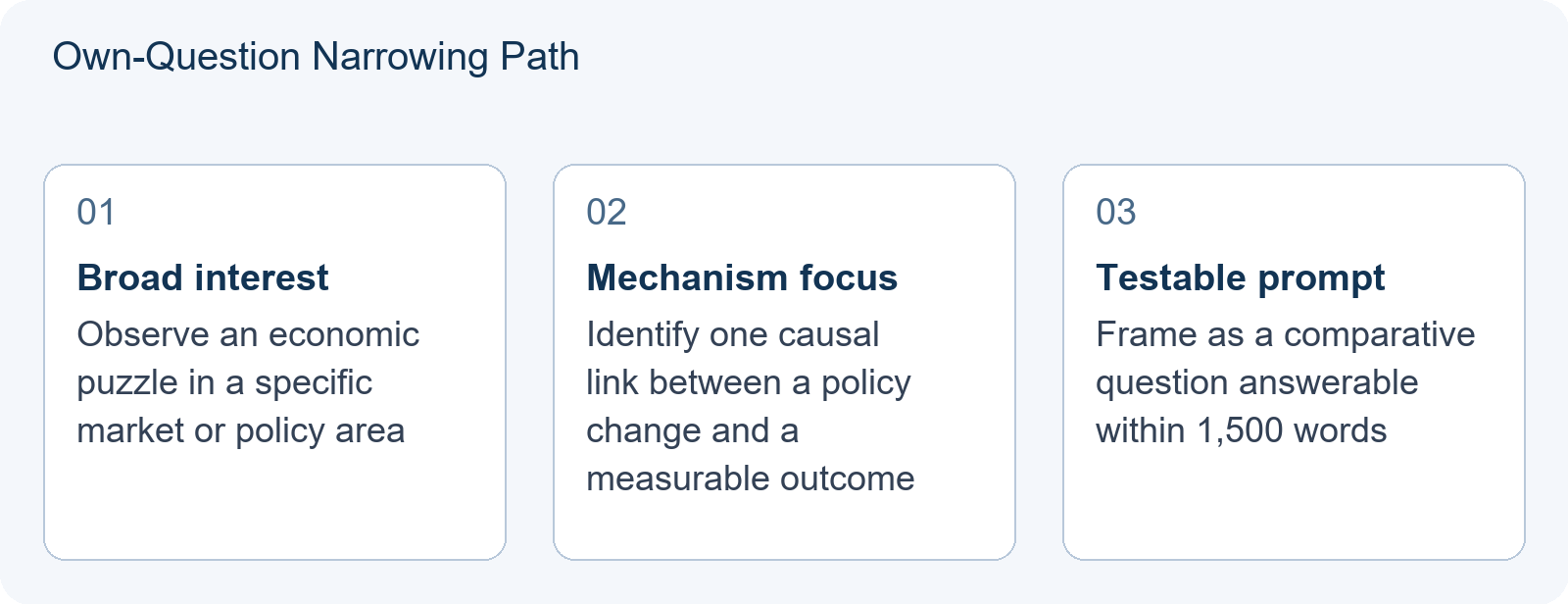
Step 1: Capture a Broad Interest and Find the Economic Tension
Start with something you have noticed in your own experience or reading. Perhaps you have observed that local restaurants struggle to retain workers after a minimum wage increase, or that your city’s public transit system loses riders when ride-hailing prices drop. These observations contain economic tension: two forces pulling in opposite directions, or a policy with winners and losers.
A Hanlin coaching observation (Lu, Hanlin Arts Teacher, 2026-11-12) notes that strong HIEEC essays often begin by identifying who is affected by a policy or technology and through what mechanism. This reflects coaching experience, not an official competition rule. The same principle applies to your own question. Before you commit to a prompt, write down: who are the affected groups, what policy or market change creates the effect, and what economic concept explains the link between them?
[Teaching example] A student interested in urban development notices that after her city introduced rent controls in some districts, new construction slowed while queue times for apartments lengthened. Her broad interest is housing affordability. The economic tension is between protecting current renters and encouraging future supply. She has not yet found her question, but she has identified a mechanism worth investigating.
Step 2: Narrow to a Single Testable Mechanism
The most common mistake in own-question essays is trying to explain everything. A 1,500-word essay cannot resolve the future of artificial intelligence, the global minimum wage, or climate finance in full. It can, however, test whether one specific mechanism holds in one clearly defined setting.
To narrow your topic, apply the scope ladder method: move from a broad policy claim down to a testable case. HIEEC Scope Ladder: From a Broad Policy Claim to a Testable 1,500-Word Case (2026-27) provides a full framework for this process. The essential move is to replace nouns like “globalization” or “automation” with a specific market, policy, and time period, then ask what change you could observe that would confirm or reject your hypothesis.
| Broad topic | Narrowed mechanism | Testable claim |
|---|---|---|
| Housing affordability | Rent control and new construction permits | Stricter rent control in District X reduced residential permits by more than the regional trend after 2020 |
| Youth employment | Minimum wage and part-time job postings | A $2 increase in the minimum wage reduced teenage job postings in retail by more than in hospitality |
| Digital payments | Payment fees and small merchant adoption | Zero fees for merchants increased small-business adoption of mobile payments faster than consumer subsidies did |
Each narrowed example identifies a specific comparison: two groups, two time periods, or two policies. This comparison is what makes your question testable. Without it, you are describing a topic rather than answering a question.
Step 3: Build Your Own Question Using the Three-Part Structure
A strong own question contains three elements: a clear economic agent, a specific policy or market change, and an outcome that can be measured. The question should invite disagreement: a reader should be able to imagine answering “yes” or “no” with different evidence, not simply agree that the topic is important.
Consider this structure when drafting your prompt:
Agent + mechanism + outcome: “When [policy X] was introduced in [specific market], did it increase [outcome Y] for [group Z] compared to [comparable group or period]?”
This structure forces you to define your terms. If you cannot fill in the brackets with specifics, your question is not yet ready. HIEEC Mechanism Map: Who Is Affected, How, and What Evidence Would Show It (2026-27) offers a template for tracing these connections explicitly.
The student from the rent-control example refines her question: ‘After District A introduced rent controls in 2022 while District B did not, did District A’s residential construction permits fall further below their 2019–2021 trend than District B’s?’ She now has a specific comparison, a measurable outcome, and a time boundary. The question is narrow enough for 1,500 words but substantive enough to require economic analysis.
Step 4: Validate Your Question with the Feasibility Test
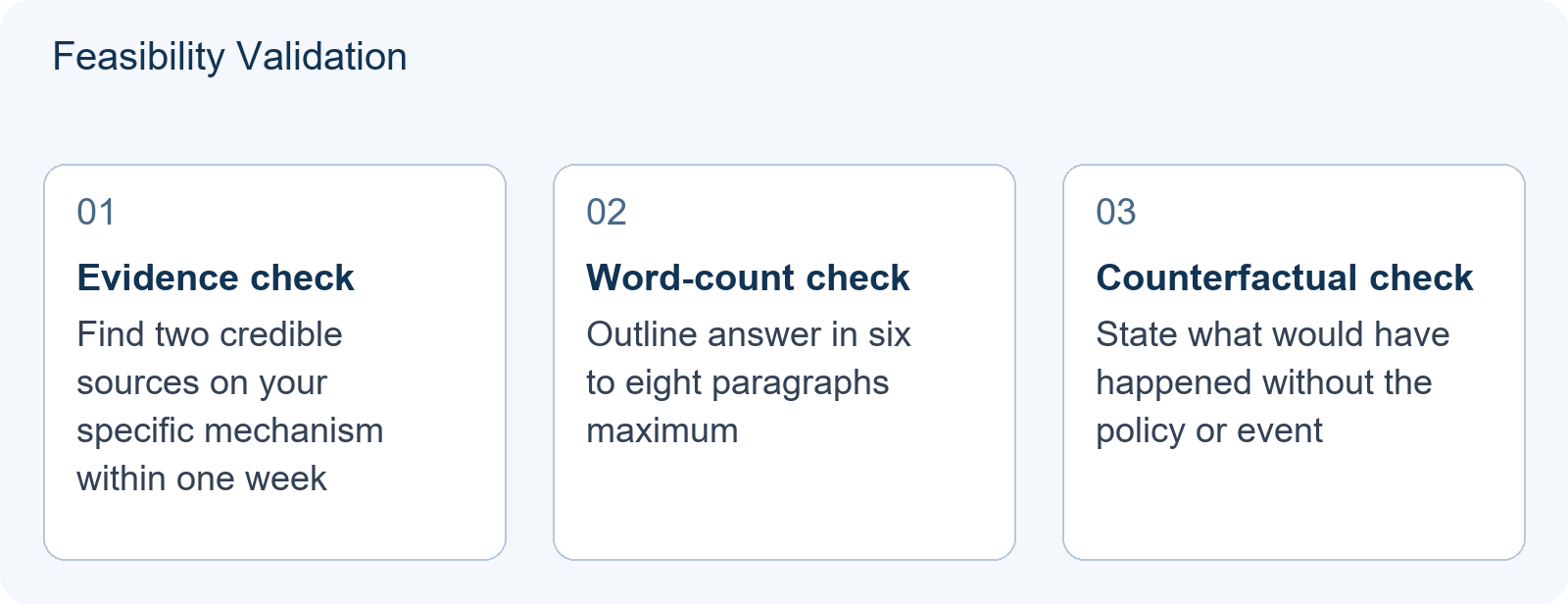
Before writing, run your question through three checks:
Evidence check: Can you find, within one week of searching, at least two credible data sources or academic papers that address your specific mechanism? If the only sources discuss your topic in general terms, your question is still too broad.
Word-count check: Can you outline your answer in six to eight paragraphs? If your outline requires twelve sections, your question needs further narrowing. HIEEC Rubric Self-Scoring: A Practical 20-Point Draft Review (2026-27) includes a paragraph-budget tool for this purpose.
Counterfactual check: Can you state what would have happened without the policy or event you are studying? If you cannot describe the counterfactual, you may be describing a correlation rather than testing a causal claim.
Passing all three checks does not guarantee success, but failing any one signals that your question needs more refinement before you begin drafting.
Step 5: Draft a One-Paragraph Proposal Before Committing
Once your question passes the feasibility test, write a single paragraph that states your question, your expected answer, and the two strongest pieces of evidence you plan to use. Share this paragraph with a teacher or peer. If they cannot repeat your question back to you in their own words, or if they respond with “that sounds interesting” rather than “that sounds arguable,” your question still needs sharpening.
This discipline prevents the common trap of writing 800 words before discovering that your question cannot be answered with available evidence. The 1,500-word limit is unforgiving: there is no room to pivot after a false start.
Common Pitfalls in Own-Question Essays
A question like ‘Should governments do more to reduce inequality?’ invites opinion, not analysis. A question like ‘When a major city introduced congestion pricing, did retail districts inside the zone see higher vacancy rates than similar districts outside it?’ invites analysis of mechanisms and evidence.
Another pitfall is confusing description with argument. Stating that a policy exists, explaining how it works, and then concluding that it is “important” does not constitute an economic argument. Your essay must take a position and defend it with evidence that could, in principle, prove you wrong.
How This Approach Connects to the Official Competition
The official HIEEC 2026–27 rules state that essays are judged on analysis, creativity, research, and structure, with each category worth up to five points. The narrowing and validation steps above are designed to help you score well across all categories by ensuring your question is focused and defensible, whether you choose a fixed prompt or write your own.
The submission deadline for the 2026–27 contest is January 5, 2027. Students who begin with a validated own question in late November or early December leave adequate time for drafting and revision. Those who begin with an unrefined topic risk rushing the narrowing process or submitting an essay that describes rather than argues.
Summary: Your Own-Question Checklist
- Identify a specific economic tension from observation or reading
- Narrow to one causal mechanism with a clear comparison
- Structure the question around agent, mechanism, and measurable outcome
- Pass the evidence, word-count, and counterfactual feasibility tests
- Draft a one-paragraph proposal for feedback before writing
Building a competitive HIEEC own question is not primarily a creative exercise. It is a disciplined process of moving from interest to mechanism to testable claim. Students who follow this process produce essays that are easier to write, easier to judge, and more likely to advance in the competition.
Diagnostic: Test Your Own-Question Focus Before Writing
This section provides a concrete diagnostic you can apply to any candidate prompt. It builds directly on the rent-control teaching example from Step 1, now developed through reader interpretation, a worked diagnostic, and a next practice task.
Reader Interpretation Check
Ask a peer to read your one-paragraph proposal and then, without looking back, state your question in their own words. If they add topics you did not mention—such as “and also the effect on homelessness” or “and whether tenants are happier”—your question has likely smuggled in extra mechanisms. The student from the rent-control example initially received feedback mentioning “housing quality” and “displacement to neighboring districts.” Both are plausible related topics, but neither appeared in her stated mechanism. She revised to remove them.
The Three-Box Diagnostic
Take your proposed question and label each component:
- Box A (Agent): Who or what is affected?
- Box B (Mechanism): What specific economic link connects cause and effect?
- Box C (Outcome): What measurable change would you observe?
Now check: does your draft essay outline spend equal space on all three boxes? A common imbalance is heavy description of Box A (the affected group) and Box C (the outcome data) but thin treatment of Box B (the mechanism). The rent-control essay passed this diagnostic only when the student could state: “Landlords expect lower future rents → reduce expected return on new construction → permit applications fall relative to trend.” This chain is Box B. Without it, the essay merely correlates rent control with fewer permits.
Explicit Answer: What Passing Looks Like
A passing diagnostic answer contains: (1) a single Box B mechanism stated as a conditional prediction, (2) evidence that could falsify it, and (3) no Box A or C elements that require their own separate mechanisms. For the rent-control case: ‘If expected-rent reductions decrease developer return on investment, then districts with stricter caps should show larger permit declines relative to their pre-policy trend than comparable districts without caps.’ This is falsifiable if districts with stricter caps show no larger permit decline than comparable districts without caps, which would suggest the mechanism is weaker than hypothesized or that other constraints dominate.
Concrete Next Practice Task
Take a topic you are considering and complete the diagnostic in writing: fill Boxes A, B, and C; identify which box receives the most space in your current outline; and rewrite Box B as a single conditional prediction. If you cannot complete this in 15 minutes, your question needs further narrowing before you write your first full paragraph.
General event background is available at Event background.
This is an independent preparation guide, not affiliated with, endorsed by, or sponsored by the Harvard Undergraduate Economics Association.
Frequently Asked Questions
Can I change my own question after I start writing?
You can refine the wording, but if your core mechanism or comparison changes, you are effectively starting over. The feasibility test is designed to prevent this by validating your question before you draft. If you discover during writing that your evidence does not support your original claim, it is better to narrow further than to broaden.
Does the own question carry more risk than the fixed prompts?
In Hanlin coaching observation, the own-question format offers more creative freedom but requires stronger self-discipline in narrowing. Students who skip the validation steps often submit essays that are too broad to score well. Students who follow the narrowing process can produce distinctive work that stands out from responses to the fixed prompts.
How do I know if my question is original enough?
Originality in HIEEC terms means your specific combination of mechanism, market, and evidence has not been addressed in the same way by published winners or the fixed prompts. Search past winning essays and current prompt lists. If your question could not be generated by rewording a fixed prompt, it is likely original enough.