For the 2026-27 HIEEC, HUEA states that judges assess analysis, creativity, research and structure, each worth five points for a 20-point total. To self-score a draft, mark the evidence your text actually supplies for each criterion, then fix the lowest weakness that blocks the thesis. The 0-5 band descriptions below are teaching illustrations, not official HIEEC scoring descriptors.
This guide is independent and is not affiliated with HUEA.
What the 20 points measure
HUEA’s HIEEC competition page, accessed 16 November 2026, states that judges assess analysis, creativity, research and structure, each worth five points, for a 20-point total. A Hanlin Courses report published 28 October 2026, HIEEC Harvard Economics Essay Competition 2026-27 Season Prompts Released: AI Takes Jobs, Globalization Recedes…, describes an anonymous review process in which trained reviewers use a rubric covering analysis, creativity, research and structure, each scored out of five. The four criterion names and the 20-point total are the verified frame here. The 0-5 descriptions in this article are teaching illustrations for draft review.
| Criterion | Less developed evidence | More developed evidence | Diagnostic question |
|---|---|---|---|
| Analysis | Assertion plus outcome | Mechanism, counterargument, scope condition | Why would this happen, and when would it fail? |
| Creativity | A fashionable topic or broad novelty | A non-obvious question or comparison used in the argument | What does this draft notice that a standard answer misses? |
| Research | Name-dropping or unsupported precision | Source fit, precise use, consistent citation | Which sentence would lose support without this source? |
| Structure | Topic paragraphs in sequence | One claim per section and a conclusion that follows | Can a reader state your through-line after one reading? |
Self-scoring is a diagnostic, not a prediction. You are not trying to guess a judge’s number. You are trying to locate the sentence or section that would give a reader evidence for a score. If you cannot point to a paragraph that supplies a mechanism, a non-obvious comparison, a source that fits the claim, or a visible through-line, the draft is asking the reader to infer too much.
The table above turns each criterion into an evidence question. Use it to mark what is present, what is missing and what can be repaired with the remaining time.
Teaching anchors for an internal 0-5 review
The following anchors are coaching illustrations for an internal draft review. Use them to ask what evidence exists in your text, not to quote a band as an official rule.
| Teaching band | Analysis evidence | Creativity evidence | Research evidence | Structure evidence |
|---|---|---|---|---|
| 0-1 | Claim and outcome, no causal chain | Fashionable topic only | Names or numbers without fit | Topic list, no visible thesis |
| 2-3 | One mechanism, no rival explanation or scope | Non-obvious angle announced but underused | Relevant source but imprecise use | Thesis visible, sections overlap |
| 4-5 | Mechanism, rival explanation and scope condition | Non-obvious comparison tested against thesis | Source fit, precision and citation discipline | One claim per section, through-line, earned conclusion |
How to review Analysis
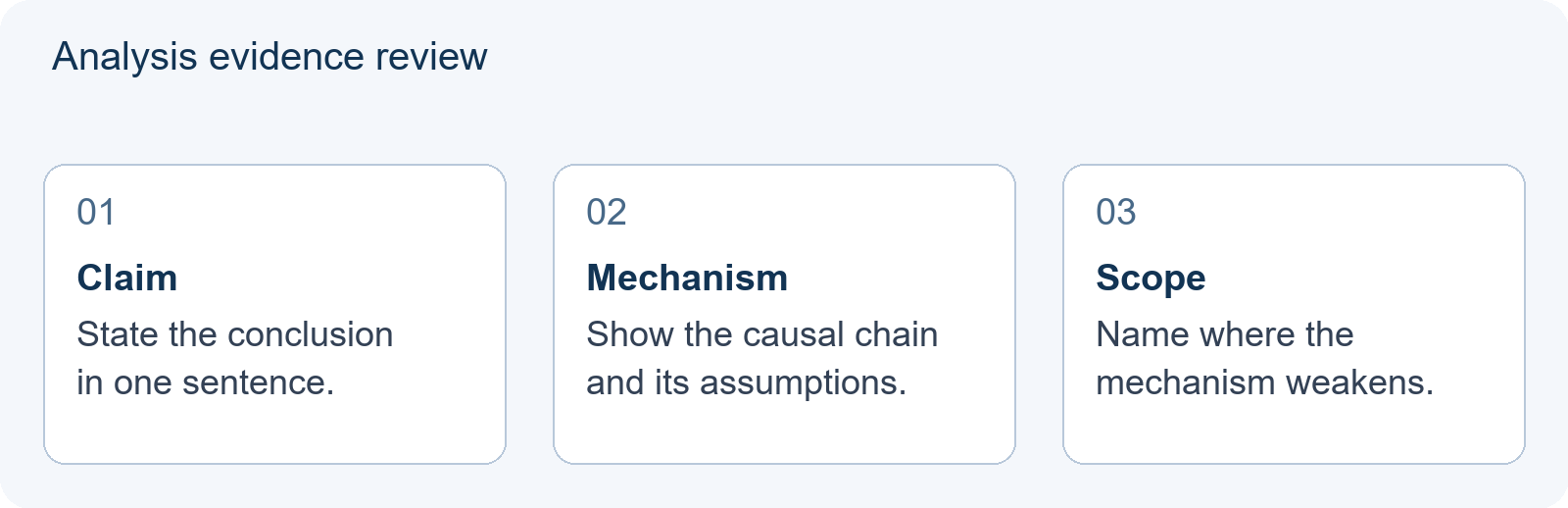
For self-scoring, analysis is one inspectable place because the evidence sits in the causal chain. A less developed paragraph says that a policy raises employment, lowers prices or improves welfare, then moves on. A more developed paragraph tells the reader which margin changes: a household budget, a firm hiring cost, a worker commute or a supplier entry decision. It then names a counterargument that could reverse the sign, not a decorative objection, and states a scope condition under which the mechanism is weaker.
A useful discipline is to underline every because and every therefore in the draft. If those words are missing, the paragraph may be a conclusion without an argument. If they are present but the chain jumps from policy to final outcome in one step, add the intermediate decision. The HIEEC Essay Counterfactuals: State What Would Have Happened Without the Policy guide is an adjacent check because a counterfactual forces you to say what the policy changed relative to a plausible baseline.
For the teaching bands, a paragraph with no mechanism, no counterargument and no scope sits near the low end. A paragraph with one clear mechanism but no limiting condition is middle. A paragraph that explains the mechanism, tests a serious rival explanation and states where the claim does not hold is at the higher end. These are coaching descriptions for revision, not official HIEEC bands.
How to review Creativity
A possible misreading is that creativity means choosing an unusual topic. In a short economics essay, a clearer teaching signal is a non-obvious question or comparison that still serves the thesis. For example, a draft could ask not only whether a policy raises average income, but whether it changes who can bear the risk of switching jobs. That is a different angle, but it remains connected to the same economic problem.
When self-scoring, mark the sentence that contains the draft’s distinctive move. If the only distinctive element is a fashionable example, the creativity score should remain modest in this teaching scheme. If the draft uses a comparison that changes the analysis, such as comparing two groups facing different constraints or two markets with different elasticities, the evidence is more developed.
A distinctive move should be explained, not merely announced. A surprising comparison that is never used in the argument is decoration. A comparison that changes which evidence matters, or which conclusion is credible, is doing work inside the essay.
How to review Research
Research is not a count of sources. A developed research paragraph uses a source because the source can carry a specific claim: a definition, a measured pattern, an institutional detail, a historical comparison or a theoretical mechanism. A less developed paragraph cites a general authority for a narrow factual statement, or reports a number without saying what population, period or unit it describes. Self-scoring should ask whether each source is doing visible work.
Citation discipline is part of the same criterion. HUEA’s current requirements state that the essay must use a consistent standard citation style, and the word limit includes footnotes but excludes references. That means footnotes cannot become a hiding place for arguments you did not make in the body. The HIEEC Literature Review: Organise Economic Evidence Around a Disagreement guide offers a way to arrange sources around a disagreement rather than around a list of names.
A practical test is to remove one citation mentally. If the sentence still stands with the same meaning, the source may be decorative. If the sentence loses its support, the source is doing real work and should be presented precisely. Check that the source can support the exact claim in the sentence, not merely the general topic of the paragraph.
How to review Structure
Structure is visible when a reader can state the essay’s through-line after one reading. A less developed structure moves from topic to topic, with each paragraph correct in isolation but no cumulative argument. A more developed structure gives each section one job: establish the puzzle, explain the mechanism, test a rival explanation, narrow the scope and draw the implication. The conclusion should follow from the sections rather than introduce a new policy wish.
A quick self-review is to write one sentence beside each paragraph describing its function. If two paragraphs have the same function, merge or cut. If a paragraph has no function beyond displaying information, it may be costing words. The Should Your HIEEC Essay Include a Diagram? Figures, Tables and the 1,500-Word Trade-off guide is relevant here because every figure or table competes for limited space in a 1,500-word essay.
Check whether the introduction promises the argument the conclusion delivers. If the introduction announces a broad topic but the body argues a narrower mechanism, revise one end to match the other. A reader should not have to reconstruct the thesis from the middle sections.
A worked teaching example: bus-fare waiver
The following is an original teaching example, not an HIEEC prompt. Suppose a city council proposes waiving bus fares for all riders, and the policy question is whether the waiver helps low-income workers. Service frequency is held constant in one version of the proposal; a second version funds the waiver by reducing frequency.
Free buses will help low-income workers because transport is expensive. This will increase employment and reduce inequality. Many cities have done this and it worked.
Using the teaching bands, this paragraph sits at the low end (0-1) on analysis. It names a conclusion but supplies no mechanism, no counterargument and no scope condition. It also uses an unsupported comparative claim about many cities.
A fare waiver lowers the out-of-pocket cost of trips, so some low-income workers may search farther from home or accept shifts that begin before formal transport starts. The size of the effect depends on service frequency and travel time: if the city funds the waiver by cutting buses, waiting time can offset the money saved. The policy also benefits higher-income riders who would have paid, so the distributional case is clearest when low-income workers are frequent users and service is already dense.
This version gives a mechanism, a counterargument about service cuts and incidence, and a scope condition about density and frequency. In the same teaching band it sits near 4/5 on analysis because the paragraph now gives a reader something to test. It does not prove that fare waivers work; it makes the argument inspectable.
The teaching point is not that every paragraph needs a numbered model. The point is that a teacher or reader should be able to quote your own sentence as evidence for the criterion. If your table says analysis 4, but you cannot point to the mechanism, rival and scope, the score is not earned.
Priority rule: fix the lowest score that blocks the thesis
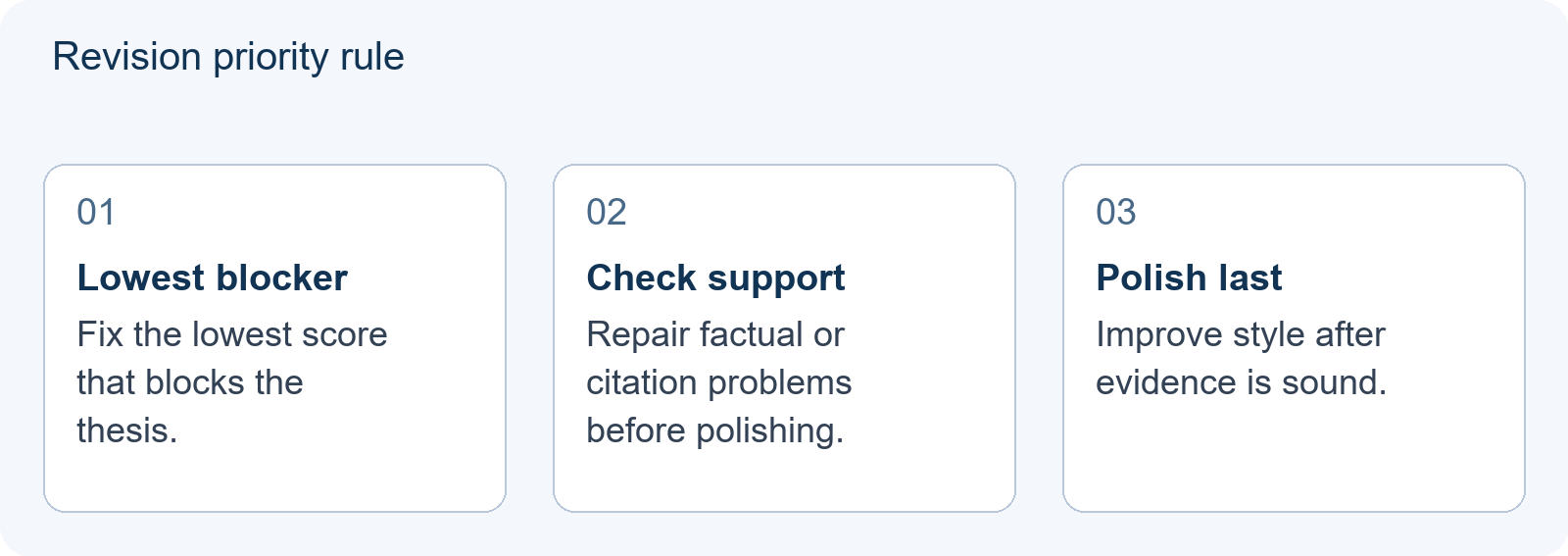
With limited time, do not polish the highest score first. Fix the lowest score that blocks the thesis. If analysis is weak because the causal chain is missing, adding more sources will not repair the argument. If research is weak because a factual premise is unsupported, a more creative comparison will remain fragile. If structure is weak because the reader cannot find the thesis, line editing is premature.
A practical order is: first repair the lowest score that affects whether the central claim can be understood and supported; second repair any factual or citation problem that could mislead; third improve creativity where the draft is merely predictable; fourth polish prose. This rule is a coaching judgment, not an official ranking of criteria.
Blank 20-point review table and pre-submission checklist
| Criterion | Evidence in my draft | Score /5 | First fix |
|---|---|---|---|
| Analysis | |||
| Creativity | |||
| Research | |||
| Structure | |||
| Total | /20 |
Before submission, check the current HUEA requirements rather than an old screenshot. For 2026-27 they state a deadline of 5 January 2027 at 11:59 pm Eastern Time, one entry per student, a maximum of 1,500 words including footnotes but excluding references, an anonymous PDF with no student or school name, a maximum file size of 10 MB, and a consistent standard citation style. Divisions are based on grade at the deadline, with specified cases for the older division. AI tools are allowed, but the ideas and arguments must be the entrant’s own and sources must be cited. These are official requirements, not coaching preferences.
How to prepare a useful second-opinion request
If you ask a teacher, coach or experienced reader for comments, make the request easy to answer. Send an anonymized draft, your completed 20-point table, and two specific questions, such as: Which paragraph gives the least developed mechanism? Which citation is doing the least work? Ask for line-level evidence against the four criteria, not a promised score. This keeps the review educational and avoids turning a self-scoring exercise into a guess about outcomes.
General event background is available at Event background.
Frequently Asked Questions
Is the 0-5 table the official HIEEC rubric?
No. HUEA states that judges assess analysis, creativity, research and structure, each worth five points, for a 20-point total. The 0-5 band descriptions in this article are teaching illustrations, not official HIEEC scoring descriptors.
Can HIEEC rubric self-scoring predict my result?
No. Self-scoring is a diagnostic for revising a draft. It helps you find missing mechanisms, weak sources or structural gaps; it does not estimate a judge’s score or an award outcome.
Which criterion should I revise first?
Fix the lowest score that blocks the thesis first. If analysis lacks a causal chain or research cannot support a central premise, polishing elsewhere will not repair the argument. Then check factual and citation problems, improve creativity where the draft is predictable, and polish prose last. This is a coaching rule, not an official ranking.