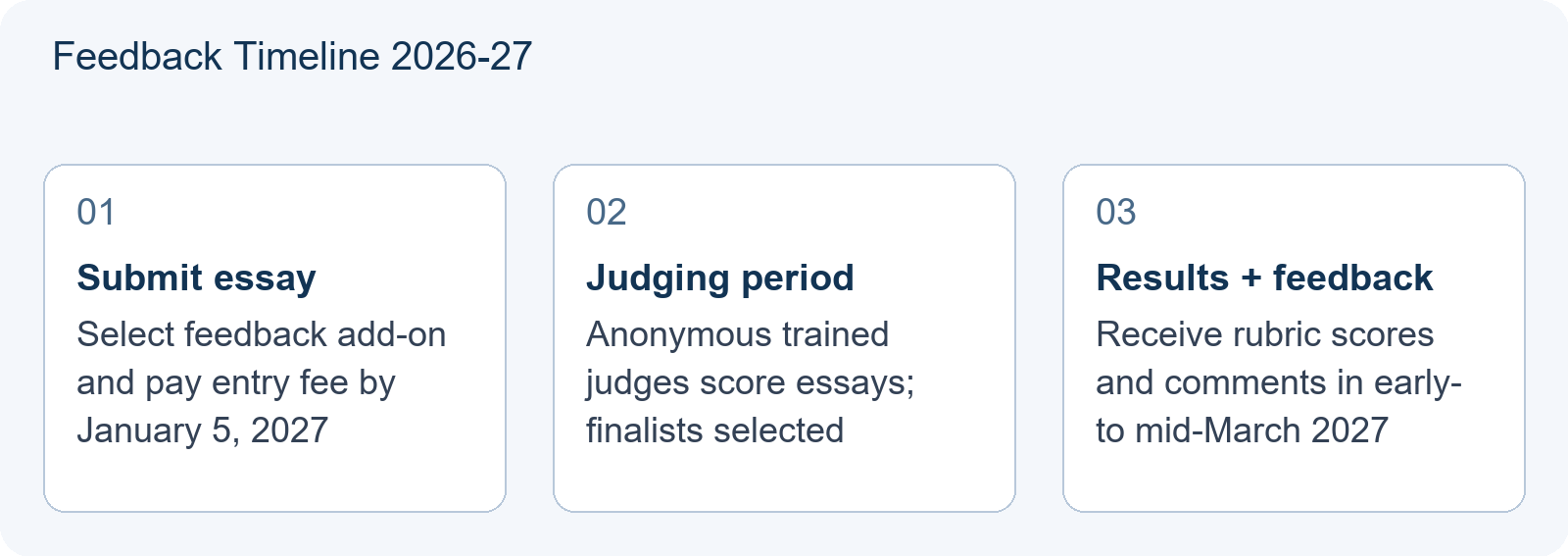
The Harvard International Economics Essay Contest (HIEEC) offers an optional 20 USD feedback add-on that gives you rubric scores and short written comments from a judge, sent after final results are released in early- to mid-March 2027. You select this add-on when you submit your essay and pay the entry fee. The feedback arrives only after the full judging process concludes, so it serves as a retrospective learning tool rather than a way to revise your current entry.
What the Feedback Add-On Contains
According to the HIEEC official competition page maintained by the Harvard Undergraduate Economics Association, the 20 USD add-on includes two elements:
| Component | What It Means for You |
|---|---|
| Rubric scores | Quantitative breakdown across the four judging criteria: analysis, creativity, research, and structure. Each category is worth five points, for a total of 20 points. |
| Short written comments from a judge | Brief qualitative remarks on your essay’s strengths and weaknesses, written by one of the competition judges. |
The source specifies that this feedback is sent after final results are released, which HIEEC schedules for early- to mid-March 2027 for the current 2026–27 season. This timing matters because it means you cannot use the feedback to improve your submitted essay; you can only apply it to future competitions or academic writing.
When and How the Feedback Arrives
The feedback follows the same timeline as the overall results announcement:
- Submission deadline: Tuesday, January 5, 2027, 11:59 pm Eastern Time
- Finalists and winners announced: Early- to mid-March 2027
- Feedback delivery: Concurrent with or shortly after results release
HIEEC does not specify the exact delivery method (email, download portal, etc.). Ensure the email address in your entry form remains active through March 2027.
How to Use the Feedback After You Receive It
Since the feedback arrives after judging concludes, its value lies in diagnosis and forward planning. Here is how to extract maximum learning from each component:
Reading Your Rubric Scores Strategically
The four rubric categories are weighted equally at five points each. A score pattern reveals where your essay excelled and where it fell short:
- Analysis (5 points): Did you construct a clear, defensible argument? Low scores here often mean the essay described rather than argued, or the thesis was too broad to prove in 1,500 words.
- Creativity (5 points): Did you approach the prompt in an original way? Low scores may indicate you chose an overly common angle or relied on well-worn examples without fresh insight.
- Research (5 points): Did you support claims with specific evidence? Weak scores typically stem from assertions without data, or from using outdated or tangential sources.
- Structure (5 points): Did the essay flow logically? Problems here include burying the thesis, weak transitions, or unbalanced section lengths.
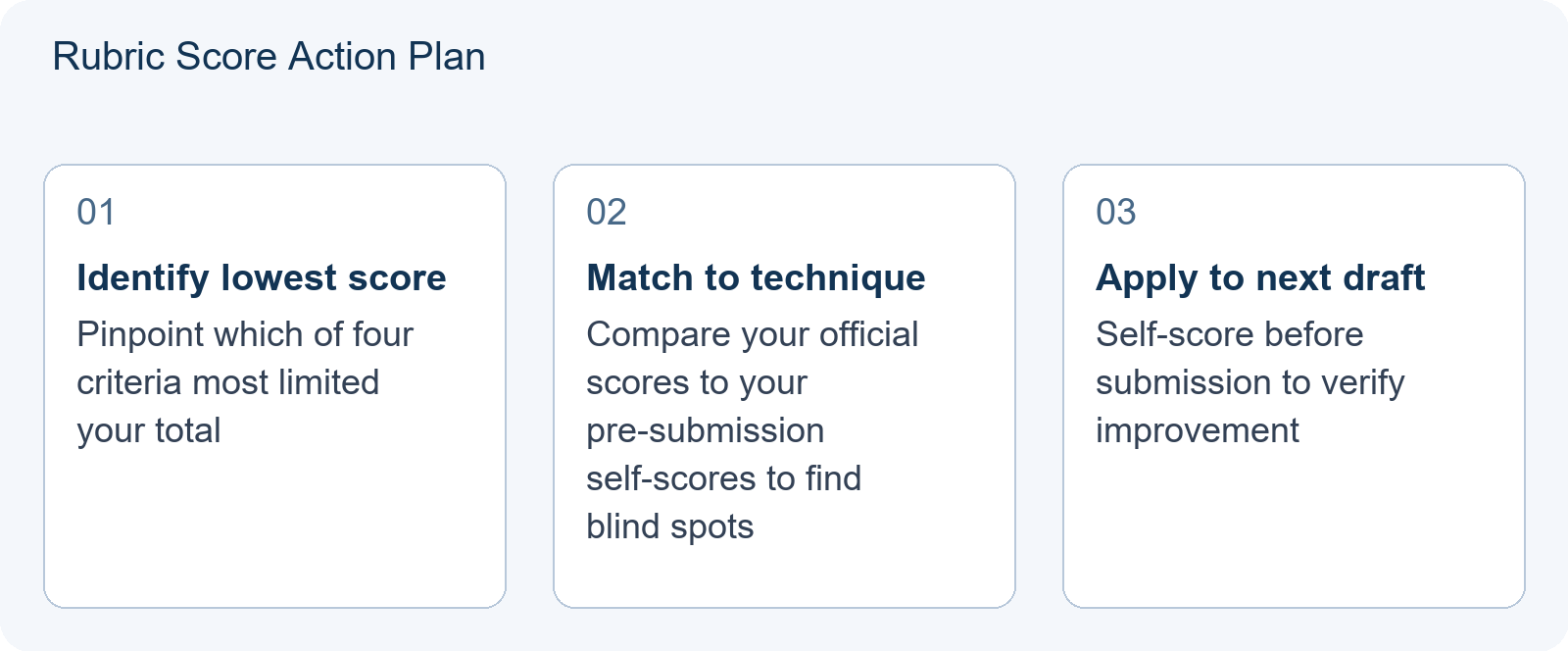
Teaching illustration: Imagine a student scores 4/5 in analysis, 3/5 in creativity, 4/5 in research, and 2/5 in structure. The priority is clear—structure is the biggest drag on the total. The student should revisit HIEEC Rubric Self-Scoring: A Practical 20-Point Draft Review (2026-27) to compare their draft against the structural checklist before their next competition.
Acting on Written Comments
Judge comments tend to be brief, so read them with specific follow-up questions in mind:
- Identify the recurring theme. If the judge notes that your “mechanism is underexplored,” this signals you need to trace causal chains more explicitly. Our HIEEC Mechanism Map: Who Is Affected, How, and What Evidence Would Show It (2026-27) provides a template for this.
- Check for scope mismatches. Comments about “ambitious claims” or “too broad” suggest your scope exceeded 1,500 words. The HIEEC Scope Ladder: From a Broad Policy Claim to a Testable 1,500-Word Case (2026-27) shows how to narrow appropriately.
- Validate your evidence use. If the judge questions a source or asks for more recent data, update your research process before the next essay.
Cost, Purchase Timing, and Refund Rules
| Item | Details |
|---|---|
| Base entry fee | 25 USD (US schools); 35 USD (non-US schools) |
| Feedback add-on | 20 USD, selected at time of entry form submission |
| Payment method | Card payment through the online entry form |
| Refund policy | Entry fees are non-refundable except for duplicate or accidental payments |
The source states the add-on is optional and selected when you submit your entry. HIEEC does not provide information about adding feedback after submission or receiving it retroactively. For questions about fee waivers or group payment, contact the organizers at competitions@thehuea.org.
Who Should Buy the Feedback Add-On?
The 20 USD add-on is most valuable for students who plan to enter HIEEC or similar essay competitions more than once, or who want structured critique to improve academic writing. Consider it if:
- You are in grades 9–10 and intend to enter again in grades 11–12
- You want concrete evidence of writing strengths for a tutor or teacher
- You struggled to self-assess your draft against the rubric
It may be less critical if you have access to detailed feedback from an economics teacher or coach who can replicate the rubric evaluation.
Preparing Now to Maximize Future Feedback
Whether or not you purchase the add-on this season, you can prepare to use feedback more effectively:
- Self-score before submission. Use the rubric to rate your own draft. When official scores arrive, compare your self-assessment to identify blind spots.
- Keep your draft and notes. In March, you will need to remember what you were trying to argue. Save your outline and any cut material.
- The competition allows individual entries only, with one entry per student. If you are grade 9–10, you can enter again next year; if grade 11–12, consider other economics essay competitions that use similar rubrics.
Key Takeaways
- The 20 USD feedback add-on provides rubric scores and short written judge comments delivered after results in early- to mid-March 2027
- It is selected during initial entry and cannot be assumed available after submission
- Use rubric scores to diagnose which of the four criteria needs attention
- Treat judge comments as specific prompts for skill-building, not as revisable edits
- Entry fees including the add-on are non-refundable except for duplicate or accidental payments
When the Feedback Add-On Reveals a Surprising Weakness: A Diagnostic Walkthrough
Receiving rubric scores and judge comments is only the first step. The real challenge is interpreting the feedback correctly when it contradicts your own assessment. Many students assume their strongest section is analysis, only to discover that structure or creativity dragged down their total. This section walks through a concrete diagnostic process to prevent misreading your results.
Step 1: Map Your Self-Assessment Against Official Scores
Before you look at the judge’s feedback, rate yourself on the same four criteria using the competition rubric. Record your predicted scores, then compare them to the official breakdown. The gap between prediction and reality is your most valuable data point.
Teaching illustration: A student who scored 3/5 in analysis, 4/5 in creativity, 3/5 in research, and 4/5 in structure predicted 4, 3, 4, and 3 respectively. The largest gap is in analysis (predicted 4, actual 3). This tells us two things: the student overestimated their argumentative depth, and their self-assessment in creativity, research, and structure was accurate. Without this pre-comparison, they might have focused on improving research, where their self-assessment was already correct, rather than on analysis where their judgment was off.
Step 2: Identify the Pattern, Not the Outlier
A single low score demands attention, but the pattern across all four criteria reveals where your essay writing system needs adjustment. Consider three common score profiles:
| Profile | Score Pattern | What It Suggests | Next Practice Task |
|---|---|---|---|
| The Analyst | High analysis and research, low creativity and structure | Strong on substance, weak on presentation and originality | Rewrite the same argument using a different prompt angle, focusing on an unexpected opening example |
| The Storyteller | High creativity and structure, low analysis and research | Compelling prose without sufficient evidence or clear thesis | Take one of your creative transitions and attach three specific data points to it |
| The Specialist | High in two adjacent categories, low in two others | Uneven development; some skills transfer, others do not | Complete a full draft using only the two weak categories as your primary focus |
Step 3: Use Judge Comments to Test Your Hypothesis
Once you have a pattern hypothesis from the rubric, turn to the written comments for confirmation or correction. Judge comments are brief, so each word carries weight. Look for specific nouns and verbs rather than general praise or criticism.
Teaching illustration: A student with the Analyst profile above receives this comment: “The Brazil-UPI comparison is well-researched but arrives too late to shape the argument.” This confirms the structure weakness (placement of evidence) and suggests the analysis weakness is actually about timing, not depth. The next practice task is specific: in your next essay, place your strongest example in the second paragraph, not the fourth.
Step 4: Design a Measurable Follow-Up Exercise
Vague intentions to “improve structure” rarely work. Instead, design a single exercise with a clear success condition. The exercise should isolate the weak skill without requiring a full competition entry.
Teaching illustration: For the student whose structure comment noted late-arriving evidence, the follow-up exercise is: Take a published HIEEC winner’s essay from a prior season. Reverse-outline it paragraph by paragraph, noting where each piece of evidence appears. Then outline your own last essay to the same granularity. Compare the two: in the winner’s essay, what percentage of paragraphs contain evidence? In yours? This produces a concrete metric (evidence density by paragraph position) rather than a vague feeling about structure.
Step 5: Calendar the Feedback Loop
The March 2027 feedback arrives too late for the current HIEEC season. To prevent the same gap next year, schedule your own practice cycle before the 2027-28 season opens. A minimal effective cycle:
- June 2027: Complete the diagnostic exercise above using this year’s feedback
- September 2027: Write one practice essay targeting your weak categories
- October 2027: Self-score using the rubric, then ask a peer or teacher to score blindly
- Early November 2027: Compare scores, note remaining gaps, adjust practice
This calendar preserves the value of your 20 USD investment across multiple competition seasons. Without it, the feedback becomes a single retrospective comment rather than a systematic improvement tool.
Common Misreading to Avoid
Students often misinterpret feedback in predictable ways. Three specific corrections:
Misreading 1: “Creativity is subjective, so a low score doesn’t mean much.” The HIEEC rubric defines creativity operationally: original framing, unexpected evidence, or novel policy implications. A 3/5 means the judge saw none of these, not that they personally disliked your topic. Check whether your essay’s opening three sentences could appear in another student’s work; if so, the angle was likely too common.
Misreading 2: “Structure is just about grammar and transitions.” The rubric weights structure on logical progression, not prose polish. An essay with flawless transitions but a buried thesis or unbalanced section lengths can score 2/5. Reverse-outlining tests this directly.
Misreading 3: “I can fix my weak category by doubling my effort there.” Often the weak category is a symptom. Low research frequently stems from overambitious scope; low analysis from insufficient planning time. The exercise in Step 4 above forces you to verify whether the weakness is truly in the category scored, or in an upstream decision that affected it.
By treating the feedback add-on as the start of a diagnostic process rather than a final verdict, you convert a 20 USD purchase into a repeatable method for competitive essay improvement.
This is an independent preparation guide, not affiliated with, endorsed by, or sponsored by the Harvard Undergraduate Economics Association.
Frequently Asked Questions
What exactly do I receive with the 20 USD feedback add-on?
You receive rubric scores for each of the four judging criteria (analysis, creativity, research, structure) plus short written comments from a judge. This is sent after final results are released in early- to mid-March 2027.
Can I get feedback on my essay if I did not purchase the add-on?
The source only describes feedback as part of the paid add-on. HIEEC does not indicate that feedback is provided through any other channel.
Is the feedback add-on worth it if this is my only HIEEC entry?
The value depends on your goals. If you want documented evidence of your writing strengths for other applications, or if you want to improve academic economics writing generally, the structured feedback justifies the cost. If you only want the competition result, the base entry suffices.