Yes — a Grade 9 or 10 student can enter HIEEC and can place well, because per thehuea.org the competition is open to high-school students in grades 9-12 with no separate junior division and no age handicap. Every essay is judged against the same standard. That is both the opportunity and the catch: a younger entrant competes head-to-head with seniors who have had two more years of economics, so strategy matters more than for anyone else in the field.
What the eligibility rule actually means for you
HIEEC does not band entrants by year. According to thehuea.org, essays are open to high schoolers of any year within grades 9-12, and everyone submits one essay of at most 1,500 words on one of four prompts, judged the same way. There is no “younger student” allowance in the marking, no age bonus, and no protected bracket. A Grade 9 essay is weighed beside a Grade 12 essay on identical terms.
This is the opposite of competitions that split juniors and seniors. It means two things at once. First, nothing stops a strong 14- or 15-year-old from reaching the shortlist — the door is genuinely open. Second, you cannot lean on “I’m only in Grade 9” as an excuse a judge will factor in; they will not. Confirm the current eligibility wording on thehuea.org each cycle, but plan as if you are being read exactly like a senior, because you are.
| Question | What thehuea.org indicates |
|---|---|
| Minimum grade? | Open to grades 9-12 (confirm exact wording each cycle) |
| Separate junior division? | No — one competition, one standard for all years |
| Age handicap or bonus for younger entrants? | None stated; essays judged on the same criteria |
| Same word limit for everyone? | Yes — a strict 1,500 words, one of four prompts |
| Same fee? | Yes — US $20 / international $30 (per thehuea.org; financial aid by email) |
Where being younger is an honest advantage
Younger entrants are not simply “behind.” In an essay competition judged on the quality of a single argument, some of the things that separate winners have little to do with how many years of economics you have taken.
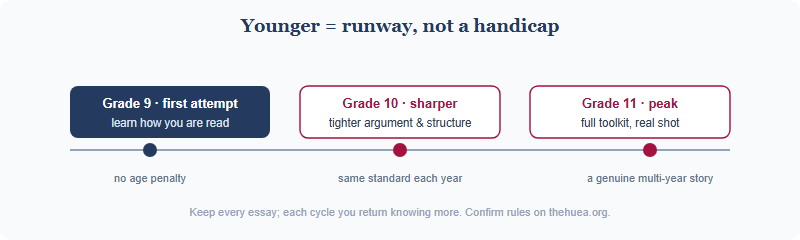
- Runway to iterate. A Grade 9 entrant can treat this cycle as the first of several attempts. Entering early, learning how your essay is read, and returning stronger is a legitimate multi-year plan — and it removes the all-or-nothing pressure that makes seniors play it safe.
- A fresh, non-formulaic angle. With up to 600 essays on four prompts, the obvious argument arrives many times. Students who have not yet absorbed the “standard” exam-style answer sometimes see a cleaner, more original angle — and originality is exactly what an expert reader rewards at the top.
- Time to go deep on one idea. You do not need the whole syllabus to write a great 1,500-word essay. You need one mechanism, applied precisely. A motivated younger student can master a single model — say, price elasticity or an externality — well enough to out-argue a senior who spreads themselves thin.
- A stronger long-game admissions story. A result earned in Grade 9 or 10, then built on, shows a genuine multi-year interest in economics rather than a one-off line added in application season.
Where the gap is real — and how to close it
It would be dishonest to pretend the two-year head start does not exist. Seniors have usually met more formal economics, written more analytical essays, and handled academic referencing before. Those are real, closable gaps — but only if you name them and target them rather than hoping they will not show.
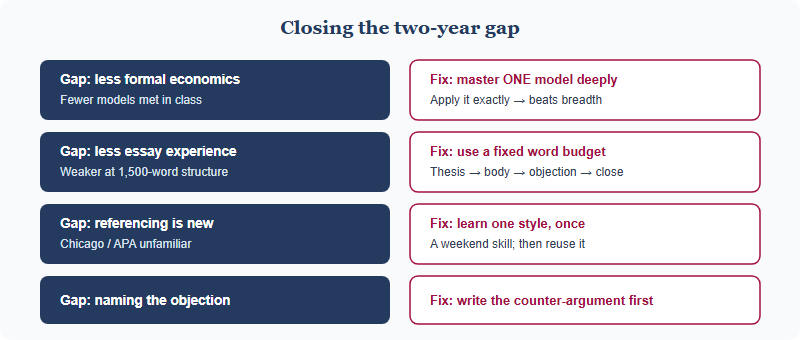
The pattern across all four is the same: you do not need to become a senior overnight, you need to remove specific, visible weaknesses. Mastering one model beats gesturing at five; a fixed structure beats improvising; one referencing style learned in a weekend erases the format gap. For the sectional word budget, our guide to writing the 1,500-word HIEEC essay gives a template you can follow line by line.
A realistic plan for a Grade 9 or 10 entrant
Treat your first HIEEC cycle as a serious attempt and a learning investment. The two goals are compatible if you sequence the work.
| Stage | Younger-entrant focus |
|---|---|
| Before prompts release | Learn one model cold (elasticity, externalities, or comparative advantage) and read one or two past winning essays to see the standard. |
| When the four prompts drop | Choose the prompt you can answer with the model you know best, not the one that sounds most impressive. |
| Drafting | Write long, then cut to 1,500 words. Build the essay around one precise argument plus its strongest objection. |
| Before submitting | Check PDF format, one referencing style done consistently, and that your thesis is clear in the first 150 words. |
| After results | Whatever the outcome, keep the essay. In Grade 10 or 11 you return knowing exactly how you are read. |
Choosing the right prompt is where younger entrants gain or lose the most ground, because it decides whether your one strong model is even relevant. Our companion piece on choosing your HIEEC prompt by strength gives a four-question test that is especially valuable when your economics toolkit is still small — pick the question your toolkit fits.
You get one essay — so spend it where you are strongest
A detail that matters more for younger entrants than anyone else: per thehuea.org, HIEEC accepts one submission per person, and essays must be written only by the entrant. You cannot hedge by entering two prompts and seeing which lands. That single-shot rule turns prompt choice from a preference into the most important decision of your cycle — and for a Grade 9 or 10 student with a narrower toolkit, choosing well is the difference between a relevant strong essay and a stretched weak one.
The practical rule is to let your knowledge pick the prompt, not the other way around. If the model you know cold is comparative advantage, the prompt you can turn into a precise argument about trade is worth more to you than a fashionable prompt on, say, monetary policy that you would answer only at a surface level. Seniors can sometimes brute-force an unfamiliar prompt with breadth; a younger entrant almost never can, so playing to a genuine strength is not timidity — it is the correct read of the one-essay constraint. This is also why the multi-cycle plan is so forgiving: the prompt you cannot yet do justice this year may be exactly the one you own by Grade 11.
A first-party note for China-based families
Among China-based international-school students, we often meet capable Grade 9 and 10 writers who assume HIEEC is “for seniors” and wait a year or two before entering. Given that the competition has no junior division and no age penalty, that wait is usually a missed head start rather than a wise delay. A younger student who enters, learns how the essay is read, and returns stronger is following exactly the multi-year path that makes an economics interest look authentic on a later application.
The honest caveat is proportion: a Grade 9 entrant should aim to write one genuinely strong, precise essay and treat a shortlist as a stretch goal, not an expectation. That framing keeps the experience motivating rather than deflating — and it is the right way to build toward a real result over several cycles. For where an HIEEC result sits in an application overall, see our piece on whether HIEEC is worth it for college applications. Eligibility, fees, prompts, and deadlines are set by HUEA and can change; confirm the current cycle on thehuea.org.
Frequently asked questions
Can a Grade 9 student really enter HIEEC?
Yes. Per thehuea.org, HIEEC is open to grades 9-12 with no separate junior division. A younger student submits and is judged on the same terms as seniors.
Is there an easier bracket for younger students?
No. There is no junior division and no age bonus. Everyone writes one essay of up to 1,500 words on one of four prompts, judged the same way.
Should a Grade 9 student wait until Grade 11 to enter?
Usually not. Entering early builds skill and gives you runway to return stronger, since there is no penalty for being younger. Aim for one precise essay.
Do younger entrants pay the same fee?
Yes — US $20 or international $30 per thehuea.org, with financial-aid requests by email. Confirm current fees each cycle before you register.
This is an independent guide operated by Hanlin Education for China-based international-school students. It is not affiliated with, endorsed by, or sponsored by HUEA, the Harvard College Economics Review, or Harvard University. Eligibility, fees, prompts, and deadlines are set by the organiser and can change; always confirm current details on the official site, thehuea.org. We correct any reported errors within 7 working days.