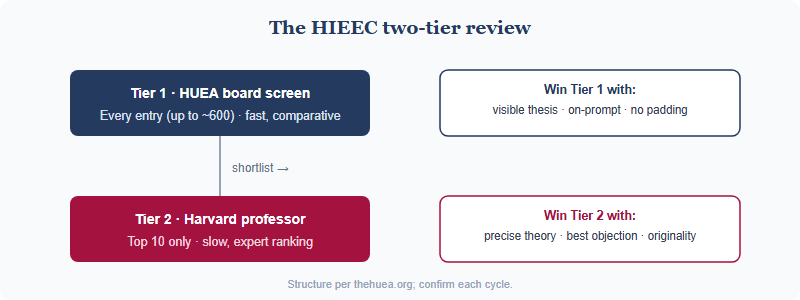
According to thehuea.org, HIEEC essays are judged in two distinct stages: the board of the Harvard Undergraduate Economics Association (HUEA) reviews every submission, and the top 10 essays are then adjudicated by an economics professor at Harvard. That two-tier structure — a broad screen followed by a narrow expert pass — should shape how you write, because the reader who shortlists you is not the reader who ranks you.
The two tiers, and why the difference matters
Most guidance treats “the judges” as one undifferentiated audience. HIEEC is not built that way. Your essay has to clear two gates that reward slightly different things, and understanding the gap between them is the single most useful thing you can know before you write. The first gate is a volume screen: with a stated cap of up to 600 essays, the HUEA board is reading at scale and deciding, quickly, whether your essay belongs in serious contention. The second gate is a depth pass: once you are in the top 10, a trained economist is weighing your argument against nine other strong essays, and small analytical distinctions decide the order.
Confirm the exact process each cycle on thehuea.org — details such as the submission cap and who adjudicates can change — but the principle is stable. You are writing one essay that must survive a fast, comparative screen and reward a slow, expert re-read. Those two demands are not in conflict, but they do change where you spend your 1,500 words.
| Dimension | Tier 1 — HUEA board screen | Tier 2 — Harvard professor pass |
|---|---|---|
| Who reads | HUEA board members (undergraduate economists) | An economics professor at Harvard |
| How many essays | Every valid entry (up to a stated cap of ~600) | The top 10 only |
| Reading mode | Fast, comparative triage — is this in contention? | Slow, expert re-read — where does this rank? |
| What it rewards | Clarity, a visible thesis, an obvious command of the prompt | Analytical depth, originality, honest handling of counter-arguments |
| What sinks you | A buried thesis, generic summary, format errors | A thin or unexamined argument that looked fine at a glance |
Tier 1: how to survive the screen
A board member reading a large stack cannot give every essay a charitable, careful first pass. That is not a criticism of the judges; it is the arithmetic of any competition that reads hundreds of entries. Your job in Tier 1 is to make your quality legible in the first page, so that a fast reader has no reason to set you aside.
- State the thesis where it cannot be missed. A screen reader should be able to name your argument after the first 150 words. If your position only becomes clear on page three, you may not get to page three.
- Answer the prompt you were given, not the one you wish you had. A visible, tight grip on the actual question signals competence immediately. Drift reads as weakness.
- Remove anything that looks like padding. At a strict 1,500-word limit (references, footnotes, titles, and headers excluded, per thehuea.org), filler is doubly costly — it burns words and it tells a fast reader you had less to say.
- Get the mechanics right. PDF only, one of the four prompts, references in Chicago or APA, written only by you. A format error is an avoidable reason to be screened out before anyone weighs your ideas.
If you are still choosing which prompt to answer, our companion piece on how to choose your HIEEC prompt by strength walks through a four-question test; a prompt you can genuinely command is the cheapest way to look strong on the screen.
Tier 2: how to reward the expert re-read
Reaching the top 10 flips the problem. Now a professional economist is reading slowly, comparing you against nine essays that also cleared the screen. Surface polish is table stakes; everyone left has it. What separates the order is the quality of thought under the prose — and an expert reader can tell the difference between an argument that is clear and one that is correct and non-obvious.
Three things earn marks at this depth of reading:
- Analytical precision. If you invoke a model or mechanism, apply it exactly — get the direction of the effect, the assumptions, and the limits right. A specialist notices a hand-waved elasticity or a mislabelled market failure instantly. Our guide on using economic theory in your HIEEC essay covers applying one model accurately, which matters far more at Tier 2 than name-dropping several.
- An honest treatment of the strongest objection. Weak essays argue one side. Strong essays name the best counter-argument and answer it. To an expert, engaging the objection you would least like to face is the clearest signal that you actually understand the question.
- Originality of insight. With ten essays on similar prompts, the obvious argument arrives ten times. A non-obvious but defensible angle — a mechanism others missed, a comparison that reframes the trade-off — is what a professor remembers when ranking.
Writing one essay for two readers
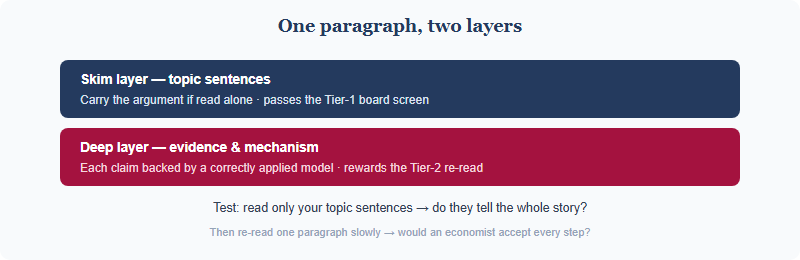
The good news is that the two tiers do not require two different essays. They require one essay layered so that its strength is visible fast and deepens on re-reading. The most reliable way to do that is to front-load clarity and back-load rigour within the same paragraphs.
| Essay part | Does the Tier-1 job (clarity) | Does the Tier-2 job (depth) |
|---|---|---|
| Opening (~150 words) | States the thesis plainly; a fast reader knows your position | Frames the specific tension, hinting the argument is non-obvious |
| Body paragraphs | Topic sentences carry the argument even if skimmed | Each claim is backed by a correctly applied mechanism or figure |
| Counter-argument | Signposts that you are considering the other side | Engages the strongest objection, not a straw man |
| Conclusion | Restates the answer cleanly | Names what would change your mind — honest, not hedged |
A useful test before you submit: read only your topic sentences, in order. If they alone tell a clear, on-prompt story, you have passed Tier 1’s skim. Then re-read a single body paragraph slowly and ask whether an economist would accept every step. If both are true, your essay is built for the way HIEEC is actually read. For the word-level mechanics of doing this inside a hard limit, see our method for writing the 1,500-word HIEEC essay.
A first-party note for China-based students
A pattern we see in strong China-based entries is essays that are technically fluent — correct models, clean references — but written to impress in general rather than to answer one reader’s likely objection. That style can clear Tier 1 comfortably and then stall in Tier 2, because a specialist is looking for the specific, examined argument, not a well-drilled survey. If your teacher or reviewer can predict your next sentence, an expert judge can too.
The practical fix is cheap: after drafting, write one sentence naming the objection an economist would raise first, then make sure your essay actually answers it rather than gesturing past it. That single habit tends to move an essay from “clearly competent” to “worth ranking.” Timelines, prompts, fees, and the judging process are set by HUEA — always confirm the current cycle on thehuea.org before you rely on any detail here.
Frequently asked questions
Who actually reads my HIEEC essay?
Per thehuea.org, the HUEA board screens every entry, and the top 10 essays are then adjudicated by an economics professor at Harvard. Confirm the current process each cycle.
How selective is the top 10?
With a stated cap of up to 600 essays, reaching the professor-adjudicated top 10 is highly competitive. Treat exact figures as per thehuea.org and verify them each year.
Does clear writing matter more than deep economics?
Neither alone wins. Clarity gets you past the board screen; analytical depth and originality decide your rank at the professor stage. You need both.
Can I see how essays are scored?
HIEEC publishes winners, finalists, and Highly Commended lists rather than a public rubric. Study what past winners did and confirm all details on thehuea.org.
This is an independent guide operated by Hanlin Education for China-based international-school students. It is not affiliated with, endorsed by, or sponsored by HUEA, the Harvard College Economics Review, or Harvard University. The judging process, submission cap, prompts, fees, and deadlines are set by the organiser and can change; always confirm current details on the official site, thehuea.org. We correct any reported errors within 7 working days.