HIEEC gives you four prompts each year and you submit on one. The choice matters more than students expect: the right prompt is not the one that sounds most impressive, but the one where you can build the strongest economic argument with theory and evidence you actually command. This guide is the method for choosing — a four-question test you can run on the current year’s prompts (which are published on thehuea.org).
Why the prompt choice decides the essay
A 1,500-word essay leaves no room to recover from a weak start. If you pick a prompt because it sounds sophisticated but you cannot state a clear thesis, name the relevant economic theory, or find real evidence, the whole essay strains. Pick the prompt where your argument almost writes itself — where you already have a point of view, the theory to support it, and data or examples to cite — and the writing becomes execution rather than rescue. Judges (the HUEA board, then a Harvard economist) reward a tight, well-evidenced argument, not topic ambition.
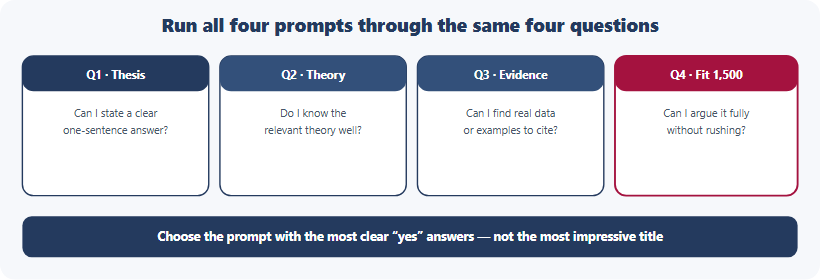
The four-question test, in detail
| Question | What a strong “yes” looks like |
|---|---|
| 1 · Thesis | You can answer the prompt in one clear sentence that takes a position — not “it depends,” but a defensible claim you will spend 1,500 words supporting. |
| 2 · Theory | You can name the specific economic concepts the argument needs (e.g. elasticity, externalities, game theory, comparative advantage) and use them correctly, not just drop the words. |
| 3 · Evidence | You know where real data, studies, or concrete examples will come from — and they actually support your thesis rather than just decorating it. |
| 4 · Fit to 1,500 | The argument is the right size: deep enough to be substantial, narrow enough to finish in 1,500 words without hand-waving. |
A worked example: running the test on two prompts
Suppose two of this year’s prompts catch your eye — one on the economics of a carbon tax, one on the future of global trade. Run the test. The carbon-tax prompt: you can state a thesis (“a carbon tax is more efficient than equivalent regulation because…”), you know the theory (externalities, Pigouvian taxes, elasticity), and you can find evidence (revenue data and studies from jurisdictions that already have one). Four clear yeses. The global-trade prompt sounds grander, but your thesis is vague (“trade is changing”), the relevant theory is sprawling, and the evidence could fill a book. Two soft yeses, two maybes. On paper the trade prompt is more impressive; on the test, the carbon-tax prompt wins — it is the one you can actually argue in 1,500 words. That is the whole method: let the test, not the title, choose for you.
Match the prompt to what you actually know
HIEEC prompts cluster around current economic issues, and they reward genuine command of the relevant field. Be honest about your strengths. If you are comfortable with microeconomics (markets, incentives, externalities), a prompt that turns on those tools plays to you. If your edge is macro (growth, inflation, policy) or development, choose accordingly. A merely “interesting” prompt in a field you half-know will expose gaps to an expert judge; a slightly less glamorous prompt you can argue with real rigour will read far stronger. Depth beats breadth every time in 1,500 words.
When two prompts both clear the bar
Sometimes two prompts both pass all four questions. Then use three tiebreakers. First, evidence access: which one can you support with specific, credible data you can actually get hold of? Second, originality: which lets you say something a Harvard economist has not read a hundred times — a less obvious angle, a sharper comparison? Third, genuine interest: which question will you still want to be reading about in week six? A prompt you find dull produces a dutiful essay; one you are curious about produces a lively one. When the test is a tie, these three break it.

Three prompt-choice mistakes to avoid
- Choosing for prestige, not fit. The most ambitious-sounding prompt is worthless if you cannot evidence the argument. Pick where you are strongest.
- Picking a prompt that is too broad. “The future of the global economy” cannot be argued in 1,500 words; a sharp, bounded claim can. Narrow ruthlessly.
- Deciding before you have read all four closely. Read every prompt, run the four-question test on each, and only then commit — the obvious first choice is often not your strongest.
Once your prompt is chosen, the next job is structure: see how to write the 1,500-word HIEEC essay, and what HIEEC judges look for. New to the competition? Start with our complete HIEEC guide.
Frequently asked questions
How many prompts does HIEEC give, and how many do I answer?
HIEEC publishes four prompts each year on a current economic issue, and you submit one essay on one prompt. Choose the prompt where you can argue most rigorously, and confirm the current prompts on thehuea.org.
Should I choose the hardest or most impressive prompt?
No. Choose the prompt where you have a clear thesis, the right theory, and real evidence. An expert judge rewards a tight, well-evidenced argument far more than an ambitious topic you cannot fully support.
What if I am strong in micro but a macro prompt looks more interesting?
Play to your strength. A prompt you can argue with genuine command of the relevant theory will read much stronger than an “interesting” one that exposes gaps to a Harvard economist.
Can I change prompts after starting?
You can while drafting, but decide early — the prompt shapes your research and structure. Read all four, test each, then commit before you invest in writing.
What if two prompts both seem equally good?
Use three tiebreakers: which has better evidence you can actually access, which lets you make a more original argument, and which you are genuinely more interested in. A prompt you care about produces a stronger essay than one you find merely impressive.
Filed underEssay Writing · Hieec Prompts · International Students
This is an independent guide to the Harvard International Economics Essay Competition, operated by Hanlin Education for China-based international-school students. We are not affiliated with, endorsed by, or sponsored by the Harvard Undergraduate Economics Association, the Harvard College Economics Review, or Harvard University. Prompts and rules change each year — always confirm the current prompts and details on the official HUEA site. Confirmed errors are corrected within 7 working days.