The HIEEC essay limit is a strict 1,500 words — anything over is simply truncated, so the limit is a design constraint, not a suggestion. The students who write well to it do one thing differently: they budget their words across a clear argument structure before they write, then edit down. This guide gives a workable 1,500-word budget, what each section has to do, and how to cut to length without padding.
A 1,500-word budget you can actually use
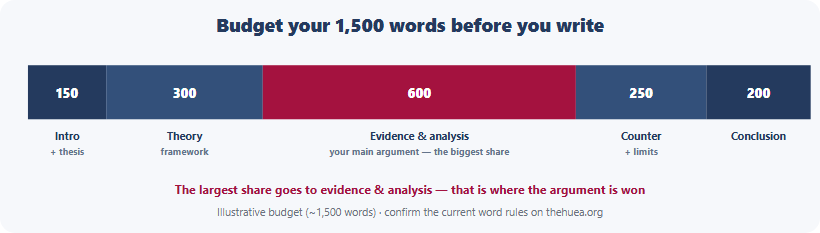
Treat 1,500 words as a budget to allocate, not a target to fill. A reliable split for an argued economics essay looks like this — adjust to your argument, but keep the shape:
What each section has to do
| Section (≈ words) | Its job |
|---|---|
| Introduction + thesis (~150) | State the question and your one-sentence answer. Do not warm up — a Harvard economist wants your claim by the end of the first paragraph. |
| Economic framework (~300) | Set up the specific theory the argument runs on (define terms, state the model) so the analysis has something to stand on. Use theory correctly, not decoratively. |
| Evidence & analysis (~600) | The core. Apply the framework to real data, studies or examples and reason to your conclusion. This is where you win — give it the most words. |
| Counter-argument (~250) | Address the strongest objection and the limits of your case. Engaging the best counter shows maturity and strengthens, not weakens, your thesis. |
| Conclusion (~200) | Land the claim, note what follows, and stop. No new arguments, no restating everything — a sharp close. |
The opening: earn your first 150 words
Your introduction is only about 150 words, but it does the most work — an expert reader decides early whether your essay is going somewhere. Do not warm up with background or a dictionary definition. State the question, then your thesis — your one-sentence answer — by the end of the first paragraph. A judge who knows your claim from the start reads the rest as evidence for it; a judge still hunting for your point at word 400 has already lost confidence. A quick test for a good opening: delete your first two sentences and see whether the essay is stronger. Surprisingly often it is — those sentences were throat-clearing, and the real argument started underneath them.
Write long, then edit down (never pad up)
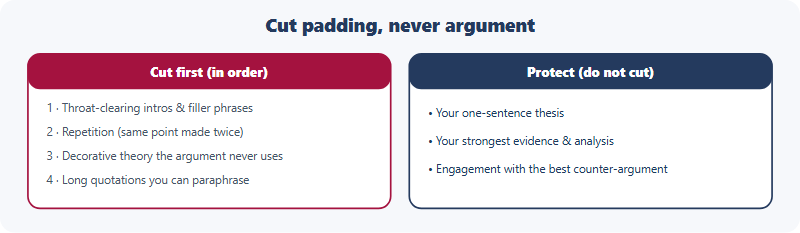
Most strong essays are first drafted over length and then cut to 1,500 — which is far better than padding a thin draft up to the limit. Because anything past 1,500 is truncated, the discipline is to make every word carry argument. When you edit down, cut in this order:
Four mistakes that cost the most marks
Four mistakes do the most damage at this length. Running out of words before the analysis — a long set-up leaves no room for the reasoning that actually wins, so the essay describes instead of argues. An over-long introduction — spending 300 words “setting the scene” when 150 would do. Decorative theory — naming models you never actually use, which an economist spots instantly. A weak conclusion — either restating the whole essay or, worse, introducing a new argument with no room to support it. The fix for all four is the same: budget your words before you write, and protect the evidence-and-analysis core when you cut.
Referencing counts — get it right
HIEEC requires a formal academic style — Chicago or APA — and good referencing signals that your evidence is real and your argument is honest. References, footnotes, titles and headers are excluded from the 1,500-word count, so cite properly without fear of the limit. Pick one style and apply it consistently; sloppy or missing citations undercut an otherwise strong essay. (We cover referencing and academic integrity in a dedicated guide.)
Which style? If your school already uses one, use it — consistency matters more than the choice. APA is common for economics and social-science writing and handles author–date citations cleanly; Chicago‘s notes-and-bibliography style suits essays with discursive footnotes. Either is fine; what loses marks is mixing the two or citing sloppily. Build your reference list as you write, not at the end, so a real source sits behind every number you quote.
Before you draft, lock your prompt and structure: see how to choose your HIEEC prompt and what HIEEC judges look for. New here? Start with our complete HIEEC guide.
Frequently asked questions
Is the 1,500-word limit strict?
Yes. Anything beyond 1,500 words is truncated, so treat the limit as a hard design constraint. References, footnotes, titles and headers are excluded from the count.
How should I divide 1,500 words?
A reliable split is roughly: introduction and thesis 150, framework 300, evidence and analysis 600, counter-argument 250, conclusion 200. Give the most words to evidence and analysis, where the argument is won.
Should I pad a short essay or cut a long one?
Cut a long one. Draft over length, then edit down by removing filler, repetition and decorative theory — never pad a thin draft, which reads as weak to an expert judge.
Which referencing style does HIEEC want?
A formal academic style — Chicago or APA. Choose one and apply it consistently. Citations do not count toward the 1,500 words, so reference properly.
How long should the introduction be?
About 150 words. State the question and your one-sentence thesis by the end of the first paragraph — do not warm up. A reader who knows your claim early reads the rest as support for it.
What is the most common 1,500-word mistake?
Running out of words before the analysis. A long set-up leaves no room for the reasoning that wins. Budget your words before writing and protect the evidence-and-analysis core, which should be the largest section.
Filed under1500 Words · Essay Writing · International Students
This is an independent guide to the Harvard International Economics Essay Competition, operated by Hanlin Education for China-based international-school students. We are not affiliated with, endorsed by, or sponsored by the Harvard Undergraduate Economics Association, the Harvard College Economics Review, or Harvard University. Word rules and formatting requirements change each year — always confirm the current details on the official HUEA site. Confirmed errors are corrected within 7 working days.