Most feedback on competition essays is wasted because of one question: “any thoughts?” Readers who are handed a draft with no brief default to what is easiest to see — wording, commas, a clumsy transition — while the argument goes unexamined. Two structured rounds, with different readers and different questions, fix this. Here is the system and the exact brief to send.
Why unstructured feedback fails
Three things go wrong, and they compound.
Timing. Students usually seek feedback when the draft feels finished, which is precisely when it is too late for the feedback that matters. If someone tells you at the end of December that your central claim is unoriginal, you cannot act on it. If they tell you in October, it costs you an afternoon.
The default question. “What do you think?” invites an overall impression, and overall impressions are almost useless. A reader who says “it flows well” has told you nothing about whether your evidence supports your claim. A reader who says “I found the third paragraph confusing” has told you something you can act on.
Volume. More readers do not mean better essays. Five readers produce five sets of contradictory line edits, and the student spends a week reconciling comma preferences while the argument stays exactly as weak as it was. Two readers per round, briefed properly, will outperform five readers left to their own devices.
Politeness. Readers who care about you want to encourage you, and encouragement is the enemy of a useful critique round. Unless you explicitly give someone permission to be blunt — and ask for one specific weakness rather than a general opinion — most readers will soften or omit the single comment you most needed to hear. Saying this out loud when you send the draft is not a formality; it changes what comes back.
There is also a structural reason to build critique in deliberately. HUEA’s published process for the most recent cycle describes two stages of reading: an initial review by the HUEA board, and then adjudication of the top submissions by a Harvard economics professor. An essay therefore has to survive two very different kinds of attention — a fast screen and a slow expert re-read. Your own critique rounds should mirror that, rather than testing the same thing twice.
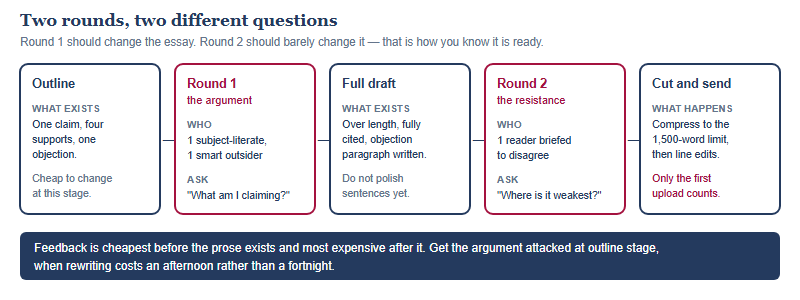
Round 1: the argument round
Run this at outline stage, or on a first full draft at the very latest. You are not asking whether the writing is good. You are asking whether the argument exists.
Send your reader three things — the prompt as published, your claim in one sentence, and your outline — and ask exactly three questions:
- “In one sentence, what am I claiming?” If they cannot answer, or their answer is not your claim, nothing else matters yet. This single question catches more failing essays than any other intervention we use.
- “Which part would an economist push back on first?” This surfaces the objection you should be answering in the essay itself.
- “What would have to be true for me to be wrong?” If your reader cannot construct a scenario in which the claim fails, the claim is probably too safe to be interesting — it is a description, not an argument.
Tell the reader explicitly: do not correct my English in this round. Without that instruction, a well-meaning teacher will return a beautifully corrected outline and say nothing about the logic. In our editorial work with China-based entrants, this is the single most common wasted round — the student writes well enough that readers reach for the easiest improvement, and the argument sails through unchallenged until it is too late to fix.
Round 2: the resistance round
Run this on a complete draft that is still over length, before final compression. Now the question inverts. You are no longer asking whether the argument exists; you are asking whether it survives someone trying to break it.
Brief one reader with a single instruction: your job is to disagree with me. Ask them to find the weakest link — the claim that rests on one source, the causal step that is really a correlation, the counterargument mentioned in a clause and never answered. A reader who returns “this is great” has failed the brief, and you should say so and ask again.
Three specific probes are worth writing into the brief, because they map onto how essays actually lose marks:
- Point at the sentence that does the most work. Every essay has one sentence that, if false, collapses the argument. If your reader cannot find it, your structure is not signposting the claim clearly enough.
- Name the source you would attack. Weak evidence is more damaging than no evidence, because it invites a specific rebuttal.
- Say where you stopped believing me. Not “where it was confusing” — where belief broke. Those are different failures with different fixes.
If Round 2 produces a structural rewrite, you did not do Round 1 properly. That is worth knowing next year: the point of the first round is to make the second round boring.
Choosing readers, and what to ignore from each
Different readers are good at different things, and most disappointment with feedback comes from asking the wrong person the wrong question. The table below is the allocation we would use.
| Reader | Genuinely good at | The question to ask them | What to politely ignore |
|---|---|---|---|
| Economics teacher | Whether the mechanism is correctly stated and the theory is applied, not decorated | “Is this how an economist would actually reason about it?” | Exam-style advice: competition essays are not marked to a syllabus rubric |
| Smart non-economist (a parent, an English teacher, a friend in another subject) | Detecting where an argument stops being followable — the fast-screen simulation | “Where did you stop being able to follow me?” | Suggestions to add background explanation; you rarely have the words |
| A peer entering the same competition | Spotting the obvious argument, because they considered it too | “Is my angle the one everybody will take?” | Comparative reassurance; their draft is not the benchmark |
| Anyone, at the very end | Typos, citation formatting, a number that contradicts an earlier one | “Is anything here inconsistent or misspelled?” | Late structural opinions — the structure is closed by then |
Triaging comments, and where the integrity line sits
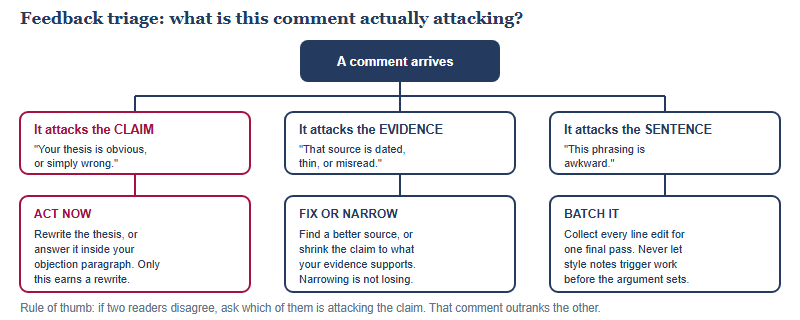
Conflicting feedback paralyses students because every comment feels equally weighted. It is not. Sort each comment into one of three buckets and act accordingly — and remember that you, not your readers, are responsible for the verdict the essay reaches.
On the integrity boundary, HIEEC’s published rules are the thing to work from rather than general intuition: the essay must be written only by the entrant, any outside assistance must be declared, and plagiarism leads to disqualification. A critique round is compatible with that, provided the division of labour is clean. Readers identify problems; you decide what to do and you write every replacement sentence. The moment a reader is drafting text for you, the work is no longer only yours. Keep a short note of who read which draft and what you asked them, so that writing an accurate declaration at the end is a two-minute job rather than a reconstruction, and confirm the current declaration wording on thehuea.org for the cycle you are entering.
On timing, work backwards from a deadline that fell in early January in the most recent published cycle. Round 1 belongs shortly after the autumn prompts land, while your commitment to a claim is still cheap — if you are still deciding which prompt to take, our guide to choosing a prompt by strength covers that decision. Round 2 belongs on a complete but over-length draft, leaving a clear fortnight afterwards for compression against the strict 1,500-word limit, which is its own discipline — see the 1,500-word method. Do not schedule a critique round in the final week: with only the first submission accepted and a submission cap in place in recent cycles, late structural advice is a risk rather than a gift.
Frequently asked questions
Does asking a teacher for feedback break HIEEC’s rules?
The rules require the essay be written only by you, with outside assistance declared. Feedback is normal; declare it and keep the writing yours.
How many readers should I use?
Two per round is enough. More readers produce contradictory line edits and slow the rewrite without improving the argument.
When should the first critique round happen?
At outline or first full draft, before polishing. Feedback on a polished draft mostly produces line edits you cannot afford.
What if two readers disagree with each other?
Ask which one is attacking the claim. Objections to the claim outrank objections to style, and only you defend the thesis.
This is an independent guide operated by Hanlin Education for China-based international-school students. We are not affiliated with, endorsed by, or sponsored by the Harvard Undergraduate Economics Association, the Harvard College Economics Review, or Harvard University. Entry rules, declaration requirements, deadlines and judging arrangements are set by the organisers and change each cycle — confirm current details on thehuea.org. Factual corrections are made within 7 working days.