An environment prompt is never really asking whether climate change matters. It is asking whether a specific policy instrument changes behaviour, at what cost, and who ends up paying. Essays that answer the first question read like op-eds; essays that answer the second read like economics. This is the working toolkit for the second kind.
What this category actually asks
The contest details published by HUEA for the most recent cycle listed four prompt areas, one of them environment — alongside inequality, remote work, and crypto and finance. Exact wording is set by the organisers and released each autumn, and the past-year prompt attributions circulating on third-party guide sites are not verifiable, so treat any specific past question you see quoted with caution and confirm the live prompts on thehuea.org. What is stable across cycles is the shape of the question, and that is what you can prepare for now.
Environmental economics questions almost always reduce to one of three forms, and knowing which one you have been given is the single most useful thing you can do in your first hour:
- Instrument choice. Should we price carbon, cap it, subsidise the alternative, or mandate a standard? The answer is comparative, and the marks sit in the comparison.
- Effectiveness. Did a policy actually reduce emissions, or did it move them? This is an empirical question, and it lives or dies on the counterfactual.
- Incidence and fairness. Who bears the cost — which households, which firms, which countries? This is where most strong essays find their original angle, because most weak essays skip it entirely.
Effectiveness questions deserve a specific warning, because they are the easiest place to write something that sounds empirical and proves nothing. Emissions falling after a policy was introduced is not evidence that the policy worked: recessions, fuel-price swings, mild winters and pre-existing downward trends all move the same series. What turns description into argument is an explicit comparison — the same sector in a jurisdiction without the policy, or the trend that was already running before it began. You do not need econometrics to do this well at high-school level. You need to name the comparison you are making, and be honest about what it cannot rule out.
The externality framing is your entry point, not your argument. Every reader already knows that an unpriced negative externality means the private cost sits below the social cost and output exceeds the efficient level. Spend two sentences establishing it, then move. A judge who reads your first 300 words and finds only the definition of an externality has learned nothing they did not know, and you have burned a fifth of your budget.
Four instruments, and the failure mode of each
The genuinely analytical move in an instrument-choice essay is to identify what each policy controls and therefore what it leaves uncertain. A tax fixes the price of emitting and lets the quantity fall where it will. A cap fixes the quantity and lets the price move. That single distinction — price instruments versus quantity instruments — is the backbone of the literature, and Weitzman’s classic treatment of prices versus quantities under uncertainty is the reference to reach for if you want to show you have read past a textbook chapter.
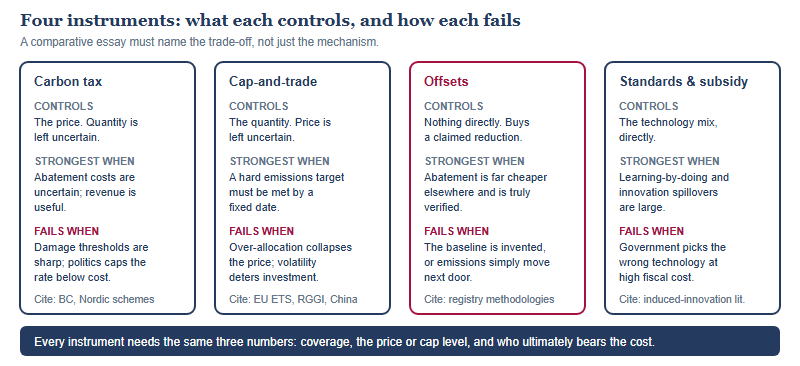
The comparison table below is the version to keep beside you while drafting. Notice that the third column is the one that produces original arguments: almost every student can describe how a carbon tax works, and almost none can say precisely when it is the wrong tool.
| Instrument | What it fixes | The objection a judge is waiting for | Where to get evidence |
|---|---|---|---|
| Carbon tax | Price per tonne | Emissions outcome is uncertain, and political economy tends to set the rate below the estimated social cost of carbon | World Bank State and Trends of Carbon Pricing; national treasury documents |
| Cap-and-trade | Total quantity | Allowance over-allocation and price volatility weaken the investment signal the policy depends on | ICAP status reports; scheme registries; ex-post evaluations of the EU ETS |
| Offsets | Neither — it transfers a claim | Additionality and permanence: was the reduction going to happen anyway, and does it last? | Registry methodologies; peer-reviewed audits of credit quality |
| Standards / subsidies | Technology adoption | Static inefficiency: a fixed abatement cost per tonne that may far exceed the carbon price | IEA reports; programme evaluations; induced-innovation literature |
Offsets: the four words that separate strong from weak
If your prompt touches offsets, carbon markets or nature-based solutions, the essay is effectively a test of whether you know that a carbon credit is a claim about a counterfactual. Nobody can observe the emissions that did not happen. Every credit therefore rests on four assertions, and each is a place where the claim can fail.
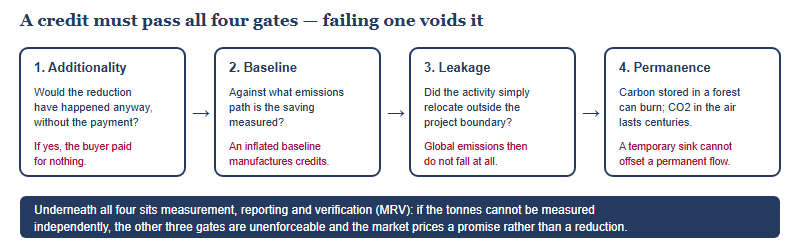
Here is the move that separates a finalist-quality essay from a competent one: do not merely list the four gates. Pick one real scheme or credit type, walk it through all four, and reach a verdict you are willing to defend. Breadth is cheap in this category; a single worked application is what demonstrates judgement.
Incidence: the section most students skip
Carbon pricing raises the cost of energy, and energy is a larger share of spending for lower-income households than for richer ones. That makes a flat carbon price regressive in its direct effect — before you account for what the government does with the revenue. Revenue recycling changes the answer entirely: a uniform per-household dividend can leave lower-income families better off in cash terms even as they face higher energy prices, while using the revenue to cut distortionary taxes points toward the long-running “double dividend” debate about whether the efficiency gain is real.
Two further distributional questions are worth a sentence each, because they are where policy actually gets stuck. Firms exposed to international competition argue that unilateral pricing shifts production abroad — carbon leakage — which is the stated rationale for border carbon adjustment mechanisms; confirm the current design and coverage of any such mechanism directly from the issuing authority, since these are actively evolving. And between countries, the historical-responsibility argument sits underneath every international negotiation: the stock of atmospheric carbon was accumulated largely by economies that industrialised first, while much of the projected growth in flows is elsewhere.
A note for China-based writers: the national emissions trading system gives you genuine local evidence access, and you can read primary material most competitors will only encounter through summaries. Use official sources, state the year of every figure, confirm current sector coverage rather than repeating an older description, and resist the temptation to make the essay a national case study when the prompt asked a general question.
Fitting it into 1,500 words
HIEEC’s published rules state that the 1,500-word limit “must be strictly adhered to,” which means this category has to be rationed harder than most. Environmental questions tempt students into three expensive habits: explaining climate science, describing several policies at equal length, and closing with a call to action. None of those earns marks. A workable budget looks like this:
- 150 words — the question restated as a claim, plus your verdict. No scene-setting about a warming planet.
- 200 words — the mechanism. Externality, then the price-versus-quantity distinction that your instrument choice turns on.
- 600 words — the worked case. One scheme, real evidence, properly cited in Chicago or APA as the rules require.
- 350 words — the strongest objection to your own verdict, answered rather than mentioned. Incidence usually lives here.
- 200 words — what would change your mind, and the conclusion that follows from the evidence you actually presented.
If you are unsure whether the environment prompt is your best match at all, judge it on evidence access rather than interest — the same test we apply in the guide to choosing a prompt by strength. And if the compression itself is what worries you, the structural method in how to build a 1,500-word essay is designed for exactly this constraint. For the competition’s structure, eligibility and organisers, start with our overview of HIEEC.
Frequently asked questions
Do I need original data for an environment essay?
No. Published series from the World Bank, IEA or scheme registries are fine, provided you cite them properly and interpret them yourself.
Is a carbon tax always better than cap-and-trade?
No. One fixes the price, the other fixes the quantity. Which is better depends on uncertainty, coverage and how revenue is used.
Can I write about China’s carbon market?
Yes, and local knowledge helps. Use official sources, state the year of every figure, and confirm current design details before citing.
How much of the essay should be economic theory?
Enough to name the mechanism, usually 200 to 300 words. The marks sit in the evidence and the evaluation, not the diagram.
This is an independent guide operated by Hanlin Education for China-based international-school students. We are not affiliated with, endorsed by, or sponsored by the Harvard Undergraduate Economics Association, the Harvard College Economics Review, or Harvard University. Prompt areas, wording, word limits and deadlines are set by the organisers and change each cycle — confirm current details on thehuea.org before you write. Factual corrections are made within 7 working days.