As of late August 2026, HIEEC has not published its 2026-27 rules or prompts. The official page says they will be posted when the contest opens this autumn, and lists the January submission deadline as tentative. Almost everything else you will read online right now describes an earlier cycle. Here is what is actually confirmed, and what to stop planning around.
The rules are not out yet, and that is normal
Every year we re-read the HUEA contest pages at the end of August, because this is the point in the season when families start making decisions and the internet is at its least reliable. The pattern repeats: search results fill with confident, specific guides, and the official page is still in pre-opening state.
That is where it stands today. The live HIEEC page describes the contest in outline — eligibility, approximate length, the shape of the calendar — and states plainly that the full 2026-27 rules and prompts will be posted when the contest opens this autumn. The January deadline is presented as tentative rather than fixed.
This matters for one practical reason. If you build a schedule now around a specific date, a specific word count and a specific fee, you are building it on last cycle's rules, and last cycle's rules are exactly the thing that changes. The point of this article is not to give you numbers. It is to show you which numbers are load-bearing and which are borrowed.
What the official page states today
Below is what we could read on the live pages, separated from what we could not. “Confirmed” means the current page states it. “Tentative” means the page itself flags it as provisional. “Not yet stated” means the page is silent for 2026-27, whatever earlier cycles did.
| Item | What the live page says | Status for 2026-27 |
|---|---|---|
| Who runs it | HUEA, a student-led Harvard undergraduate organisation working with the economics department | Confirmed |
| Eligibility | High-school students in grades 9–12, anywhere in the world | Confirmed |
| Length | Around 1,500 words | Confirmed in outline; exact rule pending |
| Prompts | A set of prompts, published in the autumn | Count and wording not yet stated |
| Submission deadline | January | Tentative on the page itself |
| Judging | Every entry read by the HUEA board; the strongest judged by a Harvard economics professor | Confirmed |
| Recognition | Finalists and Highly Commended recognised by name; winning essays published with the author's permission | Confirmed |
| Results timing | Spring | Confirmed in outline; no date |
| Reading fee | Not stated for the coming cycle on the page we reviewed | Not yet stated |
| Citation style, file format | Not stated for the coming cycle on the page we reviewed | Not yet stated |
Notice how much of the structure is confirmed and how little of the detail is. That split is useful: it tells you the process is stable and the parameters are not. You can prepare against a stable process. You cannot prepare against parameters you have invented.
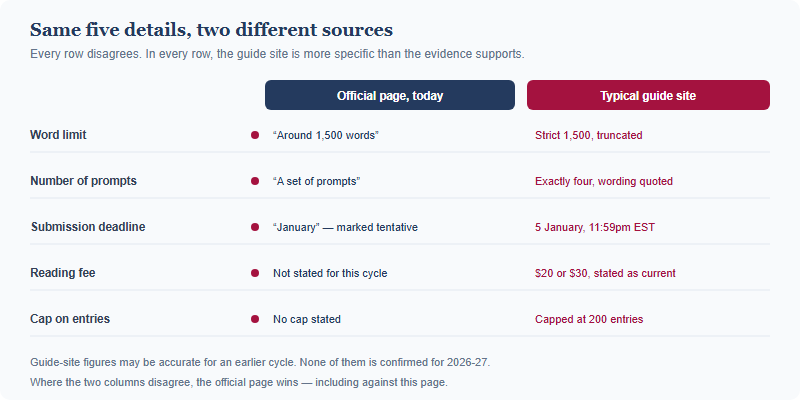
One word of drift worth noticing. Here is the kind of difference that guides flatten and students get caught by. The most recent published cycle applied a strict 1,500-word limit, excluding references, footnotes and headers, with third-party summaries reporting that anything beyond the limit was truncated. The live pre-opening page currently describes the essay as around 1,500 words.
Those are not the same instruction, and the difference is not academic. Under a strict limit with truncation, word 1,501 onward simply does not exist for the reader — if your conclusion sits there, you submitted an essay with no conclusion. Under a softer limit you have a little room. You do not yet know which regime applies to 2026-27, and there is only one safe response: write to the stricter reading. An essay that lands at 1,495 words is valid under either rule. An essay at 1,650 is a gamble on wording that has not been published.
Four claims we could not verify
These circulate widely. We are not calling them false — several are plausible and may well be accurate for a past cycle. We are saying we could not confirm them on the official page, and that you should not let them drive a decision.
1. A cap of 200 entries. Several guides state that submissions are capped. If true, this changes strategy completely: a cap rewards submitting early and punishes anyone who waits for the deadline. That is precisely why you should not act on it unverified — and also why, if the contest opens and a cap is stated, you should treat the real deadline as “whenever the cap fills” rather than the published date. Check the rules page for a cap the day it goes live.
2. A deadline extension in a past cycle. Some sources report that an earlier cycle's deadline moved from early January into late January. Extensions do happen, and if one is announced you will hear about it. What you must not do is plan for one. Working backwards from a hoped-for extension is how students end up submitting a first draft.
3. Specific past prompt wording, attributed to specific years. You will find quoted prompts labelled by cycle. We have never been able to verify those attributions against a primary source, and the archive of past results is the only place worth looking. Use quoted prompts to sense the territory the contest covers; do not draft an essay against wording that may be misremembered, paraphrased or invented.
4. Fees, citation style and format quoted as current. The most recent published cycle used a reading fee at two tiers depending on where you entered from, and asked for a recognised citation style. All of that is likely to carry over. None of it is stated for 2026-27 yet. Budget for a fee, prepare your references properly, and confirm the specifics before you pay anything.
There is a general lesson here that outlasts this cycle. A guide site is rewarded for sounding definite; the organisers are rewarded for being accurate. When the two disagree, the organisers win — and that includes disagreeing with us. If you find that thehuea.org contradicts anything on this page, the official page is right and we want to know so we can correct it.
A five-minute check that saves a term
Do this the week the contest opens, and again before you submit. It is genuinely five minutes, and it is the difference between writing to the real rules and writing to a rumour.
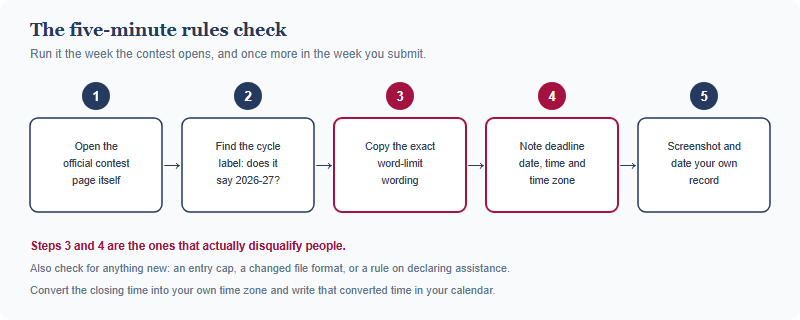
The time-zone step deserves its own emphasis for students in China. A deadline expressed in a United States time zone lands in the small hours of the following morning in Beijing, and the date on the clock in front of you will not be the date in the rules. Convert once, write the converted moment in your calendar, and aim to submit a full day before it.
What to do now, before the rules land
The absence of published rules is not a reason to wait. Everything that actually determines essay quality is independent of the parameters.
- Read. The prompt areas move around but the territory is recognisable, and background reading is never wasted. Nothing in a rules page changes whether you understand how a policy instrument works.
- Practise compression. Take an 1,800-word piece of your own and cut it to 1,500 without losing the argument. This is the skill the limit tests, and it transfers whichever wording appears.
- Sort your referencing now. Decide on a recognised style and learn to use it properly, so that when the format rule is published you are formatting rather than learning.
- Do not draft against a guessed prompt. This is the one genuinely wasteful move. A finished essay built on wording that turns out not to exist tempts you into forcing it to fit, and forced essays read exactly as forced.
- Diarise the check. Put a reminder in early October to look at the page. Prompts have historically appeared in the autumn.
If you are new to the contest, the process rather than the parameters is what you want to understand first — our overview of HIEEC and how it is judged covers that ground. Once the prompts are published, the two decisions that follow immediately are which prompt actually suits your strengths and how to build the argument inside the word limit. Both of those are worth reading before the prompts land, so that when they do you are choosing rather than panicking.
Frequently asked questions
Are the 2026-27 HIEEC prompts out yet?
Not as of late August 2026. The official page states the full rules and prompts will be posted when the contest opens in the autumn.
Is the deadline definitely 5 January?
No. The live page lists January as tentative. Early January reflects the most recent published cycle, not a confirmed 2026-27 date.
Is there really a cap on entries?
We could not verify a cap on the official page. If one is published, submit early rather than treating the deadline as your target.
Should I write to 1,500 words or a bit over?
Write to 1,500 or just under. Third-party summaries report that a past cycle truncated anything beyond the limit, and the current wording is not yet final.
This is an independent guide operated by Hanlin Education for China-based international-school students. We are not affiliated with, endorsed by, or sponsored by the Harvard Undergraduate Economics Association, the Harvard College Economics Review, or Harvard University. Everything above is a snapshot of the official pages as read in late August 2026; rules, dates, fees and prompts are set by the organisers and change each cycle — confirm current details on thehuea.org, which supersedes this page wherever the two differ. Factual corrections are made within 7 working days.