HIEEC — the Harvard International Economics Essay Competition — is a high-school economics essay contest run by the Harvard Undergraduate Economics Association (HUEA), a student organisation, together with the Harvard College Economics Review. It is open to students in grades 9–12 worldwide: you write a strict 1,500-word essay on one of four set prompts, and the strongest entries are judged by a Harvard economics professor. This independent guide explains how it works and how international students take part.
Quick facts (2025–2026)
| What it is | A high-school economics essay competition — one original argued essay on a set prompt |
| Who runs it | The Harvard Undergraduate Economics Association (HUEA) + Harvard College Economics Review — a student body, not Harvard University officially (we are an independent guide — not affiliated) |
| Who can enter | Students in grades 9–12 (any year), worldwide, with an interest in economics |
| What you write | One of four prompts, a strict 1,500-word essay (excludes references, footnotes, titles, headers); Chicago or APA style; submitted as a PDF |
| Cost & limit | A reading fee per essay (around $20 US / $30 international); one essay per person |
| When | A fall/winter cycle with a deadline typically in early January — confirm the exact date for the current cycle officially |
| Official source | thehuea.org (Harvard Undergraduate Economics Association) |
Who actually runs HIEEC (read this first)
The single most common misunderstanding is the word “Harvard.” HIEEC is organised by the Harvard Undergraduate Economics Association — Harvard’s main undergraduate economics club, founded in 2000 — in conjunction with the Harvard College Economics Review. It is a student-run competition, not an official program of Harvard University, and entering it is not an application to Harvard. That does not make it unserious: top essays are ultimately adjudicated by a Harvard economics professor. But it does mean you should treat it as a respected student-run essay contest, judge it on its own merits, and ignore anyone who implies it is “Harvard admissions.”
What you actually write
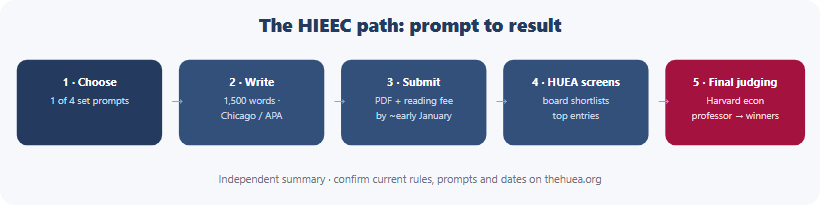
Each year HIEEC publishes four prompts built around a current, relevant economic issue, and you choose one. Your response is a strict 1,500-word argued essay — the limit excludes references, footnotes, titles, headers and footers, and anything over the limit is simply truncated, so the word count is a real design constraint, not a suggestion. Essays must be written in a formal academic style (Chicago or APA referencing) and submitted as a PDF. You may enter one essay per person. The skill being tested is not how much you can write, but how clearly you can build and defend an economic argument with theory and evidence inside a tight word budget.
How it is judged
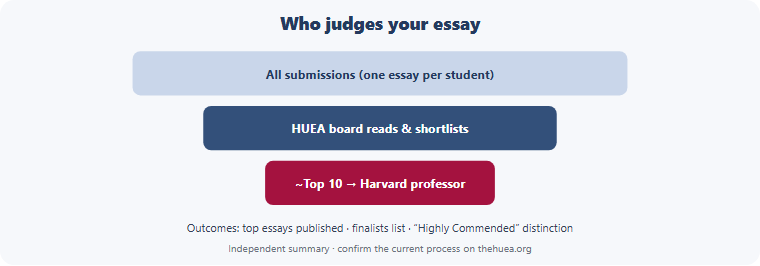
Judging runs in two stages. First, the HUEA board reads and shortlists entries; then the strongest essays — reported as around the top ten — are adjudicated by a Harvard economics professor (and the field is also reviewed by a real-world economist). The very best essays are published on the association’s site (with the author’s permission), a finalists list is posted, and additional strong entries receive a “Highly Commended” distinction. There is no published point-by-point rubric, so the practical guidance is to write for an expert economist reader: a clear thesis, correct use of economic theory, real evidence, and a tightly structured argument.
What a strong HIEEC essay looks like
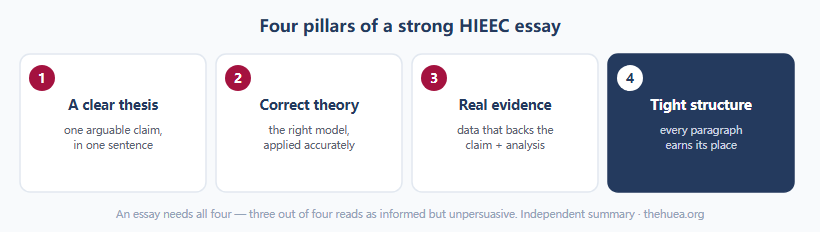
Because there is no published point-by-point rubric, the most useful question is: what does an expert economist reward? Four things, consistently. First, a clear thesis — a single, arguable claim you can state in one sentence, not a survey of “on the one hand, on the other.” Second, correct economic theory — you name the specific model the argument needs (elasticity, externalities, game theory, comparative advantage) and apply it accurately, rather than dropping terms for effect. Third, real evidence — data, studies, or concrete examples that genuinely support your claim, each followed by a sentence explaining why it matters. Fourth, tight structure — every paragraph advances the argument, and the 1,500 words go to reasoning, not throat-clearing. As a quick test: if you can delete a paragraph and your argument is unchanged, it was not pulling its weight. An essay that does all four reads as the work of someone who can think like an economist; one that does three but skips the analysis reads as well-informed but unpersuasive.
Eligibility, cost, and how international students take part
HIEEC is open to any high-school student in grades 9–12, anywhere in the world, which makes it genuinely accessible to international and China-based students — you do not qualify through a national round; you submit directly. Two practical points to plan for: there is a reading fee per essay (around $20 for US applicants and $30 for international applicants), and the essay must be a PDF in correct academic format. Work backwards from the early-January deadline: give yourself the autumn to choose a prompt, research, draft, and cut to 1,500 words. New to economics essays? See our companion guides on choosing your HIEEC theme, writing to 1,500 words, and what HIEEC judges look for.
Planning your entry: a term-by-term timeline
Because HIEEC runs on a fall–winter cycle with a deadline typically in early January, the students who do well start in the autumn and work backwards. A workable plan: in September–October, read the four prompts the day they are released, run each through a quick test of whether you have a thesis, the theory, and the evidence, and commit to one. In late October–November, research and write a first draft — deliberately over length, so you have something to cut. In December, edit ruthlessly to 1,500 words, check your Chicago or APA referencing, and read the essay aloud to catch weak sentences. Leave the final week for formatting the PDF and a last proofread, not for writing — submitting a rushed final draft is the most common avoidable mistake. International and China-based students should also confirm the deadline in their own time zone and budget for the reading fee in advance, so neither becomes a last-minute problem.
How HIEEC compares to other economics essay competitions
HIEEC is one of several essay competitions for students interested in economics, and it helps to know where it sits. Compared with the John Locke Institute‘s economics question, HIEEC is shorter (1,500 words versus 2,000) and tied explicitly to a current economic issue rather than a broad philosophical prompt. Compared with the LSESU Economics Society Essay Competition, HIEEC is adjudicated ultimately by a Harvard economics professor and run by a US university club, whereas the LSESU contest is UK-based and tied to LSE faculty. None of these is “better” in the abstract — they reward overlapping skills (a disciplined economic argument in writing), and many strong applicants enter more than one. The practical point: HIEEC’s tight 1,500-word limit and single-issue prompts make it an excellent place to practise concision and applied analysis, and a credible line on an application to economics, PPE, or business programs.
Is HIEEC worth it for college applications?
For students aiming at economics, PPE, or business, a strong HIEEC result is a credible signal — evidence that you can build a rigorous economic argument in writing, which is exactly the skill those programs value. It does not guarantee admission anywhere, and a single entry is not a “hook”; it is one component of a coherent application. The deeper value is the work itself: researching a real economic question and arguing it well in 1,500 words genuinely strengthens you as an applicant, whether or not you place. Treat it as one well-chosen, well-executed credential — not a lottery ticket.
Frequently asked questions
Is HIEEC run by Harvard University?
No. It is run by the Harvard Undergraduate Economics Association (HUEA), a student organisation, with the Harvard College Economics Review. Top essays are judged by a Harvard economics professor, but the contest is not an official Harvard University program, and entering is not a Harvard application.
Who can enter, and what does it cost?
Any high-school student in grades 9–12 worldwide. There is a reading fee per essay (around $20 US / $30 international), and you may submit one essay. Confirm current fees and rules on the official site.
How long is the essay and what format?
A strict 1,500 words (excluding references, footnotes, titles and headers), in Chicago or APA style, submitted as a PDF. Anything over the limit is truncated.
When is the deadline?
HIEEC runs on a fall/winter cycle with a deadline typically in early January. Always confirm the exact date for the current cycle on thehuea.org, as it can change year to year.
How is HIEEC different from the John Locke economics prize?
HIEEC essays are 1,500 words and respond to a current economic issue, and the strongest are judged by a Harvard economics professor. The John Locke Institute’s economics question is longer (around 2,000 words) and broader. They reward overlapping skills, and many students enter both.
Do I need to have formally studied economics to enter?
No. HIEEC is open to any grade 9–12 student with an interest in economics. You do need to use economic theory correctly, so reading around your chosen prompt matters more than having taken a formal course.
Filed underEconomics Essay · International Students · What Is Hieec
This is an independent guide to the Harvard International Economics Essay Competition, operated by Hanlin Education for China-based international-school students. We are not affiliated with, endorsed by, or sponsored by the Harvard Undergraduate Economics Association, the Harvard College Economics Review, or Harvard University. Prompts, eligibility, fees and dates change by year — always confirm the current details on the official HUEA site. Confirmed errors are corrected within 7 working days.