Students arriving from team-based competitions often wonder whether HIEEC allows multiple authors. The short answer is no: HIEEC is an individual essay competition with no source indicating team entry is permitted. Understanding this design helps you compete with confidence and discuss ideas ethically without crossing into undeclared assistance.
Why HIEEC Is Built for a Single Author
HIEEC’s structure centers on one essay per student. Unlike some economics competitions that accept group research projects or co-authored policy briefs, HIEEC asks each participant to produce a unified, original argument. This is not an incidental rule—it reflects how the competition evaluates work.
The judging criteria assume a single voice throughout the essay. A unified argument, consistent analytical framework, and personal engagement with the prompt are difficult to achieve when multiple hands shape the prose. For this reason, the competition’s integrity depends on individual submission.
Existing guidance on how much help is too much addresses assistance boundaries but does not discuss team or co-authored submissions. This gap matters because students naturally compare HIEEC to contests with different structures.
What Individual Argumentation Means in Practice
Individual authorship does not mean working in isolation. It means that the final essay represents one person’s synthesis of research, analysis, and writing. The intellectual labor behind the essay can involve conversations, reading, and feedback—but the craft of the argument must be yours.
Consider what this requires at each stage:
- Research phase: You may read the same sources as peers, but your selection and interpretation should be independent.
- Analysis phase: You can discuss economic concepts in study groups, but your thesis and supporting logic must emerge from your own reasoning.
- Writing phase: Every sentence should be composed by you, reflecting your understanding and style.
This standard aligns with how academic economics actually functions. Scholars discuss work in seminars and conferences, but published papers carry individual bylines because the intellectual contribution is traced to a specific mind.
The Declared-Assistance Boundary
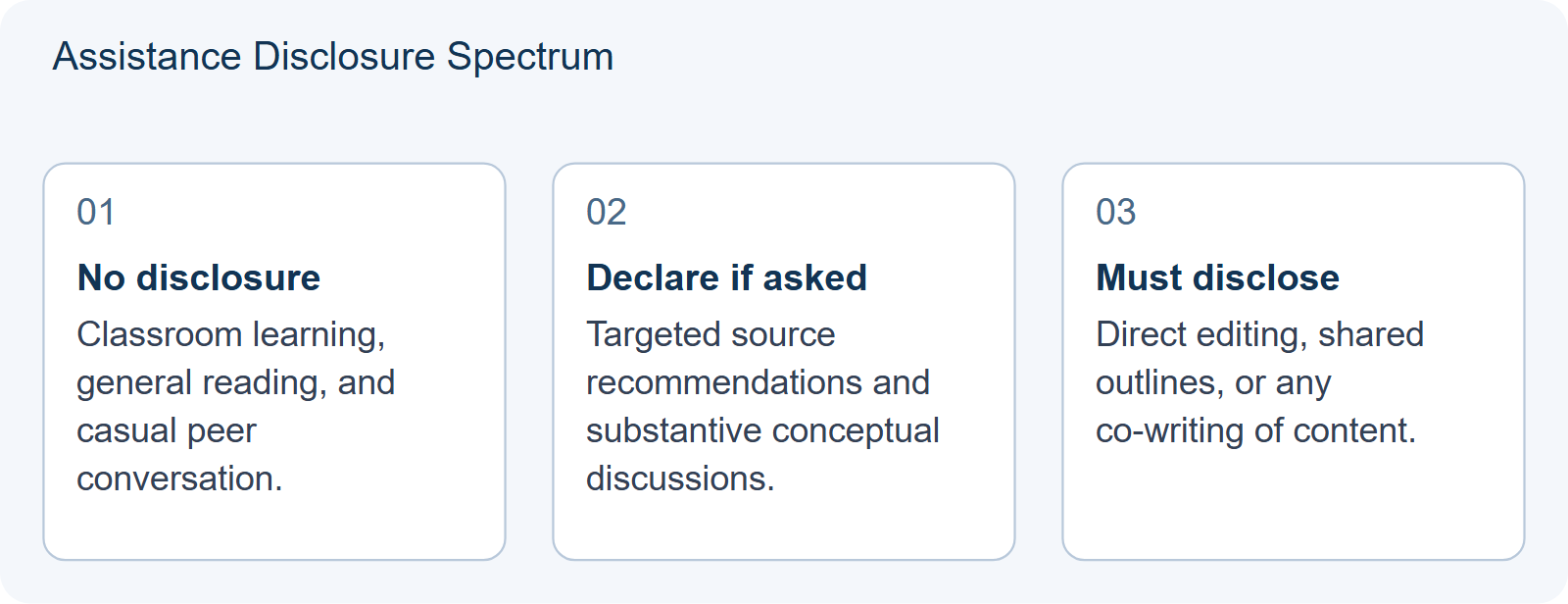
HIEEC’s declared-assistance rule requires transparency about outside help. The principle is straightforward: disclose what shaped your essay so judges can evaluate your original contribution accurately. What counts as assistance worth declaring varies by degree and kind.
Normal academic exchange—classroom discussions, library research, conversations with peers about economic theory—typically does not require declaration. These are the background conditions of learning. What crosses into assistance requiring disclosure includes direct intervention in your argument structure, provision of specific sources you would not have found independently, or substantive editing of your prose.
The declared-assistance guidance provides a framework for navigating this boundary. It does not catalog every scenario, but it establishes the ethical posture the competition expects: honesty about influence.
A Practical Framework for Peer Discussion
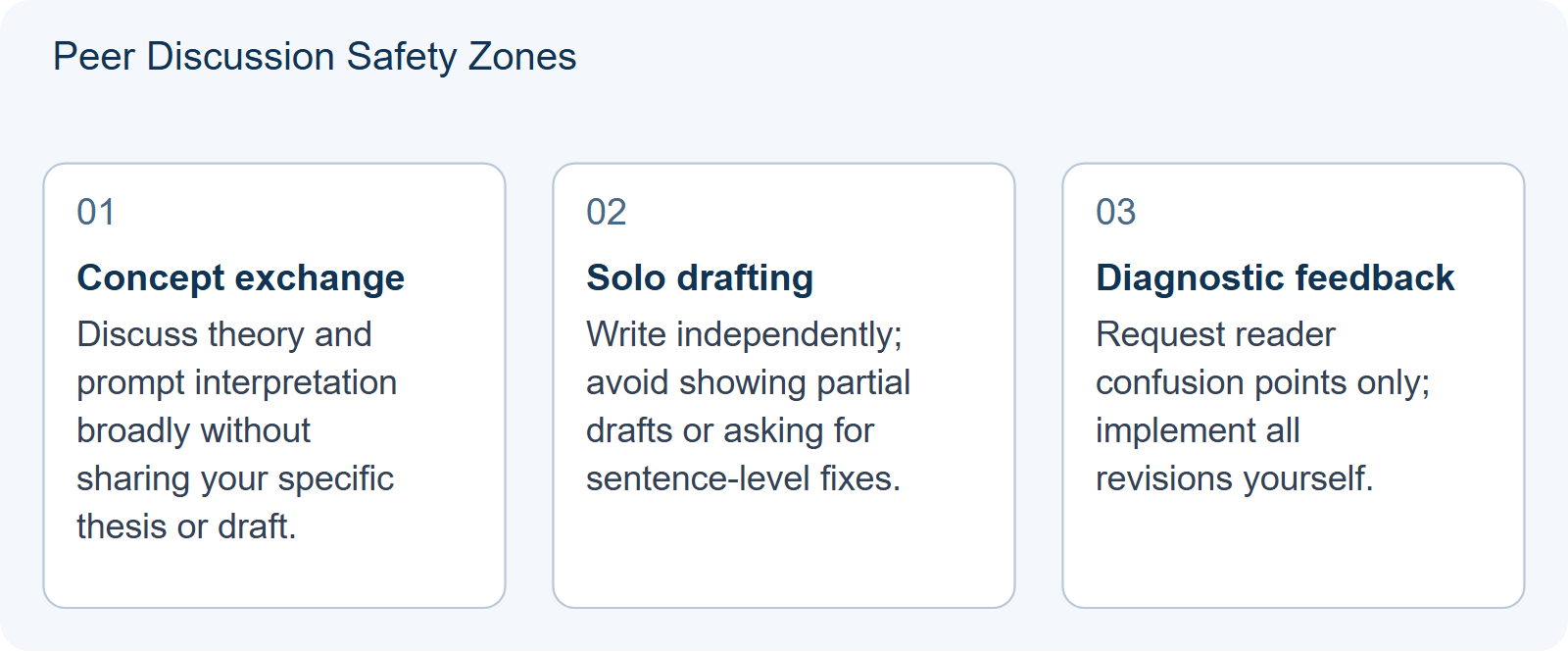
You can and should engage with peers while preparing your HIEEC entry. The challenge is keeping discussion generative rather than substitutive—helping you think better rather than thinking for you.
Before Drafting
Early conversations are lowest risk. Discussing prompt interpretations, sharing initial reactions, and identifying which questions interest you most can clarify your direction. A suggested approach: meet with one or two peers, each presenting which prompt they lean toward and why. The goal is articulation, not alignment. Hearing others’ reasoning can surface your own unstated assumptions without transferring ideas.
During Drafting
This is the highest-risk phase for undeclared assistance. The boundary line runs between discussing economic concepts and discussing your specific essay. You might ask: “Does this mechanism in trade theory work the way I understand it?” You should not ask: “Does my third paragraph refute the counterargument effectively?” The first invites conceptual clarification; the second invites co-authorship.
If a peer’s response could be inserted directly into your essay with minimal revision, you have crossed from discussion into collaboration.
During Revision
Feedback on near-complete drafts is valuable but requires care. Readers can identify where your argument confuses them, where evidence seems thin, or where transitions fail. They should not rewrite sentences, suggest specific replacements, or restructure your argument. Their role is diagnostic; the cure must be yours.
For guidance on what judges prioritize when evaluating revised work, see what HIEEC judges look for.
Red Flags: When Discussion Becomes Undeclared Assistance
Certain patterns reliably indicate that peer interaction has moved beyond ethical boundaries:
| Pattern | Why It Violates Individual Authorship |
|---|---|
| Shared outlines | Structures argument jointly, making the final essay a composite product |
| Joint research pools | Delegates source-finding to others, obscuring independent intellectual labor |
| Co-written paragraphs | Directly substitutes another’s prose for your own |
| Recursive editing | Creates iterative co-authorship where no single version represents your solo work |
These patterns share a common feature: they distribute cognitive labor in ways that make the final essay unrepresentative of any single author’s capabilities. HIEEC’s design assumes the opposite.
How to Credit Intellectual Influences
Even when discussion stays within bounds, your thinking may be shaped by conversations. This is normal and often valuable. The question is how to acknowledge these influences without implying co-authorship.
In academic practice, influence is typically credited when it directly affects specific claims or methods. General conversations that sharpen your thinking about a field need not be footnoted. However, if a peer pointed you to a specific source that became central to your argument, or if a conversation substantially redirected your thesis, noting this in your declared assistance is appropriate.
The standard is proportionality: declare what materially affected your essay’s content, not every interaction that contributed to your education.
Preparing for Your HIEEC Entry: Course-Fit and Resource Planning
If you are deciding whether HIEEC suits your strengths, consider whether you enjoy sustained individual writing and whether you have access to feedback structures that respect the boundaries above. Students who thrive in HIEEC typically have:
- Experience with long-form argumentative writing
- Comfort with independent research in economics
- Access to a mentor or teacher who understands declared-assistance rules
- Discipline to separate peer discussion from draft composition
To prepare effectively, review the HIEEC competition format and assess whether your current commitments allow the concentrated writing time the essay demands. The competition rewards depth over breadth; a narrow, well-defended argument outperforms a sweeping survey.
Frequently Asked Questions
Can two students submit the same essay with different names if they wrote it together?
No. HIEEC is an individual essay competition with no source indicating team entry is permitted. Jointly written essays violate the individual-authorship design regardless of how credit is distributed.
Is it allowed to discuss the prompt with classmates before starting my essay?
Yes. General discussion of prompt interpretation and economic concepts before drafting is normal academic exchange. The boundary crosses when peers begin shaping your specific argument or contributing to your draft.
How do I know if my declared assistance is sufficient?
Err toward transparency. The declared-assistance rule values honesty over minimal compliance. If an influence substantially affected your essay's content or direction, include it. When uncertain, disclosure carries no penalty; omission might.