HUEA has published nine winning HIEEC essays as PDFs, three each for 2022-23, 2024-25 and 2025-26. We read all nine and counted what can be counted. Every one gave space to an objection or risk and argued about policy, and all but one used section headings. Almost everything else varied: three used no charts, reference lists ran from 6 to 30 entries, and one winner printed a length of 1,302 words.
What we read, and the limits of what we counted
The essays are linked from HUEA’s results pages for 2022-23, 2024-25 and 2025-26. HUEA’s competition page says winning essays are published there with the author’s permission. When we read the pages in September 2026, the 2023-24 page listed that year’s winners without essay files, so that cycle is not in the sample.
Three limits apply. First, we counted structure, not quality, and where a feature needed judgement — whether an essay engages an opposing view, for instance — the call is ours. Second, we do not report word counts for individual essays: text extracted from a PDF cannot reliably separate headings, captions, equations and notes from the body, and a count that looks precise would not be. The one exception is the essay that printed its own count. Third, nine essays from three cycles are a small sample, written under rules that may have differed from year to year. Treat what follows as evidence about what has won, not a formula for what will.
Nine essays, eight features, and what held constant
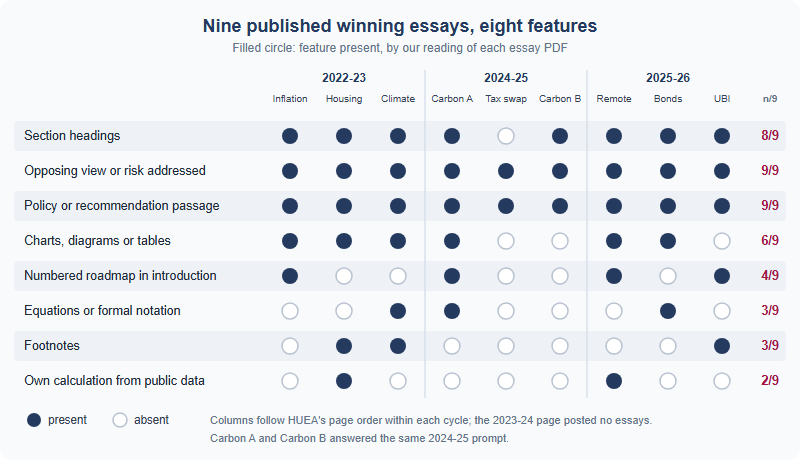
Read the matrix by row. The top three rows are close to universal; the bottom five are not. That split is the most useful finding here, because the features students most often ask us about — charts, equations, footnotes, their own data — all sit in the lower half.
An opposing view, answered. Every essay gives space to at least one counter-argument or risk before its conclusion. The inflation essay concedes that domestic causes exist before arguing that inflation is increasingly imported; the two carbon-tax essays both answer the worry about lost competitiveness, and one also rebuts emissions leakage; the basic-income essay confronts the claim that unconditional income discourages work. It is the least glamorous finding and probably the most important.
A policy passage. All nine argue about what should be done, usually in a section of their own. That fits the prompts: fifteen of the sixteen prompts HUEA has published for its last four cycles ask a question of that kind. It also means an essay that analyses and then stops has left out something every published winner included.
Visible structure and a reference list. Eight of nine use section headings, and the ninth still moves through a clear sequence of problem, precedent and proposal. All nine end with a reference list or bibliography, whatever system they use in the text.
One feature is common without being universal. By our reading, six of the nine signal their position within the opening section; the other three open with a purpose statement or a framing observation and reach their answer later. Early commitment is the majority pattern, and the minority still won.
What varied more than students expect
- Charts. Six essays use charts, diagrams or tables; three use none. The clearest case is the 2024-25 carbon-tax prompt, which produced two winners: one with five figures, one with none.
- Length. The only essay that printed its own length stated 1,302 words, comfortably under 1,500. Winning did not require using every available word.
- Sources. Reference lists run from 6 to 30 entries, with a median of 20, and two winners listed fewer than ten.
- Roadmaps. Four essays set out a numbered roadmap in the introduction. Two of them, written two cycles apart, use almost the same device: three numbered observations, each building on the one before.
- Formal tools. Three essays use equations or formal notation and three use footnotes. Only two present a calculation of their own from public data — one a housing ratio and a simple simulation, the other a tabulation of a government survey — which makes original data work the rarest feature in the sample.
- Titles. Two are plain topic labels, such as On Carbon and the Economy. Two are short metaphors or wordplay, such as Minutes to Midnight. Five pair a hook with an angle after a colon or dash, such as Affordability Crisis: A Mirror of Inequality.
| Cycle | Prompt area | Citation system | Reference entries | Title form |
|---|---|---|---|---|
| 2022-23 | Central banks and inflation | Author-date in the text, Chicago-style list | 23 | Plain topic |
| 2022-23 | US housing affordability | Numbered footnotes and a bibliography | 18 | Two-part, colon |
| 2022-23 | Economic growth and the environment | Author-date, APA-style, plus two notes | 30 | Plain topic |
| 2024-25 | Carbon tax versus subsidies (Carbon A) | Author-date, APA-style | 20 | Metaphor |
| 2024-25 | Replacing income tax with a consumption tax | Author-date, APA-style | 8 | Two-part, colon |
| 2024-25 | Carbon tax versus subsidies (Carbon B) | Author-date, APA-style | 17 | Two-part, dash |
| 2025-26 | Remote and hybrid work | Author-date, APA-style | 25 | Two-part, colon |
| 2025-26 | Tokenised government bonds | Author-date in the text, Chicago-style list | 6 | Wordplay |
| 2025-26 | Basic income and automation | Author-date, APA-style, plus explanatory notes | 26 | Two-part, colon |
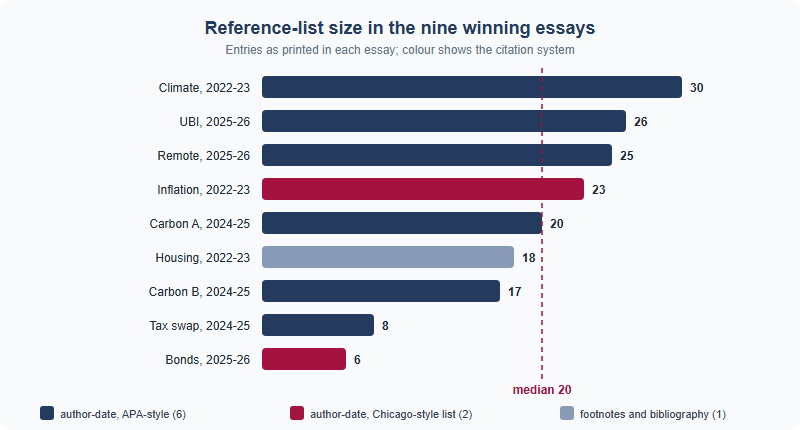
The practical reading is that surface features are not the pattern. A student who adds a chart because “winners use charts” is copying something a third of the winners did without. A student who makes sure the strongest objection is answered is copying something all nine did. And if the 2026-27 rules name a citation style, follow the rules rather than the sample: HUEA’s competition page had not stated one for the coming cycle when we checked.
What the winner biographies add: the cross-check
For 2024-25 and 2025-26, HUEA’s results pages also carry short winner biographies — five in all, since one winner has none. They are worth reading for what they show about how a result sits inside a profile. Four describe students in their junior year, the US equivalent of Grade 11, and one a sophomore in Grade 10; none was in the final year of school. All five describe earlier work in economics, business or policy, from research projects and competitions to writing for a school newspaper, and two say directly that this earlier work led to the subject of the essay. One name on the 2024-25 finalist list also appears among the 2025-26 winners.
That pattern is what makes a result persuasive to the people who read it later. An admissions reader checks a competition line against the transcript, the activity list and the essays, and a result that grows out of work already visible elsewhere in a file corroborates the rest of it — each piece makes the others more believable. The biographies are also a reminder of how small the named group is. The last three results pages each name three winners, fifteen finalists (the 2023-24 finalist list includes that year’s winners) and fifteen Highly Commended entrants, from a contest HUEA describes as drawing hundreds of essays from dozens of countries each year. No result guarantees an outcome; the biographies simply show results that fit the profiles around them.
How to use the nine essays without imitating them
Read each essay twice. The first time, read it as its intended reader would. The second time, read it for decisions: where its position first appears, which parts of its prompt it chose to carry and which it treated briefly, what its strongest objection is and where that objection is answered, and what its policy section actually recommends. Write those decisions down in your own words. That record is the transferable part.
Do not reuse their sentences, borrow a structure wholesale or adopt their sources as a ready-made reading list; an essay assembled from someone else’s decisions reads as exactly that, and reusing another writer’s wording is plagiarism under any academic standard. Nor should the features in the lower half of the matrix be treated as requirements. For what the contest itself asks, start with our overview of HIEEC; for turning these lessons into a draft of your own, our guide to structuring the 1,500-word essay is the next step.
Frequently asked questions
Where can I read the HIEEC winning essays?
HUEA links them from its results pages on thehuea.org. When we checked, nine essays were posted for 2022-23, 2024-25 and 2025-26.
Do HIEEC winning essays use charts?
Six of the nine did and three did not. One 2024-25 carbon tax winner used five figures, and another on the same prompt used none.
How many sources did the winning essays cite?
Reference lists ran from 6 to 30 entries, with a median of 20. Two of the nine winners listed fewer than ten sources.
Were the winners all in their final year of school?
No. The five winner biographies HUEA published describe four Grade 11 students and one Grade 10 student.
This is an independent guide operated by Hanlin Education for China-based international-school students. We are not affiliated with, endorsed by, or sponsored by HUEA (the Harvard Undergraduate Economics Association), the Harvard College Economics Review, or Harvard University. Essay features, counts and classifications are our own reading of the PDFs HUEA publishes; we do not reproduce the essays. Rules, prompts, deadlines and recognition are set by the organisers and change each cycle — confirm current details on thehuea.org. Factual corrections are made within 7 working days.