HIEEC’s published rules are short on this point: the essay must be written only by the entrant, and any outside assistance must be declared at the beginning or end of the essay. Plagiarism means disqualification. What the rules do not do is tell you where a teacher’s comment ends and someone else’s essay begins. This guide draws that line.
What the rule actually says — and what it does not
Start from what is verifiable on thehuea.org rather than from what other competitions do. For the 2025-26 cycle, the entry rules established the following:
- The essay must be written only by the entrant, and any outside assistance must be declared at the beginning or the end of the essay.
- Plagiarism leads to disqualification. References must be included, in Chicago or APA format.
- One essay per person — only your first submission is read; later files are not.
- The word limit is 1,500, strictly applied, with anything beyond it truncated. That limit excludes references, footnotes, titles, headers and footers.
- Submissions are PDF only, entry is open to grades 9-12, and the reading fee was USD 20 for US applicants and USD 30 for international applicants.
- Judging runs in two tiers: the HUEA board reads the field, and the top ten are adjudicated by a Harvard economics professor.
Notice what is absent. The rules do not itemise categories of helper. They do not define “assistance.” They do not supply a declaration template, and they do not state whether your declaration sentence sits inside or outside the 1,500 words. Cycle details also move — the submission cap has changed between years and other details can change too — so confirm the current wording on thehuea.org before you rely on any of it. If you are new to the competition, our complete guide to what HIEEC is sets out the rest of the format.
Because the rule is a principle rather than a checklist, you need a working standard you can apply to a specific draft on a specific Tuesday. That is what the rest of this article builds.
The help ladder: five tiers, from routine to disqualifying
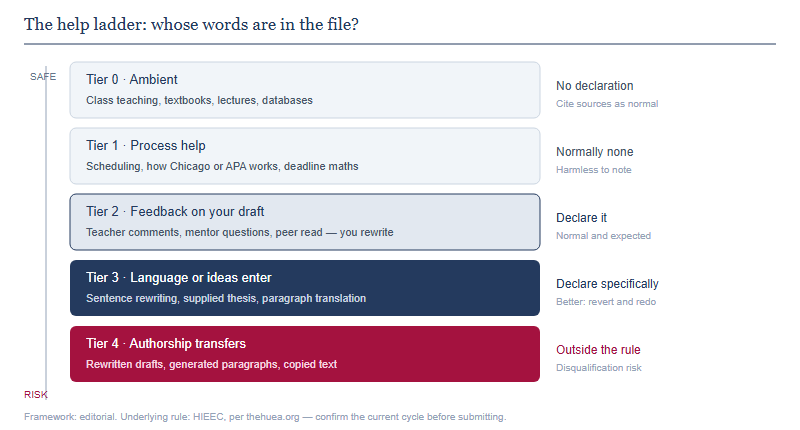
The useful question is not “did anyone help me?” — almost every serious entrant talks to someone. The useful question is whose words and whose ideas ended up in the file. Sort every interaction into one of five tiers.
| Tier | What it looks like | Whose work is in the file | Declare? |
|---|---|---|---|
| 0 — Ambient | Class teaching, a textbook, a podcast, a lecture series, a library database | Yours, informed by public knowledge | No (but cite sources) |
| 1 — Process | Someone helps you plan a schedule, explains how Chicago style works, or tells you the deadline maths | Yours | Not normally needed |
| 2 — Feedback on your draft | A teacher writes “this paragraph does not follow”; a mentor asks what your mechanism is; a friend flags a confusing page | Yours — you did the rewriting | Yes — declare it |
| 3 — Language or ideas enter | Line-editing that rewrites your sentences; a tutor supplies the thesis; someone translates your Chinese paragraphs into English | Partly not yours | Yes, specifically — and consider reverting |
| 4 — Authorship transfers | An agency or tutor returns rewritten text; undisclosed machine-generated paragraphs; copied source text | Not yours | Outside the rule — disqualification risk |
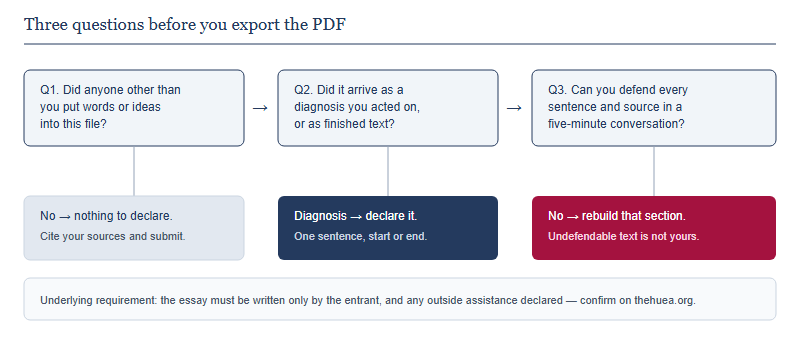
Two questions settle almost every borderline case. First: did the improvement arrive as a diagnosis or as finished text? “Your second section assumes the elasticity you need to prove” is a diagnosis; a rewritten second section is finished text. Second: could you defend every sentence and every source in a five-minute conversation with an economist? If a paragraph would collapse under one follow-up question, it is not yours yet, whoever typed it.
Generative AI: what we can verify, and a rule that holds either way
Be careful here, because the internet is full of confident claims about what this competition permits. The entry rules we were able to verify on thehuea.org set out the authorship and declaration requirements above; we could not verify a separate clause naming generative AI. Check the current cycle’s rules page yourself before you submit — organisers add and revise integrity language between years, and a rule published after this article is the one that binds you.
What matters is that you do not need an AI-specific clause to know where you stand. Two verified rules already do the work: the essay must be written only by the entrant, and outside assistance must be declared. Any tool that produces sentences or supplies arguments is doing something the rules already address. That gives you a usable band system:
- Low risk: looking up what a term means, checking a definition, translating a single word, a spell-checker that flags without rewriting.
- High risk: a tool that rewrites your sentences, restructures your paragraphs, or “polishes” your prose. That is language authorship, and the language is meant to be yours.
- Out: generating arguments, paragraphs, outlines you then fill, or citations.
The citation point deserves its own warning. Language models invent plausible-looking references — real-sounding authors, real-sounding journals, page numbers that do not exist. Under a rule set that requires references and treats plagiarism as grounds for disqualification, submitting a source you never opened is an unforced catastrophe. Every reference in your bibliography should be a document you have opened and read. That single habit protects you.
There is also a competitive argument. The first tier of judging is a board-level screen across a large field — the 2025-26 cycle capped submissions at 600. Machine-smoothed prose is uniformly competent and completely anonymous. What survives a fast read is a specific voice making a specific claim, which is exactly what generic polish removes.
How to write the declaration (and where to put it)
The rules permit the declaration at the beginning or the end of the essay. Put it at the end, immediately before your references. Your opening is the most valuable real estate in a 1,500-word essay and should not be spent on administration — see our guide to structuring the 1,500-word essay for how tight that budget really is.
On length: the published limit excludes references, footnotes, titles, headers and footers. A declaration line is not named in that list, so the conservative reading is that it counts. Keep it to one or two sentences of roughly 20-30 words and budget for it inside your 1,500. If you need certainty, ask the organiser through the contact route on thehuea.org.
A good declaration is specific about the role and the kind of input, and it makes an affirmative statement about what is yours. Three patterns you can adapt:
- Teacher feedback: “Acknowledgement: my school economics teacher read one draft and commented on the structure of the argument. The research, argument and writing are my own.”
- Paid tutor or programme: “Acknowledgement: I discussed the essay plan with a private economics tutor, who asked questions about my mechanism. All drafting and revision are my own.”
- Language help: “Acknowledgement: a family member proofread the final draft for grammar. I wrote and revised all sentences myself.”
Weak declarations do two things wrong. They are vague (“I received some help with this essay”), which reads as concealment; or they are ceremonial (“thanks to everyone who supported me”), which declares nothing. Name the role, name the input, state what is yours.
Three grey zones China-based entrants hit most
In the drafts we read from international schools in China, the same three situations generate almost all of the genuine uncertainty.
The tutoring package. Paid preparation is normal and, at tier 2, entirely compatible with the rules. The failure mode is a service that returns a rewritten document. The line is simple and worth writing on the inside of your notebook: a programme that makes you rewrite is coaching; a programme that returns your essay rewritten has written part of your essay. If you receive a marked-up file, do not accept tracked changes wholesale — read each comment, close the file, and redraft the paragraph yourself.
Drafting in Chinese, then translating. The ideas are unambiguously yours, which is why this feels safe. But if a person or a tool produced the English sentences, the English sentences are not authored by you — and English is the medium being judged. The safer workflow is to outline in Chinese if that is how you think, then draft in English from the outline, using bilingual lookup at the level of individual terms rather than whole paragraphs.
Reusing your own school work. Two separate rule sets apply and only one of them is HIEEC’s. The competition rules we could verify address assistance and plagiarism; they are not the authority on whether your school, the IB or the College Board permits you to reuse work submitted for assessment. Ask your coordinator or teacher, and confirm the competition side on thehuea.org. If an EE supervisor shaped the argument you are carrying across, that is assistance and belongs in your declaration.
Build a paper trail before you need one
The strongest protection is boring and takes two minutes a week. Draft in a system that keeps version history — Google Docs or Word both do — so the record shows an argument developing rather than appearing. Keep a dated source log with the URL or shelf mark and the date you read each item. Keep the feedback file your teacher annotated, unedited, in the same folder. Save the outline you wrote before the first draft.
The point is not paranoia. Two things follow from the habit. If a question about authorship ever arises, you can answer it in five minutes rather than five days. And more usefully, a visible revision history shows you what actually changed between drafts, which is the fastest diagnostic there is for whether your chosen prompt is producing real progress or just motion. Entrants who keep this record tend to write better essays for reasons that have nothing to do with integrity.
One closing note on timing. Only your first submission is read, so there is no revise-and-resubmit route: the version you upload is the version judged. Run your declaration check the day before you plan to submit, not in the final hour.
Frequently asked questions
Can my teacher read my HIEEC draft?
Yes. Feedback on your own draft is normal practice; the rules require you to declare outside assistance at the beginning or end of the essay.
Does the declaration count inside the 1,500 words?
The published limit excludes references, footnotes, titles, headers and footers. A declaration is not listed, so budget for it and keep it short.
Does HIEEC ban generative AI?
The rules we could verify require the essay be written only by the entrant with assistance declared; we found no separate AI clause. Confirm current wording on thehuea.org.
I submitted and forgot to declare — can I resend?
Only your first submission is read, so a second file will not replace it. Contact the organiser through thehuea.org rather than uploading again.
This is an independent guide operated by Hanlin Education for China-based international-school students. We are not affiliated with, endorsed by, or sponsored by HUEA, the Harvard College Economics Review, or Harvard University. Competition rules, fees and deadlines change between cycles — confirm current details on thehuea.org before you enter. Factual errors reported to our editorial desk are corrected within 7 working days.