When preparing for the Harvard International Economics Essay Competition (HIEEC), students often focus heavily on data collection and final conclusions. However, the structural integrity of an essay rests on its HIEEC Economic Models. A common pitfall is writing an assumption that seems reasonable at first glance but logically reverses or invalidates the conclusion when scrutinized. This article addresses that specific reasoning failure through two worked teaching illustrations, contrasting a successful model with one where the initial shortcut fails, followed by a practical diagnostic framework.
The Precision Problem in Model Assumptions
Distinguishing between broad preparation advice and this narrow technical skill is crucial. While general guides cover topic selection and structure, they rarely dissect the logical chain within a model. The difficulty lies in ensuring that every assumption holds true under the conditions required to reach your stated conclusion. If an assumption contradicts the mechanism you are describing, the entire argument collapses, regardless of how impressive the data looks. This is particularly important because How to Build an Original Economic Argument for HIEEC (Stop Writing the Obvious Answer), 2026 requires more than novel data—it demands that your assumptions and conclusions point in the same direction.
Teaching Illustration 1: The Successful Logical Chain
Consider a hypothetical essay analyzing the impact of a carbon tax on small manufacturing firms. The student assumes that these firms face low price elasticity of demand because their products are essential components in larger supply chains.
- Assumption: Demand for component parts is inelastic in the short run.
- Mechanism: Firms cannot easily switch suppliers due to certification requirements.
- Conclusion: Small manufacturers will absorb most of the tax cost rather than passing it to buyers.
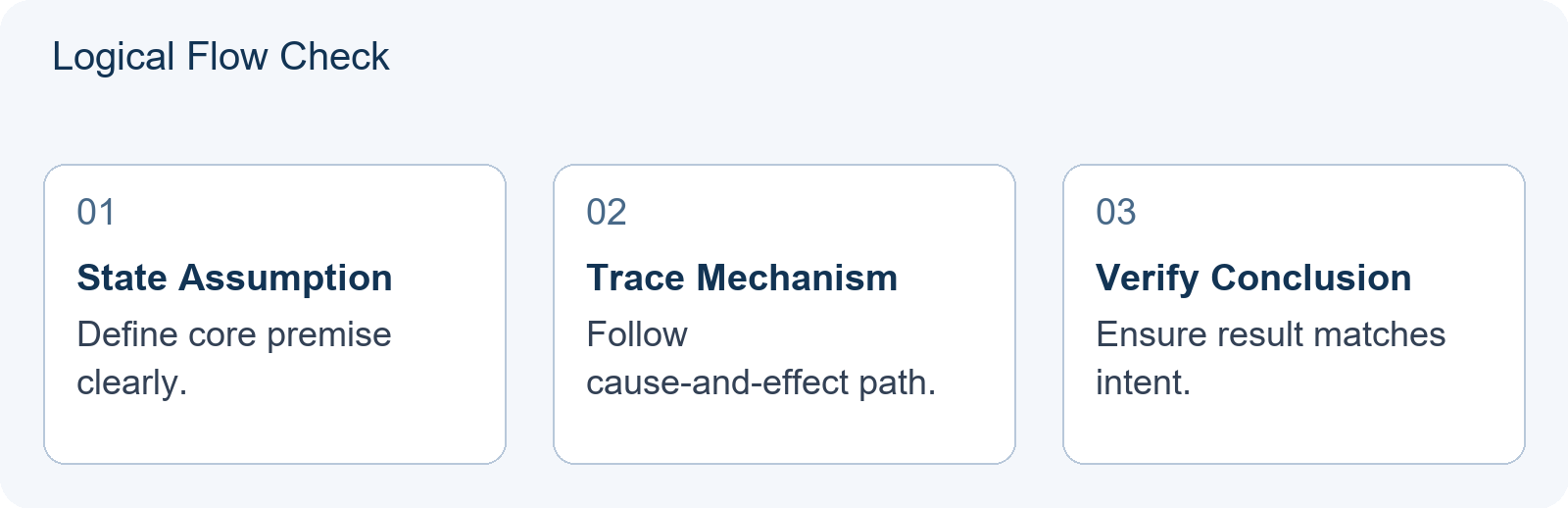
This chain works because the assumption (inelastic demand) directly supports the mechanism (inability to pass costs). The logic flows linearly without contradiction. When demand is inelastic, the burden of a tax falls disproportionately on the producer side, making the conclusion that manufacturers absorb costs economically coherent. The student has successfully aligned assumption, mechanism, and conclusion.
Teaching Illustration 2: The Reversing Assumption
Now, examine a second hypothetical case regarding minimum wage increases in the service sector. The student wants to argue that employment levels will remain stable despite higher wages.
- Assumption: Service businesses operate in a perfectly competitive market with zero barriers to entry.
- Mechanism: Firms can instantly adjust labor inputs based on marginal productivity.
- Conclusion: Employment remains unchanged because firms optimize efficiently.
Here, the assumption creates a hidden conflict. In a perfectly competitive market with instant adjustment, if the minimum wage exceeds the marginal revenue product of labor, firms must cut jobs to survive. The assumption of perfect competition actually strengthens the argument for job losses, reversing the intended conclusion of stability. The student failed to recognize that the rigor of the assumption undermined the desired outcome.
Why does this reversal occur? In perfect competition, firms are price takers with no market power. They cannot absorb higher costs by raising prices, because consumers would immediately switch to identical substitutes. Therefore, when the wage floor rises above the value of the marginal product of labor, the only rational response is to reduce employment until the remaining workers’ marginal product justifies the new wage. The assumption does not merely weaken the conclusion—it actively points to the opposite result.
Why Assumptions Reverse Conclusions: Three Cognitive Traps
Students rarely set out to contradict themselves. Three recurring cognitive patterns explain why reversing assumptions slip into drafts undetected.
Trap 1: The Prestige Assumption Fallacy. Because perfectly competitive markets, rational actors, and complete information are standard in introductory textbooks, students treat them as safe defaults. They forget that these assumptions carry predictive content. Invoking perfect competition is not neutral decoration; it activates a specific set of behavioral implications. When your conclusion requires firms to exercise pricing power or strategic patience, perfect competition becomes an active enemy of your argument.
Trap 2: The Time-Horizon Mismatch. An assumption valid in the short run may reverse your conclusion in the long run, and vice versa. Students often borrow assumptions from different time frames without adjusting the conclusion accordingly. A model assuming sticky prices and fixed capital commitments in the short run might support interventionist policy conclusions, but if the same conclusion is extended to a long-run analysis without revisiting the assumption, the argument collapses.
Trap 3: The Aggregation Shortcut. Assuming homogeneous agents where heterogeneity matters can reverse distributional conclusions. If your essay argues that a policy benefits workers generally, but your model assumes all workers have identical skill levels and outside options, you may miss that the policy harms a subset whose specific characteristics you have averaged away.
Diagnostic Table: Identifying Flawed Assumptions
To avoid this error, use the following diagnostic framework when reviewing your draft. This table helps isolate whether an assumption supports or sabotages your conclusion.
| Checklist Item | Question to Ask | Risk Indicator |
|---|---|---|
| Directional Consistency | Does the assumption push the variable in the same direction as my conclusion? | If the assumption implies high volatility but you conclude stability, check for reversal. |
| Time Horizon Match | Is the assumption valid for the specific time frame analyzed? | Short-run rigidities do not apply to long-run adjustments; mixing them causes errors. |
| Market Structure Fit | Do the assumed market conditions allow the proposed behavior? | Perfect competition assumptions contradict monopoly pricing strategies. |
Targeted Practice Sequence
Improving this skill requires deliberate practice rather than passive reading. Follow this sequence to strengthen your modeling capabilities:
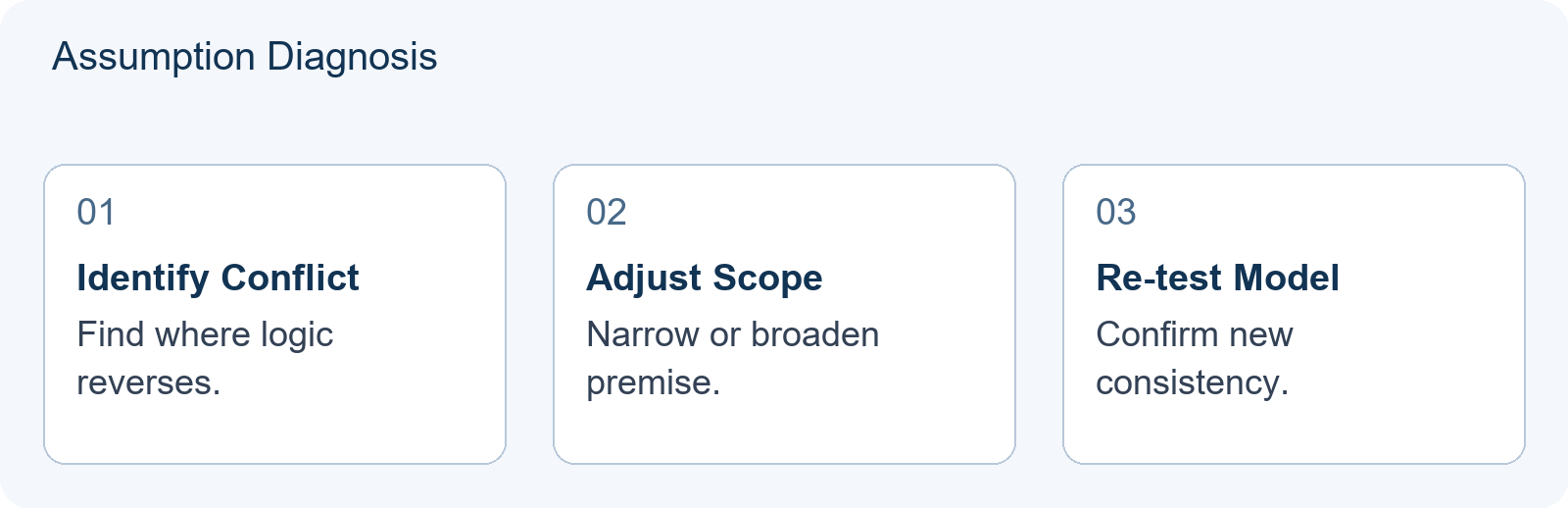
- Isolate the Core Assumption: Identify the single most critical assumption driving your model. Write it down separately from the rest of the text. If you cannot state it in one sentence, your model is underdeveloped.
- Stress Test the Logic: Ask “If this assumption is strictly true, what happens to the opposite of my conclusion?” If strict adherence to the assumption undermines your main point, the assumption is flawed. For example, if assuming perfect competition makes your stability conclusion impossible, you need a different market structure.
- Refine the Scope: Narrow the assumption to fit the conclusion. For example, change “perfectly competitive” to “monopolistically competitive” if you need to argue for brand loyalty effects that buffer employment changes. Alternatively, add a qualifier: “in the short run, before entry and exit can occur.”
For broader context on how these modeling choices fit within specific prompt categories, see our analysis of Writing the HIEEC Workforce and Education Prompt: Automation, Remote Work and Skills (2026-27), which applies similar logical discipline to automation and skills debates. You may also find useful What HIEEC Has Confirmed for 2026-27 (and Four Claims We Could Not Verify), which helps ground your assumptions in actual competition parameters rather than speculation.
Next Steps for Learners
A learner should be able to demonstrate the ability to rewrite a flawed assumption so that it aligns logically with the conclusion. This involves recognizing when a standard textbook assumption (like rational actors or perfect information) conflicts with the specific real-world scenario being analyzed. By mastering this alignment, you ensure that your HIEEC Economic Models are robust and defensible. The skill transfers beyond competition essays: it is the same discipline required in undergraduate economics when constructing formal models, and in policy analysis when evaluating whether theoretical predictions match institutional realities.
Frequently Asked Questions
What is the most common mistake in HIEEC economic models?
The most common mistake is using a standard assumption that logically contradicts the specific conclusion the student wishes to draw, such as assuming perfect competition while arguing for price-setting power.
How can I test if my assumption is flawed?
Ask yourself if the assumption makes the opposite of your conclusion more likely. If strict adherence to the assumption undermines your main point, the assumption needs refinement or replacement.
Does HIEEC require complex mathematical models?
No, HIEEC essays typically rely on logical economic reasoning and qualitative analysis. Clarity of assumption and logical consistency are valued over complex mathematical derivations.