This article was first published as a late-August 2026 pre-opening snapshot. The 2026-27 contest has since opened on 26 October 2026, with a 5 January 2027 deadline at 11:59 pm Eastern Time (6 January 2027 at 12:59 pm Beijing), five prescribed topics plus an own-question option, and results expected early to mid March 2027. The historical snapshot below records what was known before opening; current rules and prompts are on thehuea.org. Here is what is actually confirmed, and what to stop planning around.
Why the pre-opening snapshot was normal
Every year we re-read the HUEA contest pages at the end of August, because this is the point in the season when families start making decisions and the internet is at its least reliable. The pattern repeats: search results fill with confident, specific guides, and the official page is still in pre-opening state.
That was the position in late August 2026. The live HIEEC page then described the contest in outline — eligibility, approximate length, the shape of the calendar — and stated that the full 2026-27 rules and prompts would be posted when the contest opened in the autumn. January was presented as tentative rather than fixed.
That mattered for one practical reason. If you built a schedule then around a specific date, a specific word count and a specific fee, you were building it on last cycle’s rules, and last cycle’s rules are exactly the thing that changes. The point of this article is not to give you numbers. It is to show you which numbers are load-bearing and which are borrowed.
What the official page stated in the August 2026 pre-opening snapshot
The table below records what we could read on the live pages in late August 2026, before the contest opened. It is a pre-opening snapshot, not the current rule set; current verified details are in the opening update. “Confirmed” means the page then stated it. “Tentative” means the page itself flagged it as provisional. “Not yet stated” means the page was then silent for 2026-27, whatever earlier cycles did.
| Item | What the live page says | Status at that pre-opening snapshot |
|---|---|---|
| Who runs it | HUEA, a student-led Harvard undergraduate organisation working with the economics department | Confirmed |
| Eligibility | High-school students in grades 9–12, anywhere in the world | Confirmed |
| Length | Around 1,500 words | Confirmed in outline; exact rule pending |
| Prompts | A set of prompts, published in the autumn | Count and wording not yet stated |
| Submission deadline | January | Tentative on the page itself |
| Judging | Every entry read by the HUEA board; the strongest judged by a Harvard economics professor | Confirmed |
| Recognition | Finalists and Highly Commended recognised by name; winning essays published with the author's permission | Confirmed |
| Results timing | Spring | Confirmed in outline; no date |
| Reading fee | Not stated for the coming cycle on the page we reviewed | Not yet stated |
| Citation style, file format | Not stated for the coming cycle on the page we reviewed | Not yet stated |
Notice how much of the structure is confirmed and how little of the detail is. That split is useful: it tells you the process is stable and the parameters are not. You can prepare against a stable process. You cannot prepare against parameters you have invented.
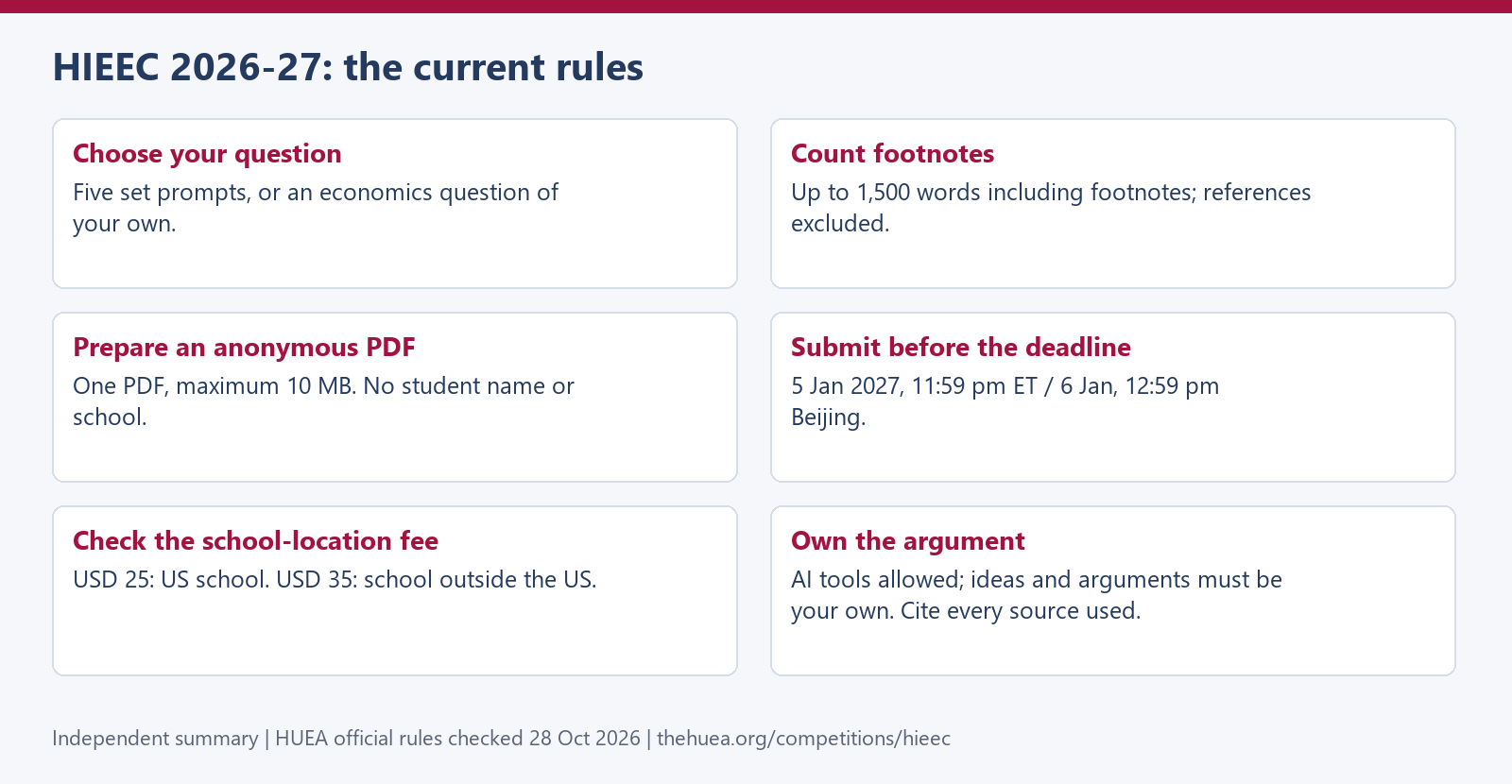
One change worth noticing. The 2026-27 rules now specify up to 1,500 words including footnotes and excluding references, so plan to that limit rather than to an “around” figure from an earlier page.
Read the live wording rather than a summary.
Four claims we could not verify in the August 2026 pre-opening snapshot
These circulate widely. We are not calling them false — several are plausible and may well be accurate for a past cycle. We are saying we could not confirm them on the official page, and that you should not let them drive a decision.
1. A cap of 200 entries. At the pre-opening snapshot, several guides stated that submissions were capped at 200. If true, a cap would change strategy: it would reward submitting early and punish waiting for the deadline. We could not verify a 200-entry cap for 2026-27, and the current rules do not state the old 600-entry cap. Do not act on an unverified cap; confirm any cap with HUEA.
2. A deadline extension in a past cycle. Some sources report that an earlier cycle's deadline moved from early January into late January. Extensions do happen, and if one is announced you will hear about it. What you must not do is plan for one. Working backwards from a hoped-for extension is how students end up submitting a first draft.
3. Specific past prompt wording, attributed to specific years. You will find quoted prompts labelled by cycle. We have never been able to verify those attributions against a primary source, and the archive of past results is the only place worth looking. Use quoted prompts to sense the territory the contest covers; do not draft an essay against wording that may be misremembered, paraphrased or invented.
4. Fees, citation style and format quoted as current. At the late-August 2026 pre-opening snapshot, none of these details was stated for 2026-27. The current rules now specify USD25 for a school in the USA and USD35 for a school outside the USA, and any standard consistent citation style. Budget for a fee, prepare your references properly, and confirm the specifics before you pay anything.
There is a general lesson here that outlasts this cycle. A guide site is rewarded for sounding definite; the organisers are rewarded for being accurate. When the two disagree, the organisers win — and that includes disagreeing with us. If you find that thehuea.org contradicts anything on this page, the official page is right and we want to know so we can correct it.
A five-minute check that saves a term
Do this the week the contest opens, and again before you submit. It is genuinely five minutes, and it is the difference between writing to the real rules and writing to a rumour.
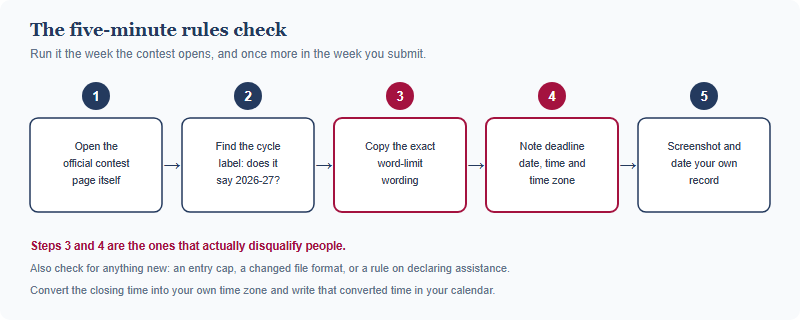
The time-zone step deserves its own emphasis for students in China. For 2026-27, the deadline of January 5 2027 at 11:59 pm Eastern Time is January 6 2027 at 12:59 pm Beijing. Convert once, write the converted moment in your calendar, and aim to submit a full day before it.
Pre-opening advice: what to do before the rules landed (August 2026)
At the pre-opening snapshot, the absence of published rules was not a reason to wait. Everything that actually determines essay quality is independent of the parameters.
- Read. The prompt areas move around but the territory is recognisable, and background reading is never wasted. Nothing in a rules page changes whether you understand how a policy instrument works.
- Practise compression. Take an 1,800-word piece of your own and cut it to 1,500 without losing the argument. This is the skill the limit tests, and it transfers whichever wording appears.
- Sort your referencing now. The 2026-27 rule allows any standard consistent citation style; decide on one and use it properly.
- Do not draft against a guessed prompt. This is the one genuinely wasteful move. A finished essay built on wording that turns out not to exist tempts you into forcing it to fit, and forced essays read exactly as forced.
- Diarise the check. In the pre-opening period, a reminder in early October to check the page was sensible; prompts have historically appeared in the autumn, and the 2026-27 prompts are now published.
If you are new to the contest, the process rather than the parameters is what you want to understand first — our overview of HIEEC and how it is judged covers that ground. Now that the 2026-27 prompts are published, the two decisions that follow immediately are which prompt actually suits your strengths and how to build the argument inside the word limit. Both were worth reading before the prompts landed, so that when they did you were choosing rather than panicking; the 2026-27 prompts are now published.
Frequently asked questions
Are the 2026-27 HIEEC prompts out yet?
Yes now. At the late-August 2026 snapshot they were not; the 2026-27 set has since been published with five prescribed topics plus an own-question option.
Is the deadline definitely 5 January?
Yes for 2026-27: 5 January 2027 at 11:59 pm Eastern Time, equivalent to 6 January 2027 at 12:59 pm Beijing, with no late entries.
Is there really a cap on entries?
The verified 2026-27 rules do not state the old 600-entry cap. Do not treat that as unlimited entries; confirm any cap with HUEA.
Should I write to 1,500 words or a bit over?
Write to 1,500 or just under, counting footnotes and excluding references. The 2026-27 limit is up to 1,500 words including footnotes.
This is an independent guide operated by Hanlin Education for China-based international-school students. We are not affiliated with, endorsed by, or sponsored by the Harvard Undergraduate Economics Association, the Harvard College Economics Review, or Harvard University. The historical sections record the official pages as read in late August 2026; the opening update and current-rule checklist reflect verified details as of 28 October 2026. Rules, dates, fees and prompts are set by the organisers and change each cycle — confirm current details on thehuea.org, which supersedes this page wherever the two differ. Factual corrections are made within 7 working days.