Your HIEEC introduction has one job: convince a reader who is skimming a large field of essays to keep going. In a strict 1,500 words you can spare roughly 150 to 200 for the opening, and those words should do four things — frame a genuine economic question, signal your angle, state a sharp thesis, and hint at your route. This guide shows how to write an opening that earns the read.
Why the Opening Decides Everything
A HIEEC judge may read many essays in one sitting, and the opening is where they decide how closely to read yours. That is not unfair; it is how any serious editor works. HIEEC is run by HUEA — the Harvard Undergraduate Economics Association, a student organisation rather than a Harvard University department — together with the Harvard College Economics Review, and the panel assesses a large field before a shortlist reaches faculty readers. A muddled first paragraph invites a skim; a crisp one buys a careful read.
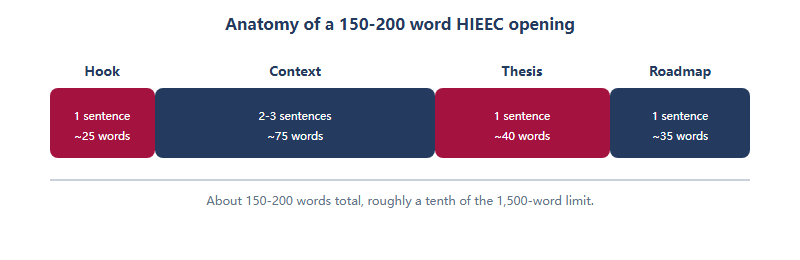
Because you are held to a strict 1,500 words — a limit that generally applies to the essay body, not the title, footnotes or references, though you should confirm the current rule on thehuea.org — the introduction is not free space. An opening of around 150 to 200 words is roughly a tenth of your budget, so every sentence has to justify its place. Before you draft a line, make sure you have chosen a question you can actually argue; our guide to choosing your HIEEC prompt walks through that decision, and a strong opening is far easier once the prompt genuinely fits your interests and evidence. For the wider rules, eligibility and format, see What Is HIEEC.
The Four Jobs of an HIEEC Opening
A strong economics opening is not one gesture but four small moves working together. Think of them as jobs to complete, not a rigid template — the proportions shift with your prompt and argument.
| Job | What it does | Rough share |
|---|---|---|
| Hook | Names a real tension, question or stake a reader cares about | ~1 sentence |
| Context | Frames the economic problem precisely and narrows the scope | 2–3 sentences |
| Thesis | States your arguable position in one clear sentence | 1 sentence |
| Roadmap | Signals the route your analysis will take | 1 sentence |
Notice what is missing: there is no space for a dictionary definition, a sweeping historical preamble, or a restatement of the prompt. In a 1,500-word essay those are luxuries you cannot afford. The opening should move from a specific problem to a specific claim in a handful of sentences.
It helps to see each job at work. The hook might name a puzzle a reader feels immediately — a policy that seems to backfire, or a market that behaves against intuition. The context then bounds it: which country, which period, which mechanism, so the reader is not guessing at your scope. The thesis resolves the tension with a claim, and the roadmap signals the order in which you will defend it. Done well, a judge finishes your opening already able to summarise your argument in a single sentence — which is exactly where you want them.
Write a Thesis, Not a Topic
The single most common way an opening fails is that it announces a topic instead of taking a position. “This essay examines the effects of minimum wages” is a topic; it commits to nothing and could sit atop a hundred different essays. A thesis, by contrast, is arguable, specific, and falsifiable: it tells the judge what you will try to prove and implies why a reasonable person might disagree.
Compare two illustrative framings (invented here for teaching, not drawn from any HIEEC prompt). Weak: “I will discuss whether carbon taxes are a good idea.” Stronger: “A carbon tax is more effective than subsidies at cutting emissions in the short run, but its distributional costs make revenue recycling essential to its political survival.” The second version has a claim, a mechanism, and a tension — three things an economics reader can grade. Your body then earns that claim with theory and evidence. If you are unsure how to translate a thesis into a full 1,500-word structure, our companion piece on writing the 1,500-word essay shows how the paragraphs should carry the argument forward.
Tightening a topic into a thesis is a repeatable move. Start with the topic (“minimum wages and employment”). Add a position (“modest minimum-wage rises need not cost jobs”). Add a mechanism that shows economic thinking (“because in imperfectly competitive labour markets, firms hold wage-setting power”). Add a limit that pre-empts the obvious objection (“though the effect likely reverses once rises outpace productivity”). Each addition makes the sentence more contestable, more precise, and more clearly yours — the three qualities a judge rewards.
A useful test: can someone intelligently disagree with your thesis sentence? If not, it is probably a description, and descriptions do not win essay competitions. Sharpen it until it stakes a defensible position.
Openings That Work vs Openings That Stall
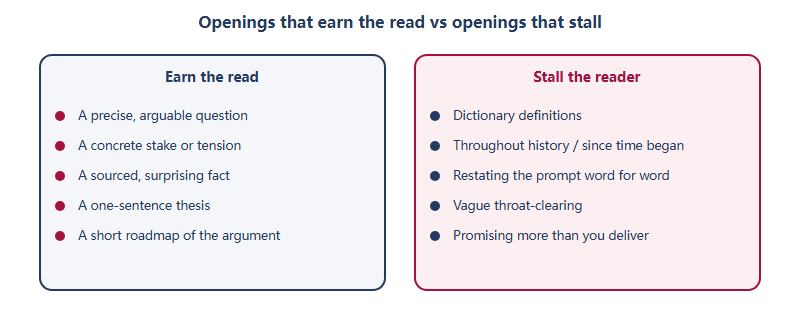
Certain opening moves reliably pull a reader in, and certain clichés reliably push them away. The good moves share one quality: they get to something concrete fast. The weak ones share the opposite: they delay the substance with warm-up.
- The sharp question. Pose the precise economic puzzle your essay resolves — not a vague “what is the role of markets?” but a bounded, answerable one.
- The concrete stake. Show why the answer matters to real people or policy, in one grounded sentence rather than grand abstraction.
- The surprising, sourced fact. A well-chosen statistic can open well — but only if it is verified and cited; never invent a figure to sound impressive.
Against those, the stalls are familiar: the dictionary definition (“Economics is the study of…”), the cosmic preamble (“Throughout human history…”), the prompt restated word for word, and the vague throat-clearing that circles the topic without landing on it. Each burns words you needed for analysis.
Write the Introduction Last
Here is the counter-intuitive part: the best openings are usually written after the body, not before it. When you draft the introduction first, you are promising an argument you have not yet built — and the essay that follows rarely matches the promise. Once the body is finished and you know exactly what you proved, you can go back and craft an opening that fits the delivered essay to the word.
A practical routine: write a rough “working thesis” to keep you on track while drafting, then throw it away and write the real opening at the end. Read your last paragraph and your first paragraph back to back — they should feel like two ends of the same argument. If the conclusion has drifted from the introduction, it is the introduction that should change, because the body is where the thinking actually happened. This final pass is also the moment to check that your opening still fits inside the word budget once footnotes and references are set aside; confirm the exact word-count rule for your cycle on thehuea.org.
One more discipline pays off here: read your opening aloud. Economics writing tempts students into dense, clause-heavy sentences, and the introduction is the worst place for them. If you run out of breath or lose the thread while speaking a sentence, a tired judge will too. Short, load-bearing sentences at the start earn trust; you can allow more complexity once the reader is committed to your argument.
A Quick Opening Self-Check
Before you lock your introduction, run it against five questions. If you can answer yes to all five, your first 200 words are doing their job.
- Does the first sentence land on something specific, not a definition or a platitude?
- Is there a single, arguable thesis a reader could dispute?
- Would a busy judge understand your position without reading further?
- Have you cut every word that only restates the prompt?
- Does the opening promise exactly what the essay delivers — no more, no less?
How long should an HIEEC introduction be?
There is no fixed rule, but roughly 150 to 200 words, about a tenth of your 1,500, lets you hook, frame and state a thesis without crowding the analysis.
Should I state my thesis in the introduction?
Yes. A clear, arguable thesis near the end of your opening tells the judge exactly what you will prove and makes the whole essay easier to follow.
Can I start with a quotation or a definition?
Usually avoid it. Dictionary definitions and generic quotations waste words; a precise question or a concrete, sourced fact works far harder in an economics essay.
Should I write the introduction first?
Often it is easier to draft it last, once your argument is settled, then revise it so it promises exactly what the essay delivers.
This is an independent guide operated by Hanlin Education for China-based international-school students. It is not affiliated with, endorsed by, or sponsored by HUEA, the Harvard College Economics Review, or Harvard University. Competition details change each cycle, so always confirm current rules, dates and fees on thehuea.org. If you spot an error, we correct verified mistakes within 7 working days.