HIEEC gives you 1,500 words and a reader moving at speed through a large field. If English is your second language, the thing that costs you marks is almost never a grammar error a reader can forgive — it is clear thinking arriving in cloudy sentences. This guide works at the sentence level: six patterns to fix, a verb ladder, and a twenty-minute routine.
Why sentence-level English matters even when it is not a criterion
Be precise about what we can and cannot verify here. The HIEEC rules published on thehuea.org set out the format — 1,500 words strictly applied, one of four prompts, Chicago or APA referencing, PDF submission, grades 9-12 — and describe judging in two tiers, with the HUEA board reading the field and the top ten adjudicated by a Harvard economics professor. We could not verify a published language-proficiency criterion, and you should not assume one exists. Confirm the current cycle’s rules yourself.
Clarity still decides outcomes, for a structural reason rather than a scoring one. The first tier is a board-level screen across a large field — the 2025-26 cycle capped submissions at 600. Under those conditions a sentence your reader has to read twice spends your word budget twice. You paid 24 words for that sentence; the second pass costs another 24 in attention you will not get back. Across a 1,500-word essay, twenty such sentences are the difference between an argument that lands and an argument that has to be excavated.
Note what this is not about. It is not about sounding like a native speaker, and it is emphatically not about sounding sophisticated. Economists writing well write plainly. Precision beats ornament every time, and ornament is the expensive habit that good ESL writers pick up from trying too hard.
Six patterns that cost the most
In the drafts we read from international schools in China, the same six habits account for most of the friction — and, usefully, for a large share of the words students are struggling to cut. Fixing them is the cheapest 150 words you will ever save.
| Pattern | Before | After | Words saved |
|---|---|---|---|
| 1. The long run-up Opening with background before the subject arrives |
“With the rapid development of financial technology, more and more investors are turning to tokenised bonds.” | “Investors are moving into tokenised bonds.” | 10 |
| 2. Nominalisation Turning a verb into a noun, then propping it up |
“The implementation of a carbon tax leads to a reduction in emissions.” | “A carbon tax reduces emissions.” | 7 |
| 3. Abstract subject, weak verb “This phenomenon”, “this situation”, “it” |
“This phenomenon has a great influence on the labour market.” | “Remote work reallocates hiring toward lower-cost cities.” | 2, and it names the actor |
| 4. The dangling topic Announcing a subject instead of asserting about it |
“As for the effect on inequality, it is significant.” | “Inequality widens under this policy.” | 4 |
| 5. Stacked hedges Three qualifiers doing one qualifier’s job |
“This may possibly to some extent tend to increase wages.” | “This may raise wages.” | 6 |
| 6. The “and” chain Four clauses joined without logic |
“The tax raises costs and firms lose competitiveness and some relocate production and this affects employment.” | “The tax raises costs, so some firms relocate production — and local employment falls.” | 3, and the causal chain becomes visible |
Pattern 5 deserves a second look, because it is the one strong students defend. Hedging is correct behaviour in economics: you should not claim more than your evidence supports. But hedges do not stack. One qualifier per claim, chosen deliberately, reads as discipline; three in a row read as a writer who has not decided what they believe. If you genuinely cannot decide, that is a signal about the claim, not about the sentence.
Verb precision: the highest-leverage word in every sentence
Most of what separates fluent economics prose from correct-but-flat prose lives in one part of speech. A vague verb forces you to add words around it to recover the meaning you did not put in the verb. A precise verb carries direction and mechanism at once, and the surrounding words disappear.
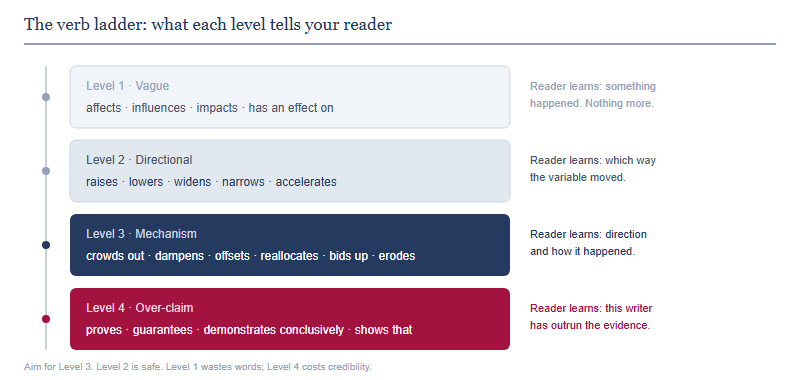
Two rules go with the ladder. First, match the verb to the strength of your evidence: a correlation in one dataset supports “is associated with”, not “causes”, and no amount of confident phrasing repairs the gap. Second, keep one term per concept. English composition teachers encourage elegant variation — calling the same thing a “levy”, then a “charge”, then an “impost”. In economics that is a defect. If you switch words, an economist assumes you switched concepts and starts looking for the distinction you meant. Pick “carbon tax” and use it eleven times.
Three sentence shapes that carry an argument
You do not need syntactic variety for its own sake. You need three shapes, used deliberately, which between them do almost all the work in an economics essay:
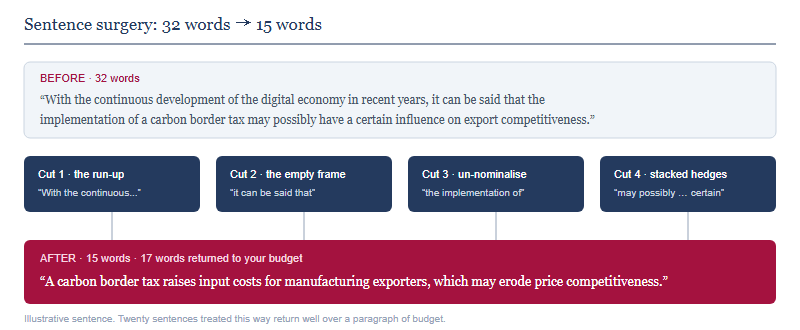
- Claim then mechanism. “A carbon border tax raises input costs for exporters, because compliance costs are passed through to intermediate goods.” The reader gets the assertion and the reason in one breath.
- Contrast with the standard case. “The textbook result assumes firms can relocate freely; in an economy where land use is administratively allocated, they cannot.” This is where original thinking usually shows up, and it needs the two-clause shape to be visible.
- Evidence attached to claim. “Firms in the affected sector cut output over the following two years, according to [source].” Source, movement and timeframe in one sentence, with the citation carrying the verification burden.
Around those, hold two paragraph disciplines. One claim per paragraph, stated in the first sentence — a reader skimming your topic sentences should be able to reconstruct your argument. And keep paragraphs under about 140 words: in a 1,500-word essay, a 200-word paragraph is more than an eighth of the whole submission spent before the reader gets a structural signal. Average sentence length of roughly 18 to 22 words, with deliberate variation, reads as controlled without reading as choppy. Our guide to structuring the 1,500-word essay sets the block-level budget these paragraphs sit inside.
A twenty-minute proofing routine
Do this once on a near-final draft, with a timer. The time boxes matter: they stop you drifting back into rewriting the argument, which is a different job done at a different stage.
- 0-4 min · Read aloud. Mark every place you stumble, hesitate or run out of breath. Do not fix anything yet. Stumbling is the most reliable detector you own, and it works in a second language.
- 4-9 min · Repair the stumbles. Shortest possible fix. Usually you are splitting a sentence or deleting a clause, not rewording.
- 9-13 min · Verb pass. Search for “is”, “are”, “has”, “makes”, “influences”, “affects”. At each hit, ask whether a level-three verb exists. Replace where one does; leave it where one does not.
- 13-16 min · Connective pass. Check that each paragraph’s opening signals the logical move — because, however, by contrast, as a result. Delete decorative connectives (“moreover”, “furthermore”) that signal nothing.
- 16-19 min · Consistency pass. One term per concept. Consistent number formatting, consistent tense for describing evidence, consistent Chicago or APA citation style.
- 19-20 min · First and last. Read your opening sentence and your closing sentence together, with nothing in between. If they do not answer the same question, one of them is wrong.
After that, a human reader helps enormously — and is entirely normal. Just remember that HIEEC requires the essay to be written only by the entrant and any outside assistance to be declared at the beginning or end. Feedback that makes you rewrite is fine and declarable; a friend who rewrites your sentences has written some of your sentences.
Three tempting shortcuts to refuse
Thesaurus inflation. Replacing plain words with longer ones to sound academic reliably produces the opposite impression, because the substitute is rarely an exact synonym in the technical register. “Utilise” is not better than “use”. “Ameliorate” is not better than “improve”, and in an economics context it is vaguer.
Machine polishing. A tool that rewrites your sentences is authoring your language. Beyond the integrity question — the verified rules require the essay to be written only by the entrant, with assistance declared; confirm the current wording on thehuea.org — polished prose is uniform prose, and uniformity is invisible in a large field. The specific, slightly angular sentence in which a student says exactly what they mean is worth more than a smooth paragraph that could have come from anywhere.
Writing whole paragraphs in Chinese and translating them. The ideas are yours, but translated paragraphs carry Chinese sentence rhythm into English and the English is not authored by you. If you think best in Chinese, outline in Chinese and then draft in English from the outline, using bilingual lookup at the level of individual terms.
None of this is about talent. Sentence-level clarity is a checklist skill: six patterns, one verb ladder, three shapes, twenty minutes. Students who run the routine on three practice paragraphs before they start their real draft write markedly cleaner first drafts — which is worth far more than editing time, because you get to spend your remaining hours on the argument itself. If you are still deciding whether to enter, our complete guide to HIEEC covers the format and calendar.
Frequently asked questions
Will judges mark me down for non-native English?
We could not verify a published language criterion. Clarity still matters because a fast reader must follow you. Confirm the current rules on thehuea.org.
Can I ask a native-speaker friend to proofread?
Feedback on your own draft is normal. The rules require outside assistance to be declared at the beginning or end of your essay.
How long should my sentences be?
Aim for an 18-22 word average with variation, and split anything past about 35 words. Paragraphs under roughly 140 words.
Does British or American spelling matter?
The rules we could verify specify Chicago or APA referencing, not a spelling standard. Pick one convention and stay consistent throughout.
This is an independent guide operated by Hanlin Education for China-based international-school students. We are not affiliated with, endorsed by, or sponsored by HUEA, the Harvard College Economics Review, or Harvard University. Example sentences are illustrative and are not extracts from submitted essays; confirm current competition details on thehuea.org. Factual errors reported to our editorial desk are corrected within 7 working days.