Citing economics papers you have not read past the abstract is one of the most common weaknesses in competition essays, and it is visible to anyone who knows the literature. The fix is not reading more papers — it is reading three properly. Here is a 40-minute route through a working paper, how to read a results table without econometrics, and the five things a citable sentence must contain.
Why abstract-only citation fails in front of this particular audience
Under the process HIEEC has published, submissions are read first by the board of the Harvard Undergraduate Economics Association, and the strongest are then adjudicated by a Harvard economics professor. That is an unusually literate audience for a school-age competition. They have read the papers you are citing, or papers exactly like them, and they know what those papers actually claim.
An abstract states the headline. The paper states the conditions. A finding that holds for one country, one decade, one subgroup and one identification strategy becomes false when you write it as a universal law — and the gap between the two is precisely what a trained reader notices first. There is a further trap: authors routinely qualify or partly retract their headline in the conclusion. Cite the abstract and you may end up asserting something the paper itself declines to assert.
There is also a rules dimension. HIEEC states that essays must be written only by the entrant and that plagiarism leads to disqualification. Summarising a finding in your own words with a proper citation is ordinary scholarship. Reproducing an author's sentences, even with a citation attached, is not the same thing. Everything below assumes you are reading in order to restate, not to borrow.
The 40-minute route through a paper
You are not reading the paper the way its referees read it. You are extracting one usable, correctly-qualified finding. Read in this order, and skip the literature review and most of the mathematics on a first pass. That is triage, not laziness.
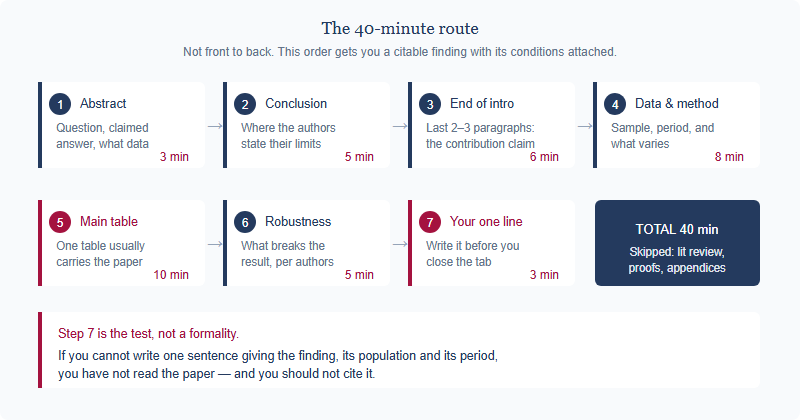
Two notes on the order. The conclusion comes second because authors are usually more candid there than in the introduction, where they are selling the contribution. And the data-and-method section comes before the results because a coefficient is meaningless until you know what variation produced it.
Reading a results table without econometrics
You do not need to have studied regression to extract a finding responsibly. You need to identify six things, in this order:
- The dependent variable — usually named at the top of each column. This is the outcome being explained. Read it carefully: “log employment” and “employment rate” are different outcomes and yield different sentences.
- The row you care about — the explanatory variable the paper is really about. Everything else in the table is usually a control.
- The sign — positive or negative. This is the direction of the relationship, and it is the one thing students almost never get wrong.
- The units — this is where most students do go wrong. Is the coefficient in percentage points, log points, standard deviations, or currency? A table note or the text will say. A number reported as “0.08” may mean eight percent, eight percentage points, or eight hundredths of a standard deviation, and those are wildly different claims.
- The sample — the observation count, and what an observation is: a person, a firm, a city-year, a country-decade.
- The number in parentheses — almost always a standard error, with asterisks marking statistical significance. This tells you how precisely the effect is estimated. It does not tell you whether the effect is large enough to matter.
That last distinction is worth a sentence in your essay if you can use it well. Statistical significance and economic significance are different questions: a very precisely estimated tiny effect is still a tiny effect. Writing “the effect is statistically robust but economically modest” — where the numbers support it — signals a level of reading most entrants never demonstrate.
One more habit: read across the columns. Papers typically add controls or tighten the specification column by column. If the coefficient stays roughly stable, the result is more credible. If it swings, the authors will normally discuss why, and that discussion is exactly the qualification you should be citing alongside the number.
Turning a finding into a sentence you can defend
A citable sentence has five slots. Miss any of them and you have written a slogan rather than evidence.
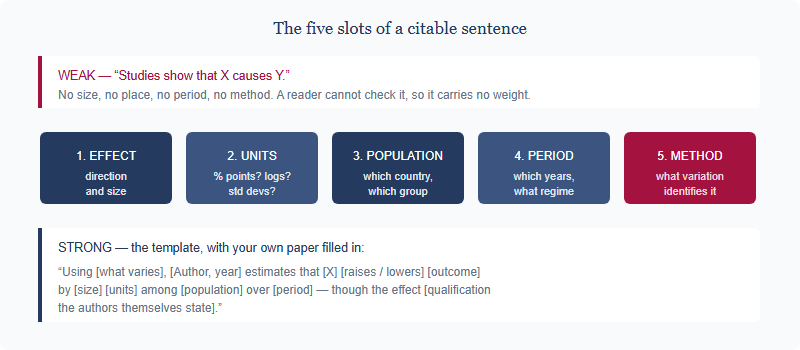
Three levels of engagement are available to you, and they are worth different amounts:
| Level | What it looks like | Words it costs | What it earns |
|---|---|---|---|
| Mention | “As [Author] argues, this is contested.” | 10–15 | Almost nothing. Reads as decoration, and an economist knows it |
| Use | The full five-slot sentence, supporting one specific step in your argument | 40–55 | Real evidential weight for the claim it sits under |
| Interrogate | Use it, then state the boundary condition and say whether it transfers to your case | 70–90 | The most marks per word available in the whole essay |
Interrogation looks like this in shape: the paper found an effect in one setting; your essay is about a different setting; you say explicitly what would have to be similar for the finding to carry across, and whether it is. That single move demonstrates that you understand what evidence is for, and it is almost impossible to fake without having read the paper.
How many papers can 1,500 words hold, and where to find them
Fewer than you think. The HIEEC word limit is strict, and in the most recent published cycle it excluded references and footnotes — so your bibliography is not the constraint, but the space to use a source is. On the arithmetic above, three to six sources is the realistic range, of which two or three should be papers you have genuinely read past the abstract. The rest can be data series or institutional publications.
Students routinely get this backwards, listing eight authors and developing none. A reader can tell within a paragraph which sources you have read, because read sources come with conditions attached and unread ones come with adjectives. If you are wondering how the rest of the word budget breaks down, our guide to structuring the 1,500-word essay sets out a full allocation.
Finding papers you can actually open. Paywalls are the usual obstacle for school students, and there are more ways around them legitimately than most people realise:
- The Journal of Economic Perspectives is free to read and is written deliberately for non-specialists by leading economists. For a competition essay it is probably the single best starting point in the discipline: each article surveys a field and points you at the primary literature.
- Working paper series — the IMF, World Bank, BIS and most central banks publish research openly, and NBER working papers are listed publicly though many readers are charged a small download fee. Note the honest caveat: a working paper has usually not been peer-reviewed. Say “working paper” when you cite one. Most entrants do not, and doing so quietly signals that you know the difference.
- VoxEU columns — short summaries written by the authors of the underlying papers, with links through. Useful for triage; cite the paper, not the column, unless the column is genuinely your source.
- RePEc / EconPapers and Google Scholar — use these to find an open version of a paper you have hit a paywall on. Authors very often post the accepted manuscript on their own university page.
- Official statistical agencies and international organisations for data, which is a different job from literature and should not be conflated with it.
Whatever you use, format the references in Chicago or APA as the rules require, and keep a running note of each source as you read rather than reconstructing citations at the end. If you are still choosing a topic, note that the availability of readable literature is a legitimate input to that decision — our guide to choosing a prompt by strength treats it as one.
Frequently asked questions
Is it acceptable to cite a working paper that is not peer-reviewed?
Yes, if you say so. Describe it as a working paper; the honesty reads as competence rather than weakness.
Can I cite a paper I only read the abstract of?
Technically yes, but it usually shows. Abstracts omit the conditions, and asserting an unconditioned finding is what marks an essay as unread.
How many sources should a 1,500-word HIEEC essay have?
Roughly three to six, with two or three genuinely read. Depth beats breadth when space is this tight.
Does summarising a paper in my own words count as plagiarism?
No — that is normal scholarship, provided you cite it. Reproducing the author's sentences is what the rules prohibit.
This is an independent guide operated by Hanlin Education for China-based international-school students. We are not affiliated with, endorsed by, or sponsored by the Harvard Undergraduate Economics Association, the Harvard College Economics Review, or Harvard University. Word limits, referencing requirements, entry rules and judging arrangements are set by the organisers and change each cycle — confirm current details on thehuea.org. Factual corrections are made within 7 working days.