In the most recent published cycle, HIEEC closed at 11:59 PM EST on 5 January. That single fact settles most of the argument for Grade 12 students: an essay submitted in January cannot produce a result before your applications close. Entering can still be worth it — but for reasons that have nothing to do with putting an award on a form.
Start with the arithmetic, not the ambition
HIEEC is open to students in grades 9 to 12, so a Grade 12 entry is entirely legitimate. The question is not eligibility; it is scheduling.
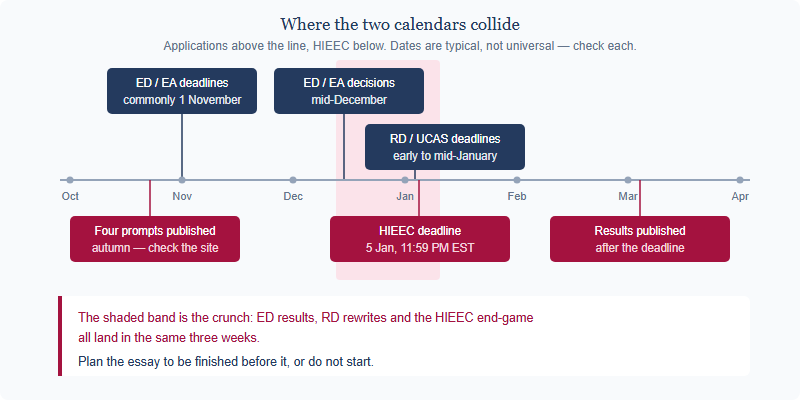
Work it through. The organisers publish four prompts in the autumn and close entries in early January — 5 January, 11:59 PM EST in the most recent cycle. Judging follows: the HUEA board reads the submissions, and the strongest are then adjudicated by a Harvard economics professor, after which the top three, a finalists list and a “Highly Commended” list are published online. All of that necessarily happens after the closing date.
Now overlay the application calendar. Early Decision and Early Action deadlines commonly fall around 1 November, with decisions in mid-December. Regular Decision deadlines commonly fall in the first half of January. UK applicants face a UCAS deadline in January; Hong Kong, Singapore and Australian systems have their own dates. Most of those close at or before the moment HIEEC stops accepting essays, and the few that fall just after it — UCAS and the mid-January Regular Decision dates — still come too soon for judging to have finished.
So the conclusion is arithmetic rather than opinion: for a Grade 12 entrant, the result almost certainly arrives too late to appear anywhere on the application. The official page we reviewed does not publish a results date, so do not plan around a specific one — but you do not need one. Nothing can be decided before the deadline, and the deadline is already past your own. Confirm the current cycle's dates on thehuea.org before you build any schedule around this.
What you can and cannot honestly claim
This is where students get into genuine trouble, so it is worth being precise.
You may truthfully report participation. If an activities section asks what you have done and you have written and submitted an essay to an international economics competition, that is a true statement about how you spend your time. Describe it as what it is: an entry.
You may not describe an unjudged entry as an award. “Finalist”, “Highly Commended” and “winner” are specific published distinctions. Claiming one you have not received is misrepresentation on an application, and universities treat that far more seriously than a thin activities list. If the result has not been published, you have no result.
The content, however, travels well. This is the real return for a Grade 12 entrant, and it is easy to underrate:
- Supplemental essays. A “why economics” or “describe an intellectual interest” prompt is answered far better by someone who has spent ten weeks arguing a specific economic question than by someone describing a general enthusiasm.
- Interviews. UK and Hong Kong applicants in particular face subject interviews after submission, sometimes months later. Having a defensible argument on a live policy question — including its weaknesses — is exactly the material those conversations run on.
- Writing samples, where a university invites one. Check each institution's policy; many do not accept unsolicited material, and sending it anyway is not neutral.
- Your own decision-making. Ten weeks of economics is a reasonable test of whether you want to study it for three or four years. Some students discover the answer is no, which is valuable information delivered cheaply.
What none of this does is improve an admissions outcome in any guaranteed way. Competitions are one small input among many, and anyone telling you otherwise is selling something. If you want the fuller treatment of what an entry does and does not signal, our overview of what HIEEC is and how it is judged sets out the process without the marketing.
The honest cost, in hours
A decision like this should be made against a realistic budget rather than an optimistic one. Here is what a competent entry actually costs, based on what we see with China-based cohorts each cycle:
| Stage | Realistic hours | When it has to happen | What goes wrong if it slips |
|---|---|---|---|
| Reading the four prompts, choosing one | 4–8 | Within a week of publication | Late choosers end up with the prompt they understand least |
| Background reading and sourcing | 8–12 | Autumn, before applications peak | Compressed reading produces an essay of assertions |
| Outline and first full draft | 8–10 | By late November | Drafting in the ED-results fortnight rarely finishes |
| Critique, revision, compression to 1,500 | 8–12 | December, ending mid-month | Compression done in the final 48 hours cuts argument, not padding |
| Formatting, references, declaration, submission | 2–3 | Well before the closing date | PDF-only formatting and fee payment are not last-hour tasks |
| Total | 30–45 hours | Spread across roughly ten weeks | Three to five hours a week — the same weeks as your applications |
For most Grade 12 students in China's international schools, November and December already carry mock examinations, IB internal deadlines, predicted grades and the emotional weather of early decisions. Three to five hours a week is affordable if it is planned. It is not affordable if it is discovered in late December.
Two tracks, depending on when you apply
The right schedule depends almost entirely on whether you have an early application in the system.
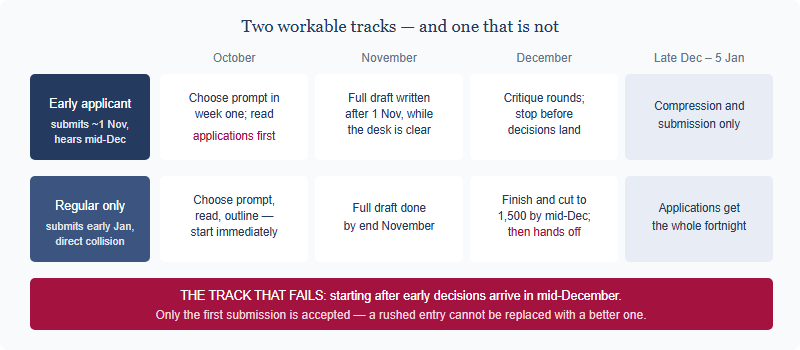
That last rule deserves emphasis, because it is a published condition rather than advice. HIEEC states that only your first submission is accepted and that further submissions will not be read. There is no revising after the fact, no swapping in a better version at 11pm on the fifth. Whatever you send is the entry.
Who should enter, and who should not
Enter if you intend to study economics and want the thinking, the interview material and the test of your own interest; if you face subject interviews later in the cycle; if you are applying in a system with later deadlines; or if you can genuinely start in the autumn rather than after early decisions. Entering because you find the question interesting is a perfectly good reason, and at this point in your school career it may be the most honest one available.
Skip it if your applications are not yet in good shape, if the only motive is a line on a CV — which, as the arithmetic shows, is the one motive that provably fails for a Grade 12 — or if you cannot commit the hours before the December crunch. There is no shame in this. An entry that consumes December and produces a weak 1,500 words is worse than no entry, and it costs a $20 or $30 reading fee depending on where you apply from.
One tempting shortcut deserves a warning. Reusing an Extended Essay or coursework piece looks efficient, but HIEEC requires that the essay not be entered in another competition or published elsewhere, and your own school will have rules on submitting the same work twice. Rebuild the research into a genuinely new 1,500-word argument rather than trimming an old one, declare any assistance as the rules require, and check both sets of rules before you rely on this route.
Finally, a note for anyone reading this in Grade 11: the timing argument runs the other way for you. An entry now produces a published result during the year in which you apply, which is the one scenario where the calendar cooperates. If that is you, the practical next steps are choosing well — see our guide to picking a prompt by strength — and then building the argument inside 1,500 words.
Frequently asked questions
Can Grade 12 students enter HIEEC?
Yes. The competition has been open to grades 9 to 12. The constraint is scheduling, not eligibility.
Will my HIEEC result arrive before university deadlines?
Almost certainly not. Entries closed on 5 January EST last cycle, so judging follows most application deadlines.
Can I list HIEEC on my application before results are out?
You can truthfully list participation. You cannot describe an unjudged entry as a finalist placing or an award.
Can I submit a revised version if I improve the essay?
No. The published rules state that only your first submission is accepted; later ones are not read.
This is an independent guide operated by Hanlin Education for China-based international-school students. We are not affiliated with, endorsed by, or sponsored by the Harvard Undergraduate Economics Association, the Harvard College Economics Review, or Harvard University. Deadlines, eligibility, fees and judging arrangements are set by the organisers and change each cycle, and university application dates are set by each institution — confirm current details on thehuea.org and with each university. Factual corrections are made within 7 working days.