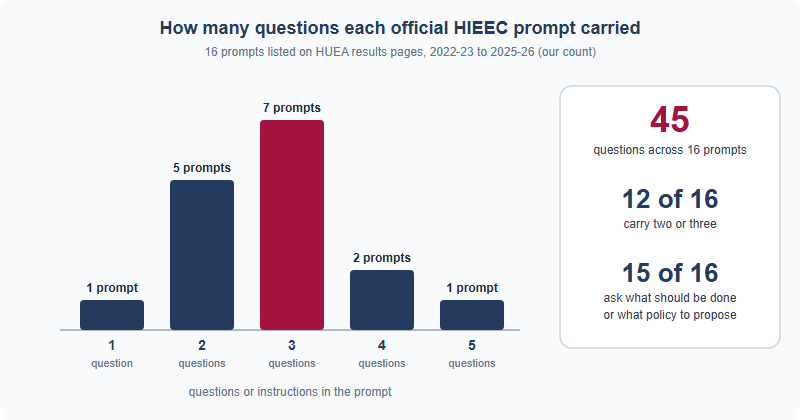
HIEEC prompts are bundles. The sixteen prompts HUEA lists on its results pages for the last four cycles contain 45 separate questions and instructions between them, and twelve contain two or three. HUEA’s pages currently state no rule on whether every part must be answered, but the wording usually tells you what is required, what is optional and what you must decide — if you read it as instructions rather than as a topic.
What we counted, and how
We took the prompts for 2022-23, 2023-24, 2024-25 and 2025-26 from HUEA’s own results pages. Those four pages are the only source we use for past wording, because prompts quoted on third-party sites are hard to trace. In each prompt we counted every sentence that either ends in a question mark or opens with an instruction such as analyse, evaluate, examine, assess, discuss, consider or propose, treating a sentence that only sets up a hypothetical scenario as context rather than as an ask. A different counting rule would move a few totals by one; it would not change the pattern.
| Cycle | Prompt, in our words | Asks | Wording worth noticing |
|---|---|---|---|
| 2025-26 | Environment: carbon offset markets as a route to lower emissions | 4 | A decision (prioritise direct cuts over offsets, or let both coexist); ends by asking you to propose policy |
| 2025-26 | Inequality: basic income or data dividends for technology-driven inequality | 3 | Two instruments to analyse (basic income or data dividends), with no recommendation asked; a list of income groups and countries |
| 2025-26 | Workforce & Education: long-run effects of remote and hybrid work | 3 | A three-item list; the role of governments and institutions |
| 2025-26 | Crypto/Finance: tokenised government bonds and blockchain public finance | 3 | A decision (wider access and transparency, or new systemic risk); how regulators should adapt |
| 2024-25 | Environment: carbon taxes compared with renewable subsidies | 2 | Context sentences describe two criticisms; the question asks for alternatives that address them |
| 2024-25 | Inequality: replacing income tax with a consumption tax | 4 | A floor (at least two groups, with examples); a yes-or-no recommendation |
| 2024-25 | Workforce & Education: education for an automated economy | 3 | A comparison (STEM versus soft skills); a floor (both policy and institutional levels) |
| 2024-25 | Crypto/Finance: digital currencies and central banks | 3 | A decision (regulate or embrace); a list of consumers, businesses and governments |
| 2023-24 | Artificial intelligence and inequality, the workforce and output | 2 | A three-item list; how nations can prepare |
| 2023-24 | Measuring economic activity: GDP, HDI, GNI and more | 2 | A five-item list; which measure you find most helpful |
| 2023-24 | Income redistribution, wealth taxes and basic income | 5 | A permission: discuss any of these issues, and expand beyond them |
| 2023-24 | US tariffs and investment limits on China | 2 | A list of firms, consumers and workers; suggestions for both countries |
| 2022-23 | Falling fertility and China’s growth | 3 | A permission: what, if anything, the government can do |
| 2022-23 | US housing affordability | 2 | A list of three kinds of actor; what can, or should, be done |
| 2022-23 | Economic growth and a healthy environment | 3 | Policies may be market-based or otherwise |
| 2022-23 | Central banks and inflation | 1 | One scaled decision: to what extent policies should differ or resemble one another |
Three findings matter more than the individual counts. Twelve of the sixteen prompts contain two or three asks, so a bundle is the norm, not the exception. Fifteen of the sixteen contain a normative question — what should be done, what to propose, whether to recommend — the one exception being the 2025-26 inequality prompt, which asked for analysis of trade-offs and responses without asking for a recommendation. And the grammar sets the task: a list can be a checklist in one prompt and a menu in another, and when a prompt does signal which, the signal is in the wording.
Five kinds of wording, and what each asks of you
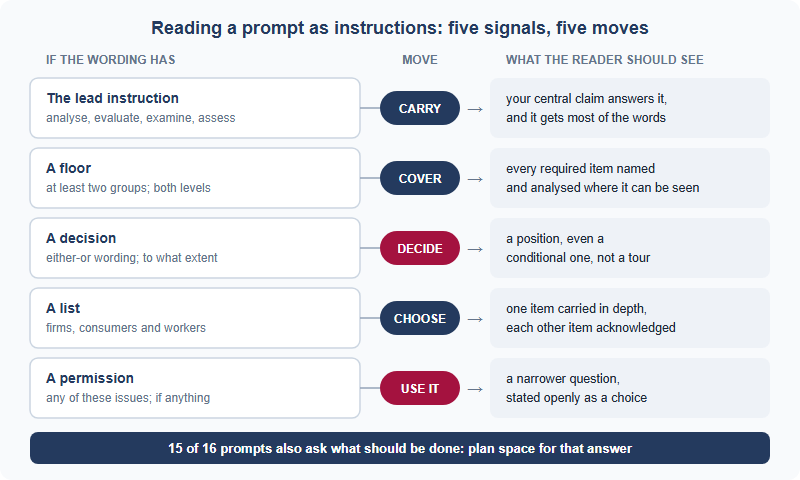
Read a prompt the way a lawyer reads a contract clause: not for its topic, which you already understand, but for its operative words. Five kinds recur across the sixteen.
- The lead instruction. Usually the first sentence after the context: analyse, evaluate, examine, assess. It is the spine of the essay, and your central claim should answer it directly.
- A floor. Wording that sets a minimum, such as at least two groups, or changes at both the policy and the institutional level — both from 2024-25 prompts. A floor is the one omission you cannot explain away, so meet it where the reader can see it.
- A permission. The 2023-24 redistribution prompt invited entrants to discuss any of its issues and to expand beyond them. A 2022-23 prompt asked what, if anything, a government could do, which permits the answer that it can do very little. Permissions license a narrower essay. Use them, and say that you are using them.
- A list. Firms, consumers and workers; productivity, urban inequality and educational priorities. A list may be a checklist or a menu, and most prompts do not say which. Our default is to carry one item in depth and give each of the others at least an explicit sentence, so that no reader concludes you missed it. When a list is introduced as examples, as the groups in the 2024-25 inequality prompt were, it is illustrative.
- A decision. Either-or wording — regulate or embrace, prioritise direct cuts or let both coexist — and scaled questions such as to what extent. These ask for a position, not a survey. A conditional position, one that holds only where a stated condition holds, is still a position. A tour of both sides that ends in “it depends” is not.
One more place to look: the context sentences before the first question. They can carry obligations of their own. The 2024-25 carbon-tax prompt described two criticisms of carbon taxes and then asked what alternatives could address the concerns raised, so an essay that never engages those criticisms has skipped half of what it was asked.
Carry, cover, decide: a ten-minute triage
Do this on paper the day the prompts appear, before you read a single source. HUEA’s competition page gives October–November as the tentative release window for 2026-27. Run the triage on every prompt, not just your favourite: a prompt whose floor you cannot meet, or whose decision you cannot take, is a prompt to avoid, which is the practical side of our prompt-choice test.
- Split and number. Break the prompt into its sentences, including the context before the first question.
- Tag each sentence. Lead, floor, permission, list, decision, normative question or context. Mark anything in the context that a later question refers back to.
- Assign a treatment. Carry the lead instruction, your side of any decision and your answer to the normative question: these get most of the words. Cover every floor and the list items you are not carrying, each with a clear paragraph or clear sentences. Park only what a permission lets you park, with a sentence saying so.
- State the scope once. One sentence early in the essay tells the reader which parts you carry. A reader who knows you set a question aside deliberately reads its absence as judgement, not oversight.
- Check before you submit. Every floor met, every decision taken, every parked item named once, and nothing carried that the prompt did not ask for.
What the published winners did with the bundle
HUEA posts winning essays alongside the prompts, and nine are currently linked from the 2022-23, 2024-25 and 2025-26 results pages. Read against their prompts, they suggest the triage above is close to what strong writers already do. We describe them without names.
- Lists used as structure. The 2022-23 housing winner organised its solutions around the actors the prompt named, taking the federal government, state and local governments, and individuals in turn. The 2022-23 climate winner gave its three main sections headings that follow the prompt’s three questions in order.
- Decisions taken, sometimes conditionally. The winner on the single to-what-extent prompt of 2022-23 set out a conditional position in its introduction. A 2024-25 winner answered the yes-or-no question about replacing income tax with a consumption tax by arguing for a blended design, and a 2025-26 winner, free to analyse basic income or data dividends, concentrated on basic income and concluded in its favour.
- Context answered. One 2024-25 winner on the carbon-tax prompt opened its analysis by working through the two criticisms described in the prompt’s context sentences.
- Coverage uneven, by design. The 2024-25 consumption-tax winner discussed several groups, well clear of the floor of two, while giving the prompt’s clause on relations with other nations comparatively little room. The 2025-26 remote-work winner announced three numbered topics of its own in the introduction and weighted them unequally.
None of this proves how judges weigh coverage. HUEA’s competition page publishes no scoring rubric, and nine essays are a small sample. What the sample does show is that winning essays did not give every question equal time, and that the parts they chose to carry were visible early.
Five ways to mishandle a bundle
- The equal-time survey. Four asks and about 1,500 words means roughly 375 words each: every part touched, none argued. The fix is the triage above.
- Answering the topic, not the question. An essay about carbon taxes in general, submitted to a prompt that asked for alternatives addressing two stated criticisms, is on topic and off task.
- Both sides of every decision. “Central banks should both regulate and embrace digital currencies” is not a position unless you say where one ends and the other begins.
- The missing answer to “should”. Fifteen of the sixteen prompts ask what should be done. Analysis that stops before that question leaves a gap every reader will notice, and a list of recommendations without the analysis that earns them leaves a worse one.
- Silent parking. Skipping a list item without a word reads as oversight. One sentence explaining why the essay concentrates elsewhere turns the same omission into a choice.
How the words then divide between the carried and covered parts is a question of structure, which our guide to writing the 1,500-word HIEEC essay works through. If you are new to the contest, our overview of HIEEC sets out what the organisers publish about eligibility, judging and recognition.
Frequently asked questions
Do I have to answer every question in an HIEEC prompt?
HUEA currently states no rule either way; check the 2026-27 rules on thehuea.org once they are posted. Meet any explicit floor, decide every either-or, and say which remaining parts your essay sets aside.
What should I do if a prompt says at least two groups?
Treat it as a floor. Two groups analysed properly beat five named in passing, but analysing only one group misses the instruction.
Should my headings follow the prompt questions?
It can work. One 2022-23 winning essay used headings that follow its prompt questions in order, but headings are a tool, not a rule.
Can I argue that little or nothing should be done?
Where the wording allows it, yes. One 2022-23 prompt asked what, if anything, a government could do, which invites that answer.
This is an independent guide operated by Hanlin Education for China-based international-school students. We are not affiliated with, endorsed by, or sponsored by HUEA (the Harvard Undergraduate Economics Association), the Harvard College Economics Review, or Harvard University. Past prompts are described from HUEA’s published results pages and the question counts are our own; 2026-27 prompts, word limits, deadlines and rules are set by the organisers — confirm current details on thehuea.org. Factual corrections are made within 7 working days.