You do not need a school economics course to enter the Harvard International Economics Essay Competition (HIEEC). What you do need is a clear picture of where your understanding sits today—so you can close the gap efficiently rather than enroll in a generic program that may not match your stage.
Use One Economic Question to Test Your Starting Point
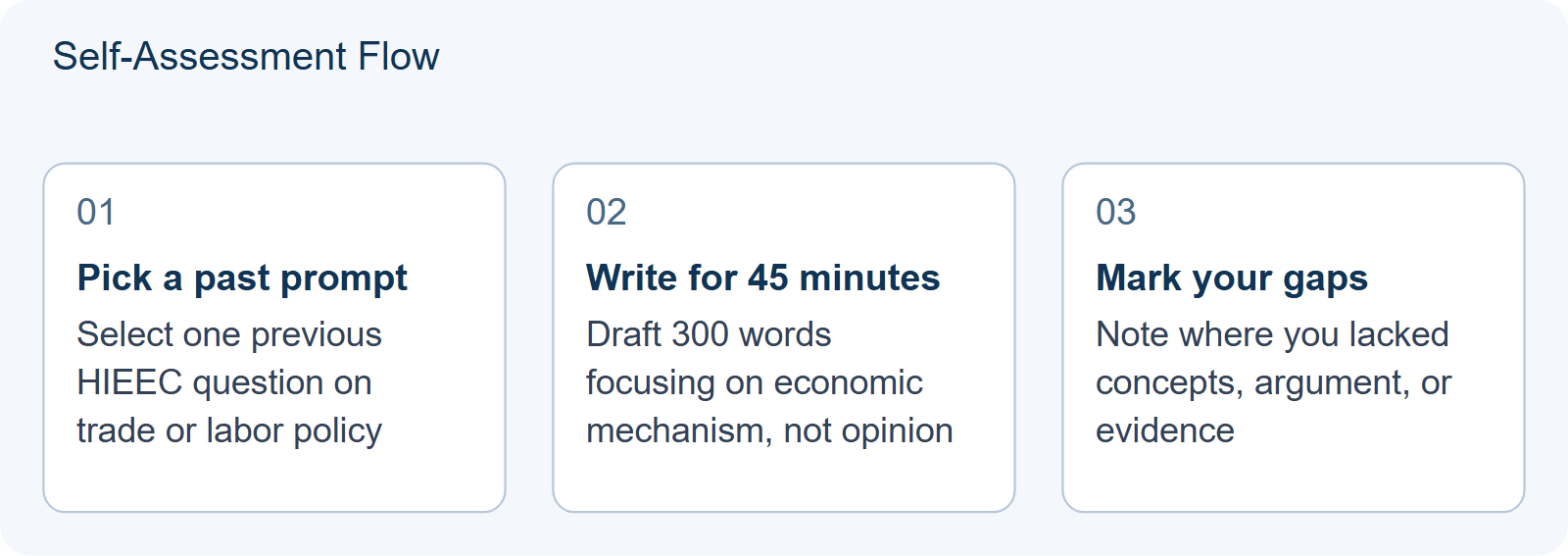
Before committing to any preparation path, try answering a past HIEEC prompt in writing—no more than 300 words, focusing on the economic mechanism. If you cannot identify which concepts apply, or you find yourself describing opinions rather than causal chains, that signal is more valuable than any diagnostic quiz.
A concrete self-test: take a prompt on trade policy or labor markets from a previous competition cycle. Write for 45 minutes. Then mark where you stopped to look up terms, where you switched to vague language, and where you lacked data to support the claim. Those three gaps—conceptual, argumentative, and evidentiary—define your starting line.
Separate Economic Concepts from Essay Organisation
Many students conflate “not knowing economics” with “not knowing how to write the essay.” These are different problems with different solutions.
| Gap type | Typical symptom | First response |
|---|---|---|
| Conceptual | Cannot define opportunity cost, externalities, or market failure in your own words | Foundational reading in micro/macro principles |
| Argumentative | Has opinions but no clear thesis with causal steps | Practice outlining with “because” chains |
| Evidentiary | Thesis exists but unsupported by data or academic sources | Curated reading list and source-note system |
| Structural | Ideas scattered, no progression from claim to implication | Essay organisation templates and feedback |
Knowing which cells apply to you prevents over-investment in the wrong area. A student with strong argumentative instincts but weak economics should not spend eight weeks on essay rhetoric. Conversely, a student who understands supply and demand but cannot structure a thesis needs organisational practice, not another textbook.
What to Read Before Requesting Coaching
If you are self-taught or homeschooled, your reading list should build conceptual scaffolding before evergreens. Consider this sequence:
- Principles-level foundation: A standard introductory economics text covering incentives, markets, market failure, and basic macro aggregates. The goal is not mastery but recognition—when you see a prompt, you should know which conceptual territory you are in.
- Policy-facing journalism: Publications like The Economist or Financial Times demonstrate how economists frame live debates. Pay attention to how authors move from data to claim to implication.
- Academic source literacy: Practice reading NBER working paper abstracts or journal introductions. You do not need to follow the econometrics, but you should identify the research question, the mechanism, and the policy takeaway.
For prompt-specific orientation, review how HIEEC themes have evolved across cycles. This helps you anticipate whether your reading should emphasize environmental economics, labor markets, development, or financial regulation.
Bring an Attempted Argument and Source Notes for Feedback
When you do seek guidance—whether from a teacher, tutor, or peer group—arrive with work product, not just questions. The most productive coaching conversations begin with a partial draft and a bibliography you have already attempted.
A suggested preparation format:
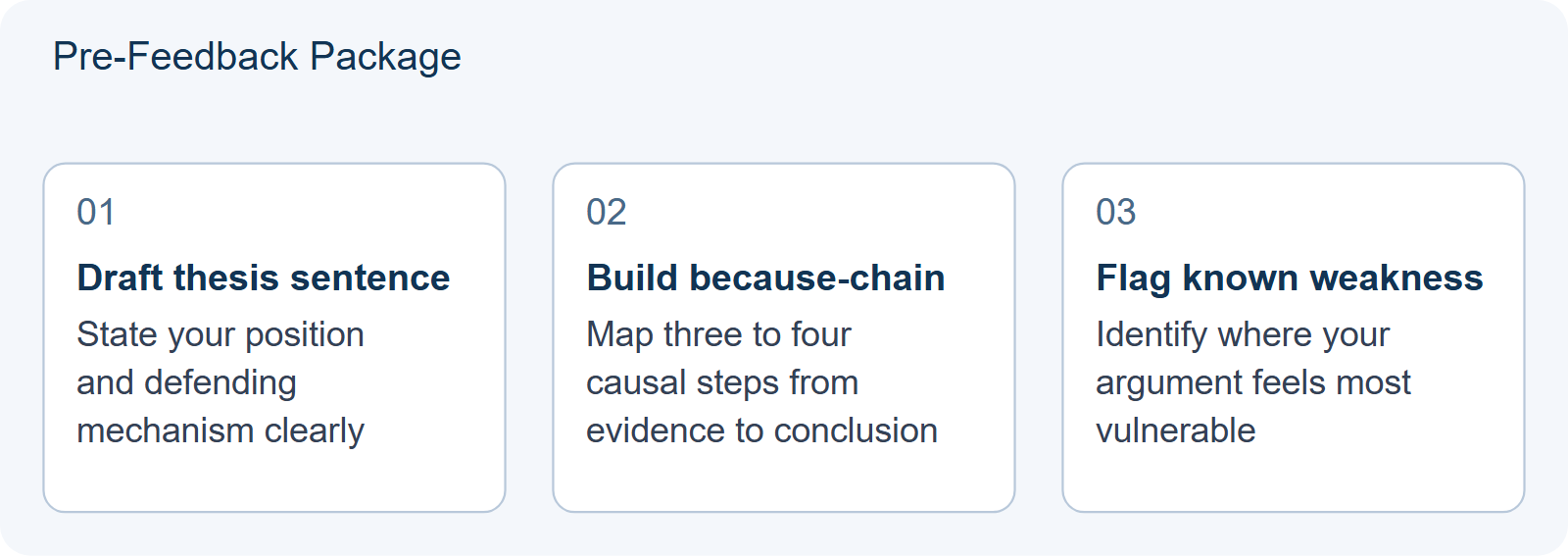
- Thesis sentence: One sentence stating your position and the mechanism you will use to defend it.
- Because-chain outline: Three to four steps connecting your evidence to your conclusion, each introduced by “because.”
- Source notes: For each source, one sentence on what it says and one sentence on how you plan to use it.
- Known weakness flag: One paragraph on where you feel the argument is weakest.
This package gives any advisor a concrete object to respond to. It also trains you to think in terms of revision rather than first-draft perfection—a habit that separates competitive entrants from casual participants.
Choose Foundational Learning or Targeted Essay Support
With your self-assessment complete, you face a decision tree:
Path A: Foundational learning first. If your test revealed conceptual gaps across multiple domains, prioritize structured reading and perhaps a principles course. The HIEEC deadline becomes a target to work toward, not a countdown forcing premature essay work.
Path B: Targeted essay support. If concepts are familiar but your argument crumbled under time pressure or lacked evidence, seek feedback on drafts and guidance on source strategy. Understanding what judges evaluate can sharpen your revision priorities.
Path C: Hybrid. Many self-taught students oscillate between paths. A suggested rhythm: two weeks of focused reading, one attempted outline, feedback, then another two weeks of deeper reading in the weakest area revealed by that outline.
Preparing to Request Course-Fit Guidance
If you plan to contact an advisor or coaching service, prepare a brief summary of your background: your highest level of economics study (formal or self-directed), the result of the 45-minute self-test described above, and your target competition cycle. This allows the conversation to move quickly to specifics rather than discovery questions. Be ready to share your attempted thesis or outline if you have one—it is the fastest way to calibrate whether you need conceptual, argumentative, or evidentiary support.
Note: HIEEC is organized by the Harvard Undergraduate Economics Association (HUEA), a Harvard College student organization. This site is an independent guide and is not affiliated with, endorsed by, or sponsored by Harvard University, HUEA, or HCER.
Frequently Asked Questions
Can I enter HIEEC if my school does not offer economics?
Yes. HIEEC is open to worldwide high school students, and homeschooled students are welcome. No school economics course is listed as a prerequisite; the key is demonstrating economic reasoning in your essay, regardless of how you acquired that reasoning. Students should ask HUEA about ambiguous eligibility.
How do I know if I need a full economics course or just essay feedback?
Use the 45-minute self-test described above. If you cannot identify which concepts apply to a prompt, you likely need foundational study first. If you understand the concepts but cannot structure a persuasive argument, you need essay-specific support.
What should I bring to a first coaching session?
Bring an attempted thesis, a because-chain outline, source notes, and a paragraph on where you think the argument is weakest. This gives any advisor concrete material to respond to and accelerates the feedback process.