Partially. IB, AP and A-Level economics all give you usable raw material for HIEEC — models, vocabulary, and some writing practice — but none of them trains the exact skill HIEEC rewards: a 1,500-word independently researched argument with scholarly referencing. This article maps what each curriculum contributes, identifies the three gaps every syllabus leaves open, and gives a bridging plan by curriculum so you know precisely what to add on your own.
What HIEEC demands that no exam course does
HIEEC, organised by HUEA — the Harvard Undergraduate Economics Association, a student club, together with the Harvard College Economics Review (not Harvard University officially) — asks entrants to answer one of four released prompts in a strictly capped 1,500 words, cited in Chicago or APA style. If you have not read the basics yet, our complete HIEEC overview covers eligibility, fees and format. For this article, four demands matter:
- A self-built thesis. There is no mark scheme to reverse-engineer. You must decide what you think and defend it.
- Independent research. The evidence is not handed to you in a data-response extract; you find, evaluate and cite it yourself.
- Extended compressed argument. 1,500 words is longer than any timed exam answer and shorter than almost any research paper — a distinct discipline of its own.
- Scholarly conventions. Formal Chicago or APA referencing, which no mainstream high-school economics exam requires.
Judge your curriculum against those four demands, not against “do I know economics”, and the picture becomes much clearer.
IB Economics: the closest fit, with a hidden blind spot
Of the three systems, IB Economics maps most naturally onto HIEEC. The syllabus pushes real-world application throughout, and the internal assessment — short commentaries analysing news articles through an economic lens — is genuine practice at connecting theory to current events in prose. IB students also arrive with essay stamina from extended-response questions, and those who write their Extended Essay in economics have effectively done a longer, referenced research project already.
The blind spot is compression. IB rewards showing your working: definitions, diagrams, structured evaluation. HIEEC's word cap punishes exactly that instinct. An IB-trained draft typically spends 300 words defining terms a competition judge does not need defined. IB students should therefore train the opposite muscle: state the frame in one sentence, and spend the recovered words on evidence and counterargument. Our guide to writing the 1,500-word HIEEC essay shows where those words are better spent.
AP Micro and Macro: strong models, near-zero writing transfer
AP Microeconomics and AP Macroeconomics deliver the most rigorous model training of the three at the introductory level — supply and demand, elasticity, market structures, fiscal and monetary frameworks are drilled until they are automatic. That toolkit is real HIEEC capital: a well-deployed model is often what separates an economics essay from a current-affairs opinion piece, as we explain in the context of building arguments from theory.
But AP courses are assessed through multiple-choice questions and short free-response problems. There is no essay anywhere in the assessment, no independent research component, and no referencing. An AP student entering HIEEC is typically strong on analytical machinery and untrained in everything else the contest grades. The bridge for AP students is therefore almost entirely a writing bridge — and it needs to start earlier than they think, because argumentative prose improves in weeks, not days.
A-Level Economics: essay practice, but exam-shaped essays
A-Level students (across the major boards) get the most extended-writing practice of the three: substantial essay questions with evaluation expectations are a standard part of assessment. The habit of building a judgement, weighing both sides and reaching a conclusion transfers directly to HIEEC.
The catch is that A-Level essays are exam-shaped: written from memory, against the clock, with no sources to cite, and rewarded for hitting familiar evaluation patterns (“it depends on the elasticity…”, “in the short run versus the long run…”). HIEEC judges read hundreds of essays; formulaic evaluation reads as filler. A-Level entrants need to replace memorised evaluation stems with genuine engagement with evidence they researched themselves — and to learn citation conventions from scratch, since A-Level requires none.
| HIEEC demand | IB Economics | AP Micro/Macro | A-Level Economics |
|---|---|---|---|
| Analytical models | Good coverage | Strongest of the three | Good coverage |
| Real-world application | Strong (commentaries, case-based teaching) | Limited (stylised problems) | Moderate (data-response, examples) |
| Extended argumentative writing | Moderate (extended responses; EE if taken) | Essentially none | Strong but exam-shaped |
| Independent research & sourcing | Some (IA uses self-chosen articles) | None | Little to none |
| Chicago/APA referencing | Only via EE, and typically another style | None | None |
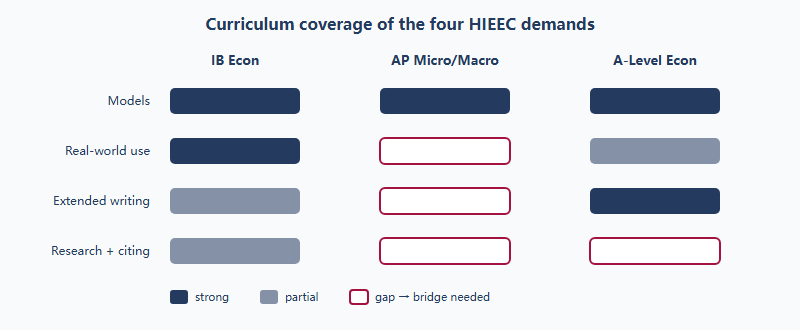
The three gaps every syllabus leaves — and the bridge for each
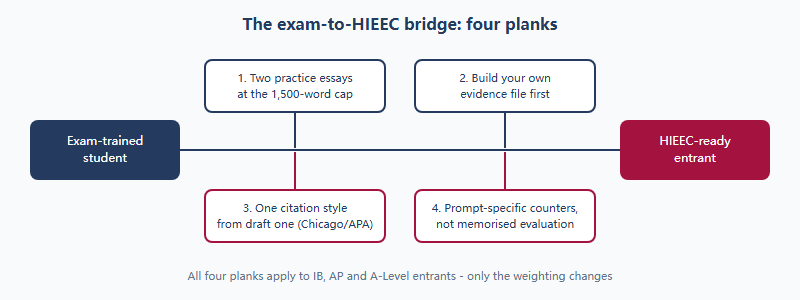
Whatever your system, three gaps recur, and each has a specific, trainable fix:
- Gap 1: the word-capped research argument. No exam format matches HIEEC's 1,500-word ceiling on a researched question. Bridge: write two practice essays before your real draft — one on any past-style economics question at 1,500 words, one deliberately drafted long and cut by 25%. Cutting is a skill; schedule it.
- Gap 2: self-sourced evidence. Exams hand you extracts; HIEEC hands you a question. Bridge: build a personal evidence file from credible sources (official statistics, central bank and IMF/World Bank publications, academic summaries) for your chosen prompt before outlining, so your argument grows out of evidence rather than being decorated with it afterwards.
- Gap 3: scholarly referencing. Chicago and APA are conventions, not talents — but they are conventions no economics exam teaches. Bridge: pick one style, set up your citations from the first draft, and follow a reliable style guide as you go rather than reformatting in the final week.
Notice what is not a gap: economic content. For most prompts, a well-taught IB, AP or A-Level student already knows enough theory to write a competitive essay. The differentiator is what you do with it — which is also why choosing the prompt that plays to your coursework is the highest-leverage decision of your whole entry.
A bridging plan by curriculum
Assuming a autumn prompt release and an early-January deadline (recent-cycle pattern — confirm the current dates on thehuea.org), here is how each student type should weight the roughly ten preparation weeks:
- IB students: 50% evidence-gathering and referencing, 30% compression drills, 20% content top-up beyond the syllabus on your chosen prompt's topic. Your IA instincts are an asset; your definition-heavy writing style is the liability to train away.
- AP students: 60% argumentative writing practice (two full practice essays minimum), 25% research and referencing, 15% content — your models are already strong. Start writing earliest of the three groups.
- A-Level students: 40% evidence-gathering, 30% de-formulising your evaluation (replace memorised stems with prompt-specific counterarguments), 30% referencing and formatting, which you have likely never done.
- Students taking no economics course: HIEEC does not require economics coursework — eligibility and entry rules are on thehuea.org. Your bridge is bigger but well-trodden: a foundations phase first (an accessible economics book plus a free online principles course), then the AP-style writing bridge. Budget extra weeks accordingly.
FAQ
Do I need to be taking an economics course to enter HIEEC?
No specific coursework is assumed in this guide's reading of the contest; eligibility is defined by the organisers, so confirm the current entry requirements directly on thehuea.org before planning.
Which curriculum gives the biggest HIEEC advantage?
None decisively. IB transfers best on real-world application, AP on models, A-Level on essay stamina — and all three leave the research-and-referencing gap that decides most entries.
Can I reuse my IB Extended Essay or IA material?
Your background knowledge transfers freely, but the HIEEC essay must answer the released prompt and meet its rules. Check the organisers' originality and submission requirements on thehuea.org before adapting prior work.
How many weeks should I budget for the bridge?
Around ten weeks from prompt release comfortably fits two practice essays, an evidence file and two revision passes. AP students and non-economics students should start their writing practice even before prompts appear.
This is an independent guide operated by Hanlin Education for China-based international-school students. It is not affiliated with, endorsed by, or sponsored by HUEA, the Harvard College Economics Review, or Harvard University. Curriculum descriptions are general characterisations — check your own syllabus — and competition details change by cycle: always confirm current rules on thehuea.org. Errors brought to our attention are corrected within 7 working days.