The 2026-27 HIEEC artificial intelligence prompt asks one causal question — whether AI is the main reason young people are finding it harder to get a first job — and supplies three facts that are often treated as though they already answered it. They do not. A strong essay defines what “main” means, shows what each fact can and cannot measure, prices at least two rival causes, and states in advance what evidence would overturn the verdict. The prompt is reproduced below exactly as supplied in the source report, separate from the editorial method that follows. The 2026-27 deadline is 11:59 p.m. US Eastern Time on 5 January 2027.
The 2026-27 Artificial Intelligence prompt, reproduced
The question text below is reproduced from the Hanlin Course report on the 2026-27 HIEEC season, published 28 October 2026. It is kept apart from all commentary.
Artificial Intelligence
“Since late 2022, employment of US 22–25-year-olds in the jobs most exposed to AI has fallen about 13% compared with similar workers in less-exposed jobs. Meanwhile, youth unemployment in the UK rose to around 16% in early 2026, and India’s biggest IT firms have almost stopped adding staff. Is AI the main reason young people are finding it harder to get a first job?”
Source and scope note
The quotation is reproduced from that supplied report, not from an independently fetched HUEA page; the report’s own heading labels this question “Artificial Intelligence”. For submission, check the organiser’s current English release. The same report states that candidates may draw on evidence from any country, including their own, and that each example in a prompt should be treated as a starting point rather than a limitation. Those two points are reported guidance here, not a verbatim quotation, because their English wording was not supplied.
Independence. This guide is not affiliated with, endorsed by, or sponsored by Harvard University or the Harvard Undergraduate Economics Association (HUEA), which organises the contest together with the Harvard College Economics Review. It is an independent preparation perspective.
First, decide what “main reason” has to mean
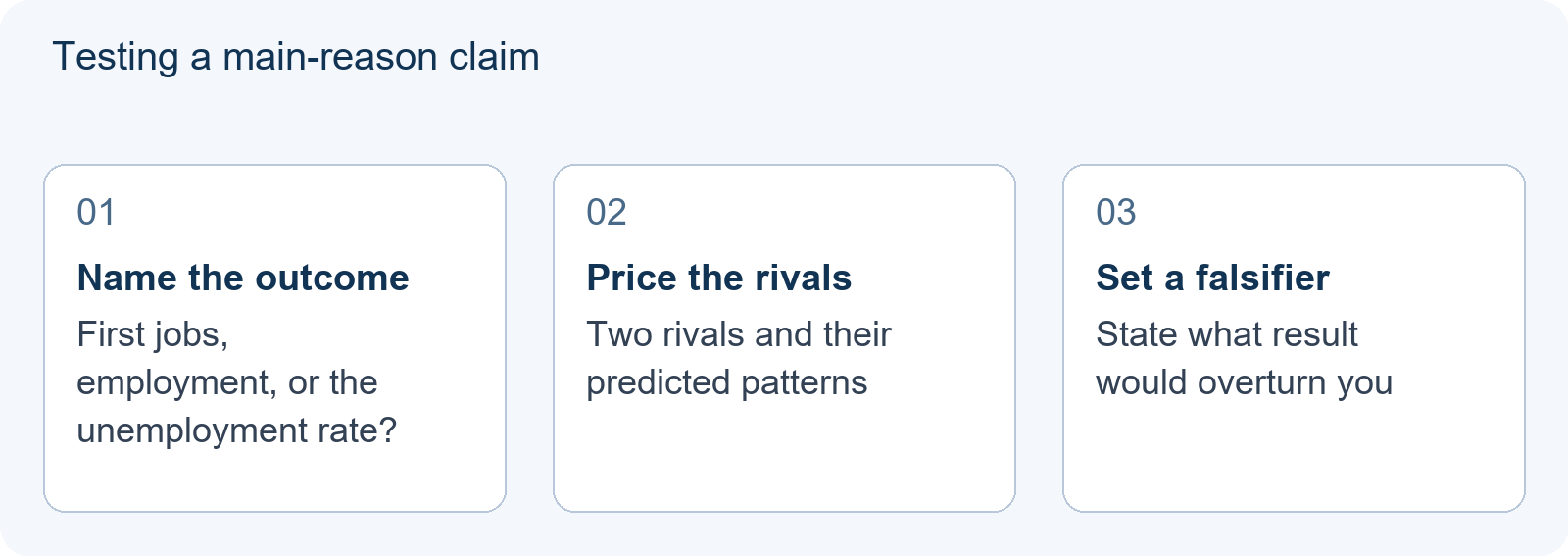
“Main” is a common failure point in drafts. A reason can be contributory (it moves the outcome slightly), necessary (without it the outcome would not have occurred), or sufficient (it alone could produce the outcome). “Main” is none of these exactly; it is comparative and quantitative. A workable test has four parts. First, a mechanism: name the channel through which AI changes hiring of young people. Second, a counterfactual: state what the outcome would plausibly have been without that channel, and say how you know. Third, a comparison: place AI’s contribution beside at least two rivals over the same period and population. Fourth, a falsifier: write down, before drafting, the result that would make you abandon your verdict.
Two distinctions then do most of the analytical work. A fall in employment in a group is not a rise in the unemployment rate: the first counts people with jobs, the second counts people without jobs who are actively searching, divided by the labour force. And an absolute change is not a relative one. The phrase “fallen about 13% compared with similar workers” can be read as a 13% fall within the exposed group, or as a 13% gap between the exposed and comparison groups. The supplied text does not settle it, so state which reading you adopt and whether your conclusion survives the other. For the counterfactual step, see HIEEC Essay Counterfactuals: State What Would Have Happened Without the Policy; for judging how much a comparison group can carry, see HIEEC Natural Experiments: Explaining What a Policy Comparison Can and Cannot Show.
The mechanism you must specify
AI does not act on “youth employment” directly; it acts on tasks. Entry-level work is often the most codified, documentable and checkable work in a firm, which makes it the easiest to automate or to compress with a tool, so a plausible substitution story runs from AI capability to fewer junior tasks to fewer junior hires. But there is also a complementarity story: if AI raises the output of senior staff, firms may keep fewer juniors per senior, or they may redeploy juniors into supervision and quality-control roles, and the net hiring effect is then ambiguous. A serious essay picks one mechanism, states the assumption it needs, and says what observable pattern would distinguish it from the other. State that assumption in the sentence that introduces the mechanism, because a different assumption can reverse the hiring prediction.
The three figures do not measure the same thing
The prompt’s three facts differ in country, population, unit and time window. They can be used together only if that is made explicit.
| Fact in the prompt | What it actually measures | What it can support | What it cannot support |
|---|---|---|---|
| US employment of 22–25-year-olds in the most AI-exposed jobs, down about 13% versus similar workers in less-exposed jobs since late 2022 | A within-country comparison between two groups of young workers; unit is employment in exposed occupations, with a less-exposed comparison group | That exposed young workers did worse than comparable less-exposed young workers over the period | A national youth employment rate; a claim that all youth hiring fell; a causal estimate on its own |
| UK youth unemployment around 16% in early 2026 | A rate for a national youth population: unemployed and actively seeking, divided by the labour force | That UK youth unemployment rose to that level by that date | Why it rose; whether first-job seekers specifically were affected; any AI attribution |
| India’s biggest IT firms have almost stopped adding staff | Headcount-growth behaviour at a set of large firms | That hiring growth at those firms slowed sharply | A national Indian youth measure — the supplied material gives no share of youth employment for those firms |
A frequent slip is in the third row. A hiring freeze at large firms says nothing about young people unless you also know those firms’ share of youth employment and what happened at smaller firms and other sectors. If you cannot source those shares, use the India point as an illustration of a mechanism, not as evidence about a national labour market.
Teaching illustration 1: a falling AI-exposed channel that is still a minority cause
The numbers below are invented for teaching and describe no real economy.
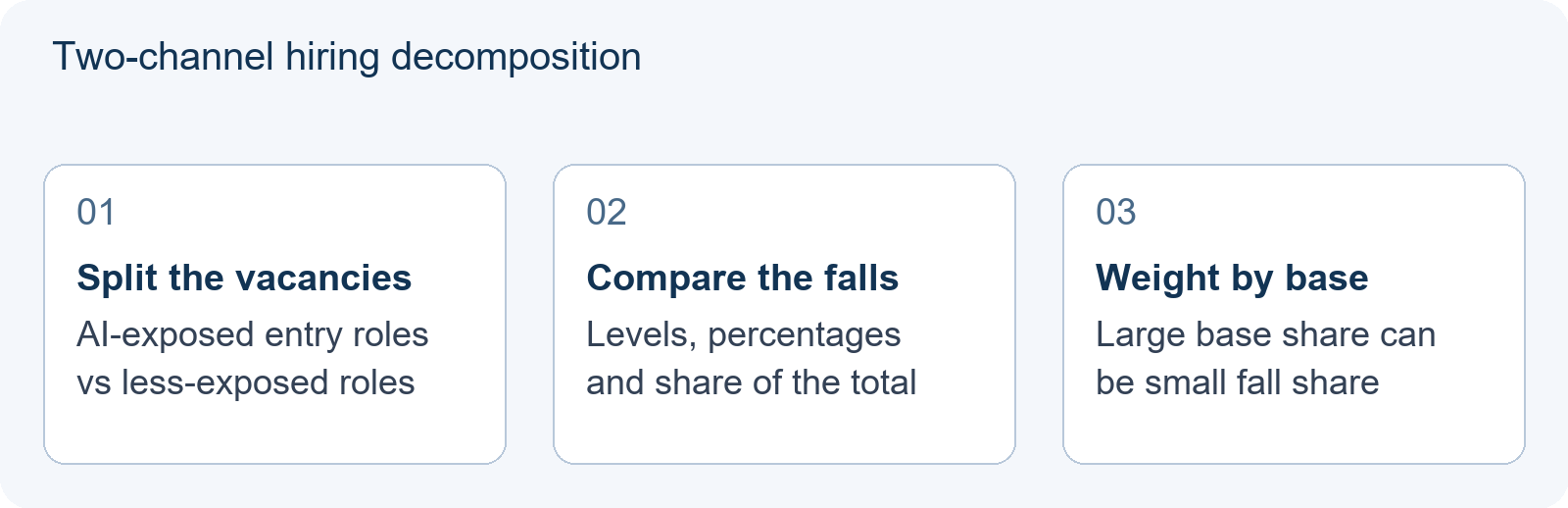
Suppose an economy had 1,000 entry-level vacancies in 2022: 400 in AI-exposed occupations and 600 in less-exposed ones. By 2026 it has 350 and 500. Total vacancies fell from 1,000 to 850, a fall of 150, or 15%. The AI-exposed channel fell by 50, which is 12.5% of its own base, while the less-exposed channel fell by 100, or 16.7% of its base.
Now read the claims you could honestly make. “Employment in AI-exposed entry roles fell” is true. “AI-exposed roles are 40% of the base” is true. Neither makes AI the main reason for the total decline: the exposed channel accounts for 50 of the 150 lost vacancies, one third of the fall, and its proportional decline is smaller than the less-exposed decline. A writer who quoted only the exposed-group fall would have produced a correct statistic under a wrong headline. What would change the verdict? If the exposed channel had fallen by 130 of the 150, that same 400-vacancy base would be contributing roughly seven-eighths of the total decline, and the primacy claim would at least be arithmetically supported — though it would still need a mechanism and a timing check.
Teaching illustration 2: what a 16% youth unemployment rate does and does not say
Again, invented numbers, chosen for arithmetic clarity.
Take a youth labour force of 1,000 with 150 unemployed. The rate is 15.0%. Now let 100 more young people enter the labour force seeking work, of whom 26 are unemployed and the rest find jobs, with nothing else changing. Unemployment is 176 and the labour force is 1,100, so the rate is exactly 16.0%. A one-point rise in the headline rate is compatible with an increase of 26 unemployed young people in this population, because the denominator also moved.
Three lessons follow. The rate is silent about why people entered the labour force, so an inflow of searchers can raise it without any employer changing behaviour. The rate excludes young people who have stopped searching, so discouragement can push it down. And the rate covers all youth unemployment, not first jobs, so it cannot confirm a claim about entry into work. The composition point generalises: a change in who is counted can move an average without anything happening to any individual.
Rival causes, and the falsifier that decides the essay
At least two rivals should be priced, not merely listed. Plausible ones for a 2022–2026 window include tighter monetary policy raising the cost of hiring and cutting entry-level postings; normalisation after an unusually tight post-pandemic youth labour market; changes in minimum wages or payroll costs that raise the relative cost of inexperienced workers; outsourcing and offshoring of routine white-collar tasks, which can look like AI displacement in the data; credential mismatch; and composition — more 22–25-year-olds staying in education, changing who appears in an employment count.
Then write the falsifier. A useful form is conditional: if, within the same country and period, the less-exposed entry-level decline is as large as the exposed decline, AI’s explanatory share falls sharply; if the exposed-group break predates the diffusion of the tools you are invoking, the timing fails; if the gap disappears once sector demand and firm size are held constant, the mechanism is weak. Stating this in the introduction is not weakness — it is what turns three cited numbers into an argument.
Fitting the argument into 1,500 words
The word limit is 1,500 words including footnotes but excluding references, so the analysis must be budgeted like a resource.
| Section | Budget | Job |
|---|---|---|
| Verdict and definition of “main” | 150 | Commit to a qualified position early |
| Mechanism | 200 | Substitution versus complementarity at entry level |
| Evidence audit | 250 | Three facts, three units, three limits |
| Two rival causes | 250 | Price them; do not merely list them |
| Falsifier and country variation | 200 | What would change your mind, and why countries differ |
| Qualified verdict | 200 | Restate the claim with its conditions attached |
| Introduction and conclusion | 250 | Signposting and payoff |
If a diagram would help, budget its labels as text: a diagram that carries information in words still consumes space in a tight 1,500-word essay. Readers who have previously practised the older workforce and education prompts will find that the mechanics transfer but the causal target does not: Writing HIEEC Workforce and Education Past-Prompt Practice: Automation, Remote Work and Skills handles automation, remote work and skills, which is a different question from whether AI is the main reason first-job entry has worsened.
Submission rules that shape the argument
- Deadline: 11:59 p.m. US Eastern Time on 5 January 2027.
- Length and file: a maximum of 1,500 words including footnotes but excluding references, submitted as a single PDF no larger than 10MB.
- Anonymity: review is anonymous, so no author or school name may appear in the PDF.
- AI tools: permitted, but the ideas and argument must be the candidate’s own and every source used must be cited.
- Divisions: two groups decided by grade on the deadline: Grades 9–10 (three or four years from secondary graduation); and Grades 11–12 (one or two years from secondary graduation), plus students in a pre-university gap year, military service or similar. Both groups answer the same questions.
- Judging: anonymous scoring by trained reviewers on analysis, creativity, research and structure, each out of five, with top-scoring essays going forward to a final panel.
All of the above is reported in the Hanlin Course release report of 28 October 2026 and is subject to the organiser’s current published rules, which should be the version you check before submitting.
Preparing a prompt-fit or diagnostic request
Whether you seek a second opinion or simply self-review, four items make the conversation useful. First, one sentence stating your verdict and the sense of “main” you are using. Second, the two rival causes you will test, with the pattern each would leave in the data. Third, your source list with access dates, so a reader can see whether the US comparison, the UK rate and the Indian firms are being used at the right level of aggregation. Fourth, your word budget across the seven sections above, because over-length drafts are often over-long in one place. Bring those and the discussion is about the argument; bring a draft alone and it becomes an editing session.
General event background is available at Event background.
Frequently Asked Questions
Does the 2026-27 HIEEC AI prompt require me to argue that AI is the main reason?
No. It asks whether AI is the main reason, so a qualified yes, a qualified no, or a conditional verdict are all legitimate. What the question does demand is a definition of ‘main’, a mechanism, and a comparison against at least one rival cause. A verdict that rests only on the three supplied figures, without saying what they measure, is a common weakness in essays for this prompt.
Can I use evidence from my own country instead of the US, UK and India examples?
The Hanlin Course report of 28 October 2026 states that candidates may use evidence from any country including their own, and that each example in a prompt should be treated as a starting point rather than a limitation. The English wording of that instruction was not supplied for reproduction, so check the organiser’s current release before relying on it. If you do substitute a national case, keep the unit of measurement explicit and do not mix a national unemployment rate with a firm-level hiring figure.
What are the length, deadline and anonymity rules for 2026-27?
According to the same 28 October 2026 report, the deadline is 11:59 p.m. US Eastern Time on 5 January 2027; the limit is 1,500 words including footnotes but excluding references; the file must be a single PDF no larger than 10MB; and because review is anonymous, no author or school name may appear in the PDF. AI tools are permitted provided the ideas and argument are the candidate’s own and every source is cited. Confirm all of these against the organiser’s current published rules before submitting.