Every HIEEC prompt that asks you to evaluate a policy forces you to answer one question first: compared to what? The counterfactual—what would have happened without the policy—is not a decorative flourish. It is the logical backbone that separates a description from an argument. Without it, you are merely listing effects; with it, you can attribute causation and measure magnitude.
This article works through the mechanics of building credible counterfactuals for the 1,500-word HIEEC essay. The approach below is developed as a practical teaching framework, not an official scoring rubric. It is designed for students who have encountered the concept in economics coursework but need to translate it into concise, competition-ready prose.
Why Counterfactuals Decide HIEEC Essays
A policy evaluation without a counterfactual is like a regression without a control group. You might observe that unemployment fell after a minimum-wage increase, but you cannot claim the policy caused the improvement until you establish what unemployment would have done anyway. The counterfactual supplies the baseline against which your policy is measured.
In the HIEEC context, this matters because judges read hundreds of essays that describe the same policy. Essays that demonstrate analytical discipline identify the causal question, construct a plausible alternative world, and derive implications that are falsifiable rather than merely rhetorical. The counterfactual is what makes your argument testable.
The challenge is space. At 1,500 words, you cannot simulate a full structural model. You need a lightweight, transparent method that signals sophistication without consuming your word budget. The following framework is designed for that constraint.
The Three-Step Counterfactual Framework
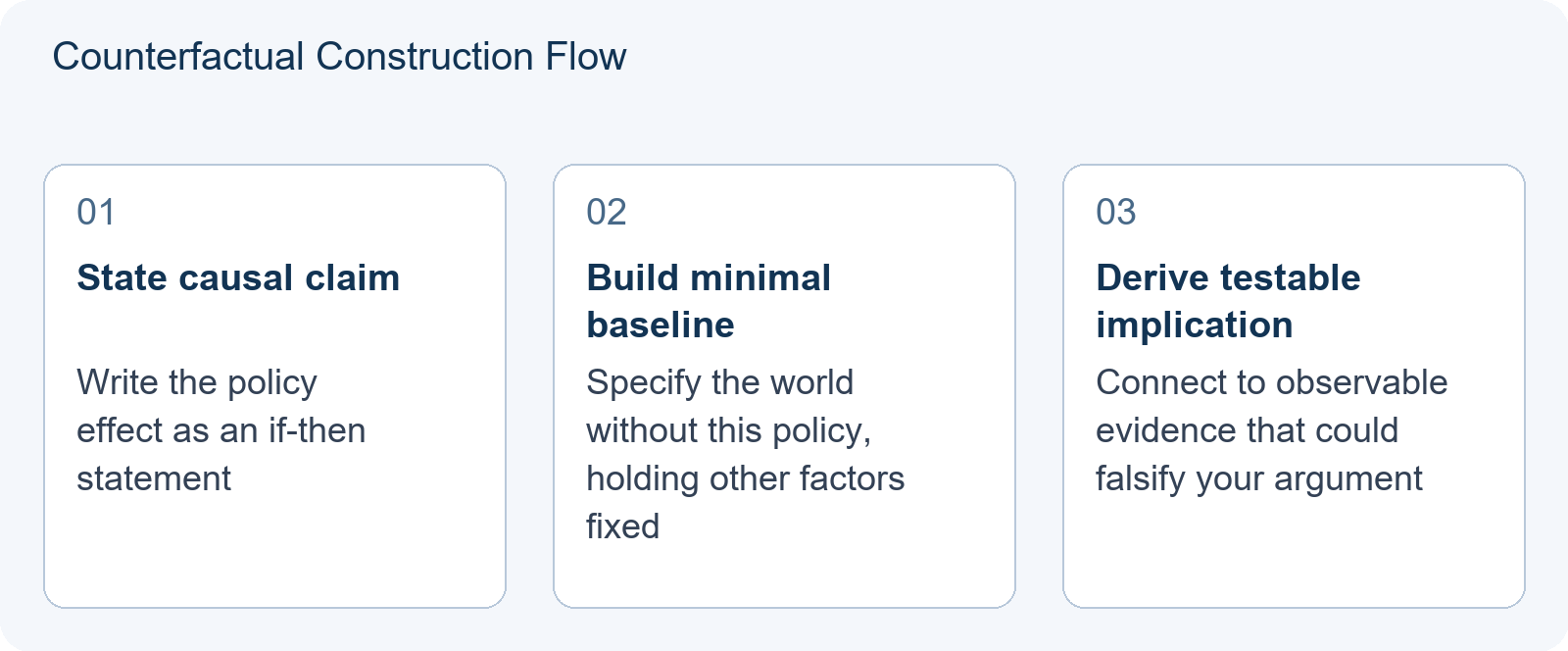
Step one: state the explicit causal claim. Before touching the counterfactual, write the policy’s intended effect as a conditional statement. For example: “If City A had not implemented its congestion pricing pilot in 2026, then traffic volume in the charged zone would have remained at pre-policy levels.” This clarifies what you are trying to prove and exposes the mechanism you must defend.
Step two: construct the minimal viable counterfactual. You do not need to describe a world without pricing altogether. You need only specify the state of the world that would have obtained if this specific policy had not been enacted, holding other factors constant. The appropriate benchmark is usually the status quo ante or a credible trend projection. For congestion pricing, the counterfactual might be: “Traffic volume continues to grow at the rate observed from 2023 to 2025, because no price signal redirects commuter behavior.”
Step three: derive the falsifiable implication. Connect your counterfactual to observable evidence that could distinguish your claim from alternatives. In the congestion pricing case: “If the counterfactual is correct, then we should observe that post-implementation traffic falls relative to the projected trend, and that this divergence begins precisely when charges take effect, not gradually beforehand.” This step transforms your essay from opinion into argument.
Teaching Illustration: A Worked Case
The following is a teaching illustration using completely hypothetical numbers, designed to demonstrate the framework’s application. It is not a verified historical account.
Consider a hypothetical HIEEC prompt on urban traffic policy. Suppose two comparable cities each start with 100,000 daily vehicle trips in the charged zone. City A implements congestion pricing; City B does not. After one year, City A records 90,000 trips; City B records 96,000 trips.
Explicit causal claim: “If City A had not implemented congestion pricing, its traffic would have followed the same trajectory as City B, reaching approximately 96,000 trips.”
Minimal viable counterfactual: Under the parallel trends assumption, City B’s outcome represents what City A would have experienced without the policy. The counterfactual baseline is therefore 96,000 trips, not the original 100,000.
Calculated incremental effect: The observed 90,000 trips minus the counterfactual 96,000 trips yields an incremental change of -6,000 trips. A naive comparison against the original 100,000 would incorrectly suggest -10,000 trips, overstating the policy effect by 67 percent.
Critical assumptions to label: This illustration relies on (1) no interference between cities, (2) comparable composition of traffic, (3) no concurrent policies in either city affecting vehicle use, and (4) uncertainty about whether the parallel trend would have persisted. These assumptions must be stated, not hidden.
Critical check: Pre-trend extrapolation requires stability; it is not automatically invalid, but it must be justified. Naming a difference-in-differences or synthetic control design does not solve endogeneity if the policy was selectively adopted in response to deteriorating conditions.
Where Superficially Similar Approaches Fail
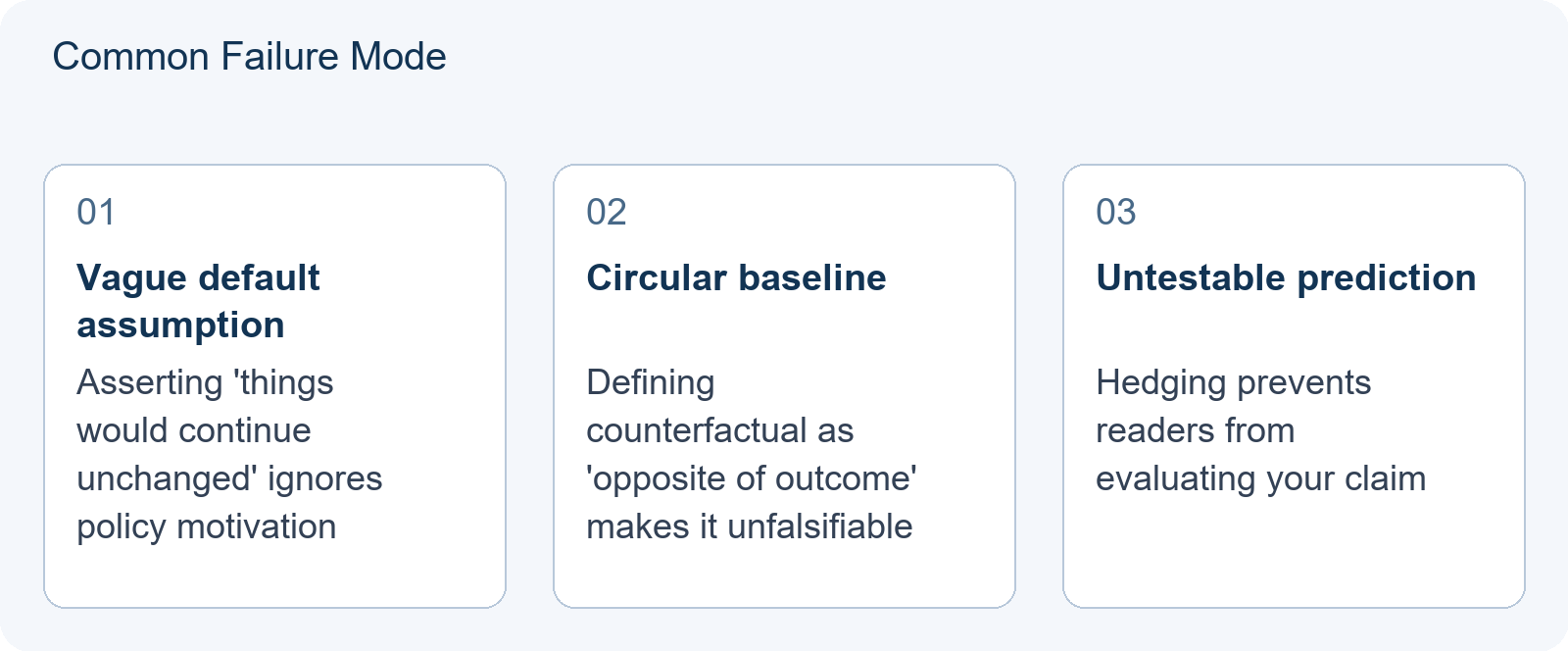
A common mistake is the “everything else equal” counterfactual that simply asserts the world would have continued unchanged. This is logically incoherent for most policies because the policy itself is often a response to changing conditions. If you write, “Without the policy, the economy would have continued on its previous path,” you beg the question of why the policy was enacted.
Consider a student essay on a hypothetical pandemic-era fiscal stimulus. The superficial counterfactual: “If the government had not issued stimulus checks, household consumption would have remained at pre-crisis levels.” This fails because the crisis had already shifted behavior, supply chains were disrupted, and precautionary savings were elevated. A credible counterfactual must incorporate these constraints: “Absent stimulus checks, household consumption would have fallen further below trend given the income losses and uncertainty that characterized the period.”
The arithmetic of this distinction matters for your essay’s credibility. Using a naive baseline of pre-crisis levels implies a treatment effect far larger than the actual observed change, because much of that change would have occurred anyway as households adjusted to crisis conditions. An essay that uses the naive counterfactual overstates the policy’s impact and signals to judges that you have not thought carefully about identification.
Diagnostic Application: Test Your Own Counterfactual
Before finalizing your essay, apply this three-question diagnostic to your counterfactual:
- Is the baseline specified independently of the policy outcome? If your counterfactual is defined as “the opposite of what happened,” it is circular and unfalsifiable. The baseline is a conditional model, not necessarily independent of policy selection; status quo can be appropriate when justified.
- Does the counterfactual account for the policy’s motivation? If the policy was enacted in response to a crisis, your counterfactual must include the crisis. Pretend extrapolation requires stability, not automatic validity.
- Can a reader derive a specific numerical or ordinal prediction from your counterfactual? Vague alternatives like “things would be different” do not advance your argument.
Suppose you are evaluating a hypothetical carbon tax. Your draft counterfactual states: “Without the tax, emissions would have continued rising.” Applying the diagnostic: the baseline is not independent (it assumes rising emissions are the default); the counterfactual does not address why the tax was enacted (perhaps a technological shift was already reducing emissions intensity); and the prediction is too vague to test. A revised version: “Without the tax, emissions would have declined at a pre-policy trend rate of approximately 1.2 percent annually—an illustrative figure, not real data—because the power sector’s transition was already underway; the tax accelerated this transition, with the incremental effect visible in the post-implementation divergence from the pre-policy trend.” This passes all three questions.
What Your Diagnostic Result Means for Revision
If your counterfactual fails the independence test, you are likely conflating description with evaluation. The fix is to identify a specific pre-policy period or control group that establishes the baseline without reference to the outcome. For historical policies, this might involve comparing the target jurisdiction to a similar jurisdiction that did not adopt the policy.
If your counterfactual fails the motivation test, you are treating the policy as exogenous when it was likely endogenous. The fix is to acknowledge the selection problem explicitly: “The policy was adopted precisely because outcomes were deteriorating, so the pre-policy trend may overstate or understate the counterfactual baseline. A better estimate adjusts for this selection by using a synthetic control or difference-in-differences design.” Even if you cannot execute such a design in 1,500 words, naming it signals methodological awareness—though naming alone does not solve endogeneity.
If your counterfactual fails the prediction test, you are hedging too aggressively. The fix is to commit to a specific directional or magnitude claim and defend it with mechanism-based reasoning. Judges prefer a clear, defensible claim to an ambiguous one that cannot be evaluated.
Connecting Counterfactuals to the Rest of Your Essay
The counterfactual is not a standalone section. It should discipline your entire argument. Once established, use it to structure your evidence sections: each empirical claim should be framed as a test of the counterfactual’s predictions. If your counterfactual implies that a tariff reduced import volume by raising domestic prices, then your evidence section should show price increases and quantity reductions, and explicitly note whether the timing and magnitude align with the counterfactual.
This integration is what separates essays that mention counterfactuals from essays that are built around them. The former treat the counterfactual as a box to check; the latter use it as an organizing principle that constrains and clarifies every subsequent claim.
Building From Related Skills
For the foundational skill of identifying assumptions that can reverse your conclusion, see HIEEC Economic Models: Writing the Assumption That Could Reverse Your Conclusion. For distinguishing what policy comparisons can and cannot show, see HIEEC Natural Experiments: Explaining What a Policy Comparison Can and Cannot Show. For readers beginning their preparation without formal economics training, HIEEC Essay Preparation Without School Economics: Where to Start offers a structured entry point.
The Harvard Undergraduate Economics Association (HUEA) hosts the HIEEC; this guide is independent and not affiliated with, endorsed by, or sponsored by Harvard University or HUEA. For official competition information, consult thehuea.org.
Frequently Asked Questions
How much space should I devote to the counterfactual in a 1,500-word HIEEC essay?
A well-constructed counterfactual typically requires 150–250 words to state, motivate, and connect to your causal claim. The investment pays off because it disciplines the remaining words, preventing digressions into unsupported description. Essays that omit this section often spend more words defending weaker claims.
Can I use a counterfactual for a proposed policy that has not yet been implemented?
Yes, but the standard of evidence shifts. For enacted policies, you can compare observed outcomes to your counterfactual baseline. For proposed policies, you must rely on theoretical mechanisms, analogous cases, or structural estimates. The key is still explicit: state what would need to be true for the policy to matter, and identify the evidence that would distinguish it from alternatives.
What if I cannot find data to test my counterfactual’s prediction?
Data limitations are common in 1,500-word essays. The solution is to be transparent about what would constitute evidence and why it is unavailable, then substitute mechanism-based reasoning or comparative case analysis. Judges value analytical honesty over false precision; acknowledging an untestable prediction is stronger than pretending you have tested it.