Short answer: the 2026-27 HIEEC digital economy prompt asks whether a country’s everyday payment system should be free to use, not whether UPI or Pix is a good national brand. A defensible answer is conditional: free at the point of use for individuals can be justified, but “free to merchants” or “free to society” needs an explicit funding source and a named market failure. A practical essay splits “free” into three separate prices: what users pay, what merchants pay, and what taxpayers or the public balance sheet fund. Then it shows how a merchant fee can be passed into prices and which market failure, if any, justifies a subsidy.
What the 2026-27 digital economy prompt actually asks
The 2026-27 HIEEC digital economy prompt, under the heading “Digital economy,” reads in the supplied Hanlin Courses note dated 28 October 2026:
“India’s UPI and Brazil’s Pix, both built by public bodies, let people send money instantly by phone and each handle billions of payments a month. UPI is free for both users and shops, while Pix is free for individuals but charges businesses a small fee. Should a country’s everyday payment system be free to use?”
That is the complete prompt text supplied for reproduction. The same note does not include the official English shared-instruction block, so this article does not paraphrase or reconstruct that block. Before drafting, verify the complete official wording from the competition’s own materials.
The note separately reports that the 2026-27 essay limit is 1,500 words including footnotes but excluding references; the file is a single PDF no larger than 10MB; review is anonymous, so no author or school name should appear; the submission deadline is 5 January 2027, 11:59 p.m. ET; and both grade divisions answer the same questions. Those are time-bound source facts, not permanent rules for every season.
This guide is independent and is not affiliated with Harvard University, HUEA, or HCER.
The first analytical move: map the two-sided market
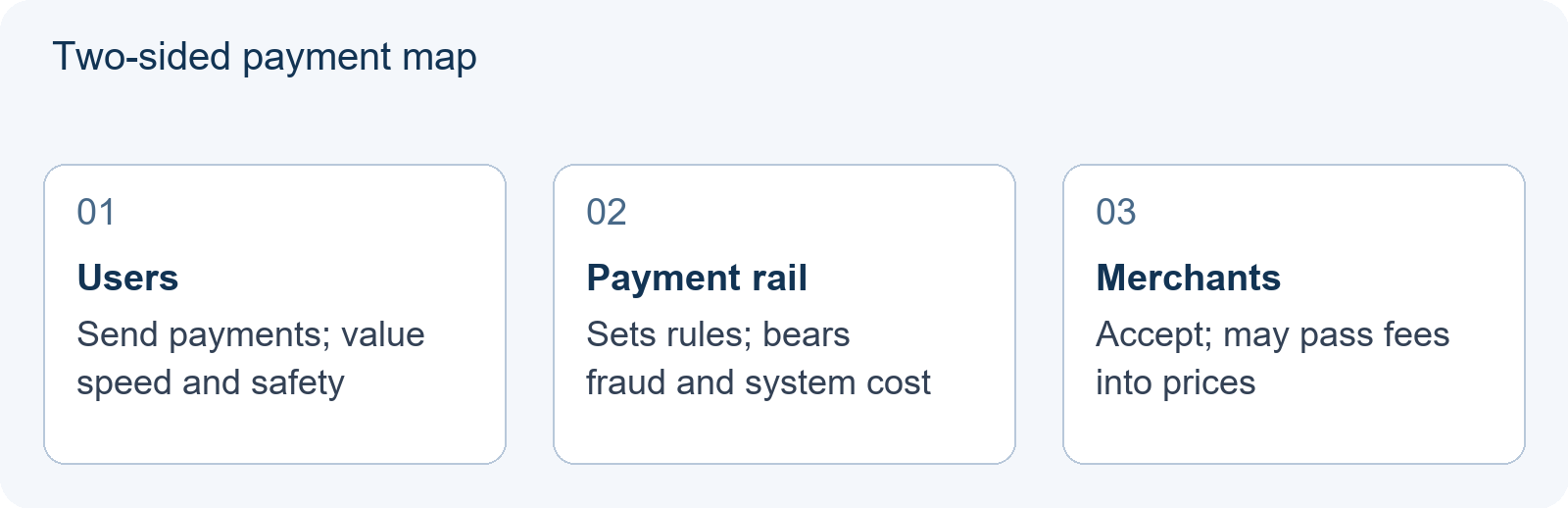
An everyday payment rail connects at least four parties: users who pay, merchants who accept, the payment infrastructure that clears transactions, and the public budget or regulator that sets rules and may absorb costs. The prompt gives a fee contrast, but a fee is not the same as an economic cost. A zero price at the counter can still be funded by general taxation, cross-subsidy from other services, float income, or hidden merchant charges.
| Model | Users | Merchants | Public budget | Main incidence question |
|---|---|---|---|---|
| UPI-style, as described in the prompt | No direct charge stated | No direct charge stated | Prompt does not specify the funding line | Which budget, fee or cross-subsidy covers the rail? |
| Pix-style, as described in the prompt | No direct charge stated | Small fee stated | Prompt does not specify any subsidy | How much of the merchant fee reaches consumer prices? |
| Analytical user-fee contrast | Pay per use or subscription | No direct fee | May still fund infrastructure | Does charging users suppress adoption? |
The table is a drafting aid, not a set of claims about either country’s full budget. The prompt says both systems were built by public bodies and each handles billions of payments a month, but it does not give matching transaction counts, merchant-size distributions, fraud losses or budget lines. Those missing data matter before anyone claims that one model is more efficient or fairer.
Why UPI and Pix are not a clean natural experiment
It is tempting to write: UPI is free to shops, Pix charges businesses, therefore one model is more inclusive. That inference is too fast. The comparison is not a controlled experiment with identical countries, identical merchant mixes and only the fee changed. The prompt gives a fee contrast, but not the data needed to isolate its causal effect.
A draft should use UPI and Pix to motivate a mechanism, then state what evidence would test it. For example: if merchant fees are passed into prices, consumers may bear part of a charge that is nominally paid by businesses. That is an incidence mechanism, not a proven fact about Brazil. To test it, a writer would need fee levels, merchant margins, pass-through evidence and the share of transactions affected. That distinction matters because UPI and Pix differ in many ways beyond the fee.
A labelled teaching illustration: where does the fee go?
This is a teaching illustration, not actual UPI or Pix data. Suppose a country’s payment rail handles 1,000,000 monthly transactions. A public-funding model costs $0.01 per transaction. A merchant-fee model charges $0.02 per transaction. Assume, for the sake of argument, that 50% of the merchant fee is passed into consumer prices.
| Item | Calculation | Monthly result |
|---|---|---|
| Public funding | 1,000,000 × $0.01 | $10,000 |
| Merchant fee revenue | 1,000,000 × $0.02 | $20,000 |
| Consumer pass-through at 50% | 0.50 × $20,000 | $10,000 |
| Merchant retained cost | $20,000 − $10,000 | $10,000 |
The arithmetic is balanced: $10,000 borne by consumers plus $10,000 retained by merchants equals the $20,000 fee. But the comparison is not an equivalence. The merchant fee raises twice the illustrative public cost. That gap is the interesting part. Is the fee a tax? Does it pay for fraud control, chargebacks, customer service or cross-subsidy? If the draft cannot explain the gap, it should not present the numbers as if they were directly comparable.
The illustration also shows why “free to users” is incomplete. If merchants pass half the fee into prices, users pay $10,000 indirectly even though their payment app shows no charge. A draft that stops at “individuals pay zero” has not finished the incidence analysis. For the elasticity logic behind pass-through, see HIEEC Essay Elasticity: Explain Why a Policy Works Differently Across Markets.
Efficiency: what does free buy, and what does it hide?
Payment rails can have network effects: a rail is more useful when more people accept it, and merchants value a rail more when more customers use it. That can justify public support for adoption, especially where the social benefit of a common rail exceeds what any single user or merchant would pay. A public body may also internalise security and standard-setting costs that fragmented private networks would duplicate.
But free is not costless. Fraud checks, dispute resolution, uptime and cybersecurity use real resources. If users and merchants face a zero price, they may demand more transactions or more customer service than they would if the cost were visible. That is an efficiency risk, not a proof that charging is better. The key question is whether the rail has large fixed costs and low marginal costs, making broad public funding attractive, or whether each extra transaction creates meaningful fraud and service costs that a small charge should signal.
A defensible essay distinguishes adoption externalities from ordinary subsidies. “More people should use the rail because acceptance becomes more valuable to everyone” is an externality argument. “The government should pay because payments are important” is not yet an economics argument.
Equity: who is actually free?
Equity analysis must ask who bears the merchant fee and who is outside the digital rail. A small merchant with thin margins may absorb the fee rather than raise prices, especially if demand is elastic. A larger merchant may pass more of the fee into prices. If the fee is spread across all prices, cash users may also pay higher prices without receiving the digital convenience. That is a possible distributional effect, not a universal result; it depends on market structure and pass-through.
Small merchants also face fixed compliance costs: signing up, reconciling payments, handling disputes and adapting to new rules. A small percentage fee can be less important than a fixed cost or a minimum charge. This is where a draft can move beyond “free is fair”: a Pix-style fee may be progressive if it is waived below a turnover threshold, but regressive if it hits micro-merchants hardest. The prompt does not supply such thresholds, so the writer must state the assumption or avoid the claim.
A useful equity section names the counterfactual. Compared with what? Cash? Private card networks? A subsidised rail with no merchant fee? A payment system is not equitable in the abstract; it is equitable relative to the next-best option for the people who actually use it.
The counterargument: hidden costs versus exclusion
One objection to free payments is that zero prices encourage overuse and hide the cost of fraud, disputes and infrastructure. If users do not see the cost, they may choose the rail when cash or another method would be cheaper for society. That risk is strongest when marginal costs are significant and demand is price-sensitive.
The opposite objection is stronger when merchant charges exclude small sellers. A merchant fee can be a barrier to entry if it is combined with fixed compliance costs or if small merchants cannot pass it on. In that case, a free-to-merchants model may broaden acceptance, but the public budget still bears the cost. The condition matters: hidden-cost risk dominates when fraud and service costs rise with each transaction; exclusion risk dominates when fixed costs and small-merchant margins are the binding constraint.
A defensible answer does not choose one risk forever. It states which risk dominates under which market conditions, then designs a rule: a small merchant exemption, a cap, a public-funding line, or a user fee with a free tier. Each rule has a different incidence.
Diagnostic: free to whom, funded by whom, which market failure?
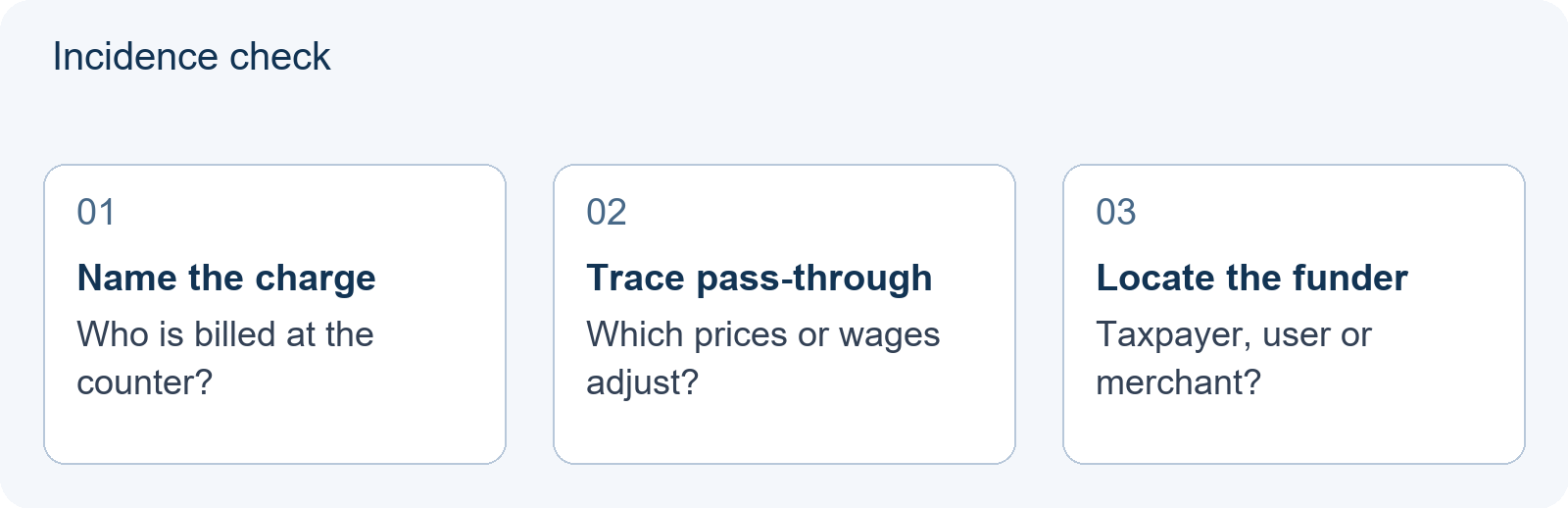
Before drafting the thesis, run a five-question test. First, free to whom: users, merchants, or both? Second, funded by whom: taxpayers, merchants, users, float income or cross-subsidy? Third, which market failure justifies the subsidy: network externality, natural monopoly, fraud, information asymmetry or exclusion? Fourth, what is the counterfactual: cash, private cards, or no rail? Fifth, what evidence would change the conclusion: pass-through rates, small-merchant margins, fraud losses or adoption gaps?
- A defensible thesis: everyday payments should be free at the point of use for individuals, but not necessarily free for all merchants; a small merchant fee is justified only if it buys reliability, fraud control and broad acceptance, and if exemptions prevent small-seller exclusion.
- A second defensible thesis: the rail should be free to users and merchants as public infrastructure when the fixed cost is high, marginal fraud cost is low and universal acceptance creates large network benefits; otherwise a transparent charge should fund the service.
Notice that both theses answer “should” and both name a funding source. A draft that says “UPI is free, so payments should be free” has described a policy, not defended one. The adjacent stablecoin and central-bank digital currency prompt raises different monetary-control questions; for that contrast, see Writing the Crypto and Finance Prompt: Stablecoins, CBDCs and Monetary Control in 1,500 Words.
When asking for feedback, bring a one-page memo: your chosen country or rail, the fee model, the assumed pass-through, the market failure and the counterargument you will test. That lets a reviewer challenge the economics rather than rewrite your prose. For a structured critique process, see How to Get Feedback on Your HIEEC Draft: A Two-Round Critique System That Works.
General event background is available at Event background.
Frequently Asked Questions
Does the HIEEC 2026-27 digital economy prompt require a direct UPI versus Pix comparison?
No. The prompt uses UPI and Pix as examples and asks about a country’s everyday payment system in general. You can compare them, but a useful essay can use the contrast to test a mechanism such as merchant-fee pass-through, then apply it to a clearly defined country or rail.
Should the essay conclude that everyday payments must be completely free or never free?
Neither extreme is required. The prompt asks “should,” so a conditional answer is defensible: free at the point of use for individuals may be justified, while merchant fees or public funding depend on fraud costs, network effects and small-merchant exclusion. State the condition that would reverse your conclusion.
Can I use a numerical example in the HIEEC digital economy essay?
Yes, if it is clearly labelled as a teaching illustration and every assumption is stated. Do not present hypothetical transaction counts or fee rates as actual UPI or Pix data. Use the numbers to show incidence, then explain what evidence would be needed to replace the assumptions.