The 2026-27 HIEEC inequality prompt is not asking for a simple yes or no. It asks to what extent big minimum-wage increases reduce inequality in countries where many people work informally. The defensible short answer is conditional: a large statutory increase can raise pay for covered formal workers, but its economy-wide effect on inequality is weaker, and may reverse for some groups, when coverage is low, compliance is uneven, or workers are displaced into informal jobs. A strong essay specifies a mechanism, a limit and an inequality measure.
What the 2026-27 inequality question asks
A Hanlin Courses WeChat post published 28 October 2026 (source note title translated as ‘HIEEC Harvard Economics Essay Competition 2026-27 Season Prompts Released: AI Takes Jobs, Globalization Retreats…’) reproduces the item under the heading ’05 Inequality’ as follows:
Inequality
Mexico’s minimum wage has more than doubled after inflation since 2016, while over half of Mexican workers have informal jobs outside the tax and labor system. To what extent do big minimum-wage increases reduce inequality in countries where many people work informally?
That is the complete question text supplied in the note. The source note did not include a separate English background block or the complete English shared-instruction text, so this guide does not paraphrase missing official wording here. The same note reports that the 2026-27 essay limit is 1,500 words including footnotes but excluding references; the file must be a single PDF no larger than 10MB; review is anonymous, so no author or school name should appear; the deadline is 5 January 2027, 11:59 p.m. ET; and both grade divisions answer the same questions. Verify the complete official wording before submission. This guide is independent and is not affiliated with Harvard University, HUEA or HCER.
Why informality changes the minimum-wage question
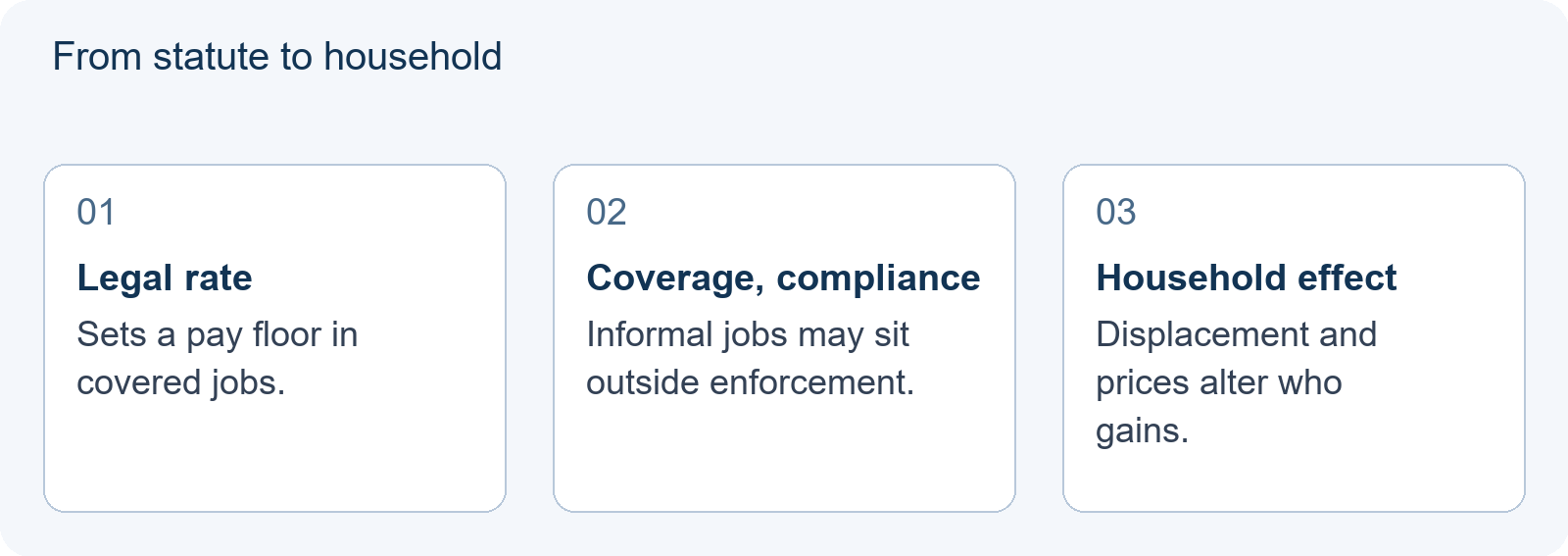
Start with coverage. A minimum wage is a legal floor for employees in covered jobs. Where over half of workers are informal, outside the tax and labor system as the prompt puts it, the statute may not bind their pay at all. Informal work can include unregistered firms, casual labor, self-employment and jobs that are hidden from labor inspection. The key question is not whether the law announces a higher wage, but how many workers are covered, how employers comply, and what happens to workers who lose formal jobs.
A high legal minimum with low coverage is partly symbolic. It can still matter: it may set a reference point for wage bargaining, shape formal-sector norms, or encourage some formalization when registration brings benefits. But those are channels to argue, not assumptions to assert. An essay that simply applies a standard competitive labor-market diagram to all workers will miss the central feature of the prompt: the wage floor may cover only part of the labor market.
The formal-sector effect is not the whole effect
For covered workers, the direct effect of a higher minimum wage is a pay increase. What happens next depends on employer responses. A profit-constrained firm may cut hours, hire fewer workers, substitute capital, reorganize tasks, or pass costs into prices. If demand for low-wage labor is relatively inelastic, employment loss may be small; if it is elastic, job loss may be larger. This is the kind of market-specific reasoning covered in HIEEC Essay Elasticity: Explain Why a Policy Works Differently Across Markets.
The distributional effect inside the formal sector is also mixed. Workers who keep covered jobs gain. Workers who lose them may lose far more than the wage increase. Employers, consumers or taxpayers may bear part of the cost through lower margins, higher prices or reduced hours. So the phrase ‘reduces inequality’ needs a population and a unit: covered workers? all workers? households? hourly wages or monthly income? The direct formal-sector gain is real, but it is not yet an economy-wide inequality result.
A worked teaching illustration: 100 workers
The following is a hypothetical teaching illustration, not Mexico data. Suppose an economy has 100 workers. Before the policy, 60 informal workers earn $6 per hour and 40 formal workers earn $10 per hour. Total wage income is 60 x $6 + 40 x $10 = $360 + $400 = $760. The formal-informal wage gap is $4 per hour, and the formal-informal wage ratio is 10 / 6 = 1.67.
| Stage | Informal workers | Informal wage | Formal workers | Formal wage | Total wage income |
|---|---|---|---|---|---|
| Before | 60 | $6 | 40 | $10 | $760 |
| After | 65 | $6 | 35 | $12 | $810 |
Now raise the minimum wage to $12. Suppose 35 formal jobs remain at $12, while 5 former formal workers are displaced into informal work at $6. After the change, total wage income is 65 x $6 + 35 x $12 = $390 + $420 = $810. Average wage income rises from $7.60 to $8.10. The formal wage bill rises from $400 to $420.
But the distribution is not uniformly better. The formal-informal gap widens from $4 to $6, and the formal-informal wage ratio rises from 1.67 to 2.00. The five displaced workers lose $4 per hour each relative to their previous formal wage. The formal sector’s share of this simple wage bill actually falls slightly, from about 52.6% to 51.9%, even though formal workers who keep their jobs gain. Whether household inequality rises or falls depends on household composition, hours, prices, taxes and transfers, none of which this illustration models. The point is narrower: total wage income can rise while the sector gap widens and displaced workers lose.
Displacement, prices and the tax base
Displacement is central because a minimum wage can move workers from formal to informal work. The illustration has five displaced workers; in a real economy, displacement can appear as fewer hours, subcontracting, self-employment or non-compliance. If the informal sector absorbs more workers, informal wages may fall under pressure, so even workers who were already informal can lose. Firms may also pass higher costs into prices, which matters if poor households spend a larger share of income on the affected goods.
The tax base is another channel. If the formal wage bill shrinks relative to total wage income, or if firms reorganize to avoid payroll taxes, the government may collect less revenue for redistribution. That does not automatically make the policy bad, but it weakens the claim that a minimum wage alone will reduce inequality. A minimum wage is a price floor, not a transfer: it can help covered workers, but it does not by itself reach informal workers or compensate displaced workers.
Which inequality? Match the measure to the claim
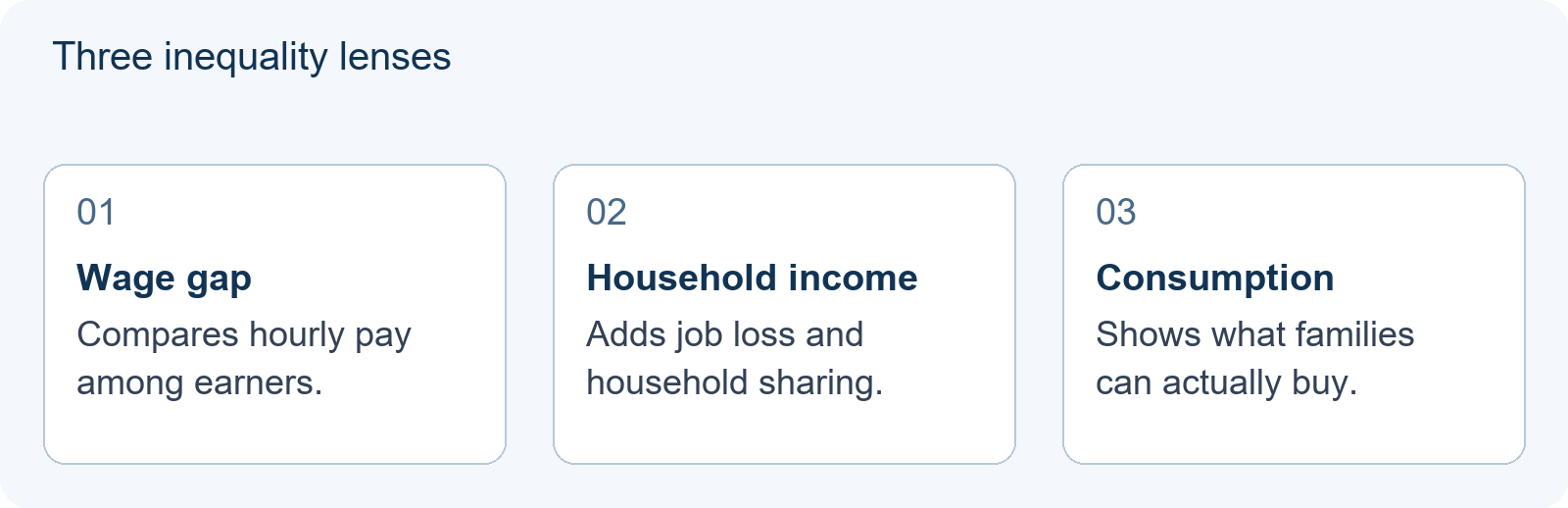
Different inequality measures can move in different directions. The prompt does not require one measure, but a strong essay must state the population and unit and then justify the choice. Use a table like this to keep the claim consistent:
| Measure | Population and unit | What it captures | What can mislead |
|---|---|---|---|
| Formal-sector wage gap | Covered employees, hourly wage | Pay floor among formal jobs | Ignores informal workers and job loss |
| Economy-wide wage inequality | All workers with earnings, hourly or monthly | Dispersion across formal and informal work | Misses hours, unemployment and household sharing |
| Household income inequality | Households, per-capita or equivalized income | Job loss, multiple earners and transfers | Informal income is hard to measure |
| Consumption inequality | Households, consumption per person | What families can actually buy | Prices and borrowing affect the link to income |
| Fiscal redistribution | Taxes and transfers, government budget | Tax base and spending capacity | Not a household outcome by itself |
This is where welfare language can slip. A policy can improve efficiency in one market while worsening fairness in another. For a fuller distinction, see HIEEC Welfare Analysis: Distinguishing Efficiency Gains From Fairness Claims. For a different past inequality prompt on universal basic income and data dividends, see Past HIEEC Inequality Prompt Practice: Universal Basic Income vs Data Dividends in 1,500 Words.
The counterargument: when a minimum wage still matters
A minimum-wage increase can still reduce inequality where informality is high, but the argument needs institutions. It may raise the reference wage, strengthen bargaining for low-paid formal workers, or encourage formalization if registration brings social insurance and legal protection. It may also compress pay within the covered sector. These effects are plausible, but they are conditional. Weak enforcement can make the policy symbolic; strong enforcement without adjustment support can increase displacement.
A defensible answer therefore avoids two errors. The first is asserting that a higher minimum wage must reduce inequality because it raises wages. The second is dismissing it because informality exists. The question asks about extent, so the answer should identify the conditions under which the policy helps: coverage, compliance, labor-demand elasticity, the size of the increase, the informal sector’s capacity to absorb displaced workers, and the inequality measure used.
A one-paragraph thesis test for your draft
Try a thesis with three parts: mechanism, limit and measure. For example: ‘A large minimum-wage increase can reduce wage inequality among covered formal workers by raising their hourly pay, but in an economy where over half of workers are informal, its economy-wide effect on household inequality is limited and may be offset by displacement and non-compliance; the extent depends on coverage, enforcement, labor-demand elasticity and whether the chosen measure is wage, household income or consumption.’ Then test every body paragraph against one of those clauses. If a paragraph does not establish the mechanism, the limit or the measure, cut it or rewrite it.
Also keep the prompt’s Mexico premise in its proper place. The note’s question says Mexico’s minimum wage more than doubled after inflation since 2016 while over half of Mexican workers have informal jobs. That is context supplied by the prompt, not proof that a minimum-wage increase caused a particular inequality change. Use it to frame the question, then argue with mechanisms and evidence rather than treating the premise as a causal estimate.
How to prepare a useful feedback or resource request
Before asking a teacher, coach or peer for feedback, prepare a one-page brief: the exact prompt; your chosen inequality measure and population; your coverage assumption; the counterfactual; one mechanism; one limit; and one piece of evidence you still need. This is not a checklist for a particular service. It is the minimum another reader needs to test whether your argument answers the question.
If you request resource help, ask for something answerable: ‘Which official or peer-reviewed source measures informal employment and minimum-wage compliance in Mexico for the period after 2016?’ or ‘Where can I find comparable household income and consumption data?’ That is more useful than a generic reading list. A well-reasoned essay on this prompt will not hide the informal sector behind a formal-sector diagram; it will show who is covered, who is displaced and which inequality measure is doing the work.
General event background is available at Event background.
Frequently Asked Questions
Does the 2026-27 HIEEC inequality prompt require a yes or no answer?
No. The phrase ‘to what extent’ asks for a degree and conditions. A strong answer explains when large minimum-wage increases reduce inequality, through which mechanism, and for which measure.
Is the $6, $10 and $12 example Mexico data?
No. It is a hypothetical teaching illustration with 100 workers, used only to show how total wage income can rise while the formal-informal gap widens and displaced workers lose.
Which inequality measure should I use?
State the population and unit, then justify the measure. Wage, household income, consumption and fiscal measures capture different things, and the supplied prompt does not require one single measure.