In the drafts we review with China-based students, most arrive at around 2,300 words. The current rule is blunt: up to 1,500 words including footnotes and excluding references. So revision is not polish — it is the difference between a judge reading your conclusion and never seeing it. This is a five-pass method for cutting roughly 800 words while the argument gets stronger, not thinner.
Cutting is a rules problem before it is a style problem
Start from what the competition actually states. For 2026-27, HUEA publishes a limit of up to 1,500 words that includes footnotes and excludes references; the rules do not name separate exclusions for titles, headers or figure captions. Submissions are anonymous single PDFs of no more than 10 MB, any standard consistent citation style is accepted, and ownership and plagiarism terms should be confirmed against the current page. Always confirm the current wording for your cycle on thehuea.org before you submit.
Three consequences follow, and they change how you cut:
- Over-length is a compliance problem, not a style problem. An over-length essay is not a place to hide extra analysis: the limit includes footnotes, so every note competes with body text. Assume the reader will judge the essay against the stated limit and keep your bounded claim inside it.
- Trimming your bibliography saves you nothing. References sit outside the count, so deleting sources is pure loss: fewer verifiable claims, identical word count. Cut prose, never citations.
- Footnotes are not extra space. Because footnotes count inside the 1,500 words, moving a definition or data caveat into a note still costs words; use notes for precision, not overflow. What the rules do not spell out is whether titles, headers or figure captions are excluded; do not gamble on the ambiguity. Build the essay so it clears 1,500 words on the strictest reading, and confirm the current interpretation on the official site.
If you have not yet mapped how the 1,500 words should be distributed in the first place, read our structure guide on writing the 1,500-word HIEEC essay before you start cutting — revising a draft that was mis-budgeted from the outset is much slower than re-outlining it.
The cut hierarchy: what goes first
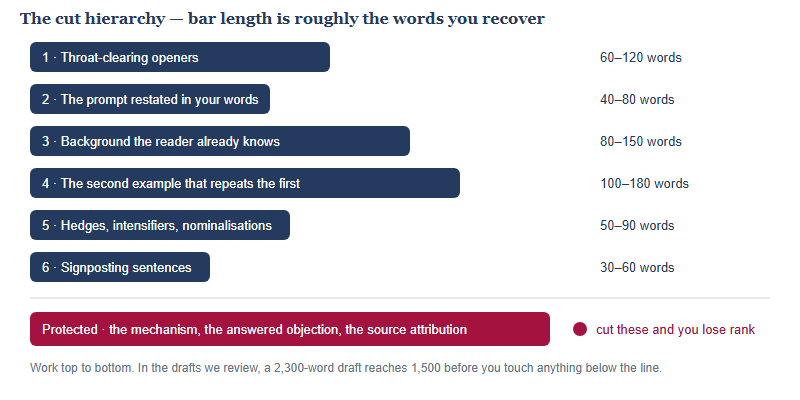
Undisciplined cutting shaves a few words from every sentence and leaves an essay that is uniformly compressed and uniformly flat. Disciplined cutting removes whole categories of text in a fixed order, so that the analytical core is never touched until everything else is gone.
| Order | What to remove | Why it is safe | Typical saving |
|---|---|---|---|
| 1 | Openers such as “In today's increasingly globalised world” or “Economics has long debated” | Carries no claim, no evidence and no mechanism. The judge has read hundreds of them. | 60–120 |
| 2 | Your paraphrase of the prompt | The judge chose the prompt. Restating it proves nothing and delays your thesis. | 40–80 |
| 3 | Textbook background (what inflation is, how tariffs work) | A specialist reader assumes it. Keep only the definition your argument turns on. | 80–150 |
| 4 | The second illustration that makes the same point as the first | Two examples of one mechanism is repetition. One example plus one objection is analysis. | 100–180 |
| 5 | “It is important to note”, “very significant”, “the implementation of” | Hedges and nominalisations dilute the sentence they sit in. | 50–90 |
| 6 | “This essay will now turn to…” | Under 1,500 words the structure is visible without narration. | 30–60 |
The five passes, with time boxes and stop rules
Each pass has one job. Doing them simultaneously is why revision stalls: you cannot judge whether a paragraph belongs while you are also rewording its third sentence.
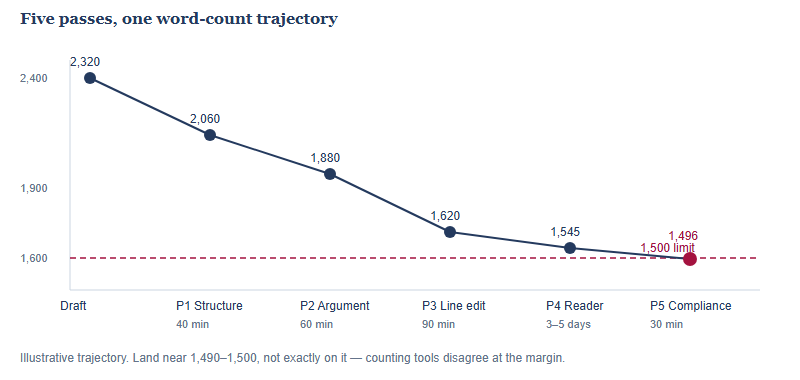
Pass 1 · Structure (40 minutes). Copy only your topic sentences into a separate document. Read that list on its own. If it does not read as a connected argument, the problem is not your prose. Delete or merge any paragraph whose topic sentence does not advance the thesis, and stop as soon as the list reads cleanly — do not start rewording.
Pass 2 · Argument (60 minutes). For each surviving paragraph ask: does this state a mechanism, supply evidence for one, or test one? Anything that only describes a situation is a cut candidate. This is also where you check that the essay answers your chosen prompt rather than the topic in general — a distinction we cover in choosing your HIEEC prompt.
Pass 3 · Line edit (90 minutes). Now, and only now, work sentence by sentence with the compression patterns in the next section. Set a per-paragraph target rather than a global one: knowing that a 210-word paragraph must reach 160 makes the decisions concrete.
Pass 4 · Reader (three to five days of elapsed time). Give a full draft to one teacher, one strong peer or one mentor, and ask three specific questions instead of “is it good?”: What do you think my claim is? Where did you stop believing me? Which paragraph could disappear without loss?Act on structural feedback; ignore feedback that is really a different essay. The line you must not cross is authorship: the essay must be your own argument in your own words, and every source used must be cited. Someone rewriting your sentences for you is not revision. Feedback of this kind is normal; the current page does not specify a mandatory outside-assistance declaration, so ask HUEA if you are unsure and confirm the current wording on thehuea.org.
Pass 5 · Compliance (30 minutes).Pass 5 · Compliance (30 minutes). Count the body text on the strictest reading. Confirm one standard consistent citation style is used throughout, export to PDF and reopen the file to check nothing reflowed. Remember that entrants are limited to one essay; the current page does not specify a first-entry-only rule, so if you need to correct a submission, contact HUEA rather than assuming a replacement file will be read. Check the current deadline, time zone and reading fee on thehuea.org — our registration, fees and submission guide walks through the submission form, fee payment, time-zone conversion and one-essay rule. For 2026-27 the deadline is 5 January 2027 at 11:59 pm Eastern Time, equivalent to 6 January 2027 at 12:59 pm Beijing, with no late entries; fees are USD25 for a school in the USA and USD35 for a school outside the USA, based on school location, and optional written feedback is USD20 after results. Confirm figures for your own cycle.registration, fees and submission guide walks through the submission form, fee payment, time-zone conversion and one-essay rule. For 2026-27 the deadline is 5 January 2027 at 11:59 pm Eastern Time, equivalent to 6 January 2027 at 12:59 pm Beijing, with no late entries; fees are USD25 for a school in the USA and USD35 for a school outside the USA, based on school location, and optional written feedback is USD20 after results. Confirm figures for your own cycle.
Line-level compression: where 300 words hide
Pass 3 is mechanical once you recognise the four patterns that inflate student economics prose. The sentences below are illustrative examples written for this guide, not model answers — the point is the transformation, not the content.
| Pattern | Before | After | Saved |
|---|---|---|---|
| Announcement | “In this essay, I will argue that trade liberalisation has had mixed effects.” (12) | “Trade liberalisation raised aggregate output while concentrating adjustment costs regionally.” (10, and it now states the claim) | 2 words, large gain in force |
| Nominalisation | “The implementation of the policy led to a reduction in emissions.” (11) | “The policy reduced emissions.” (4) | 7 |
| Hedge stack | “It is important to note that, in many cases, this effect may possibly be quite significant.” (16) | “This effect is large in the cases studied.” (8) | 8 |
| Narrated evidence | “Data published by the World Bank in 2023 showed that GDP per capita had increased over the period in question.” (20) | “GDP per capita rose over the period, with the source given in a footnote.” (14 in body; the citation itself sits outside the count) | 6 plus the citation |
Four transformations of this size in every paragraph of a ten-paragraph essay is roughly 250–300 words — usually the entire remaining gap after passes 1 and 2. Where does the total come from? A realistic ledger for a 2,320-word draft looks like this.
| Section | Draft | Target | Cut | Where the cut comes from |
|---|---|---|---|---|
| Opening | 300 | 190 | −110 | Scene-setting and the restated prompt |
| Framework & mechanism | 560 | 430 | −130 | Textbook derivation the reader assumes |
| Evidence & application | 780 | 520 | −260 | The duplicate example; narrated statistics |
| Objection & response | 350 | 200 | −150 | Restating the objection twice before answering |
| Conclusion | 330 | 156 | −174 | Summary of everything already said |
| Total | 2,320 | 1,496 | −824 | No analytical content removed |
Have you cut muscle instead of fat?
There is a failure mode on the other side. Essays cut too aggressively read as competent summaries: everything is accurate, nothing is argued. Because the strongest essays are passed to a final panel, and HUEA intends to involve Harvard faculty or other economics professionals if possible, not guaranteed, a compressed-but-empty essay is exactly the profile that clears a first read and stalls on the second.
Run these four diagnostics on your 1,496-word version. Any “no” means you should restore words by cutting further down the hierarchy instead.
- The mechanism test. Can a reader point to the sentences explaining why your cause produces your effect? If the causal chain has been compressed into an assertion, you cut muscle.
- The objection test. Does one paragraph still state the strongest case against you and answer it? A deleted objection is the most expensive 150 words you will ever save.
- The attribution test. Is every number still traceable to a named source? Compressing “according to the IMF's World Economic Outlook” into “studies show” saves five words and costs your credibility.
- The specificity test. Does the essay still contain at least one claim that only you would make? If cutting has produced a general survey of a topic, restore your distinctive analysis and delete more background instead.
A practical rule from drafts we review with China-based students: when the essay finally fits, put it away for 48 hours and read it cold once more. Reading your own compressed prose immediately after cutting is the least reliable moment to judge whether it still makes sense. If you are unsure what “well-argued” looks like at this length in the first place, our overview of what HIEEC is and how it is judged sets the standard the revision is aiming at.
Frequently asked questions
Does the 1,500-word limit include my references?
References are excluded, but footnotes are included inside the 1,500-word limit; the rules do not name separate exclusions for titles, headers or figure captions. Confirm current wording on thehuea.org.
What happens if my essay is 1,600 words?
The rule is up to 1,500 words including footnotes; an over-length draft does not fit the stated limit. Cut it before submitting and confirm the current rule.
Can a teacher edit my draft for me?
Ask for feedback and questions, not rewriting. AI tools are allowed, but the ideas and arguments must be yours and every source used cited; confirm current integrity wording on thehuea.org.
Should I aim for exactly 1,500 words?
Aim for about 1,490. Word-count tools disagree at the margin, and there is no reward for using every available word.
This is an independent guide operated by Hanlin Education for China-based international-school students. We are not affiliated with, endorsed by, or sponsored by the Harvard Undergraduate Economics Association (HUEA), the Harvard College Economics Review, or Harvard University. Rules, fees, deadlines and prompts change between cycles — always confirm current details on thehuea.org. Factual errors reported to our editorial desk are corrected within 7 working days.