If you study in China, the Chinese economy is the case you can write about with real detail — and the case most likely to lose your reader. HIEEC essays are screened by the HUEA board and, for the top ten, adjudicated by an Economics Professor at Harvard: readers who know economics but may not know your institutional context. This guide covers sourcing, translation and framing so your home-market advantage survives the read.
Your advantage, and the two ways it goes wrong
Using China as your evidence base is legitimate and often strong. You can read primary Chinese-language sources, you have direct observation of institutions most applicants only read about, and you can supply detail that a generic essay on the same prompt cannot. There is no country requirement in the prompts we have seen — what governs your case selection is the prompt itself, which is reissued each cycle and can be scoped to a particular question or region. Read this cycle's four prompts on thehuea.org before assuming a China case fits, and see our breakdown of the four HIEEC prompt categories for how they have been framed in past years.
Two failure modes account for most of the lost marks in China-based drafts we review.
- The cliché essay. It recites scale — largest this, second-largest that, fastest growth in history — and concludes that China is important. Every number is true and none of them is an argument. A specialist reader has seen the aggregates; what they have not seen is your mechanism.
- The opaque essay. It is full of genuine institutional detail — the hukou system, land finance, provincial transfers, policy banks — used as if the reader already shares your background. The judge cannot evaluate a mechanism built from terms they cannot place, so the essay reads as assertion.
The fix for both is the same discipline: every China-specific fact in the essay must earn its place by doing analytical work, and must be legible to a reader who has never lived here. That is a writing problem with a repeatable solution, not a matter of luck.
Sources a non-China reader can actually check
Evidence is only as good as the reader's ability to verify it. A number the judge cannot trace is, functionally, a number you asserted. Rank your sources by verifiability before you rank them by convenience.
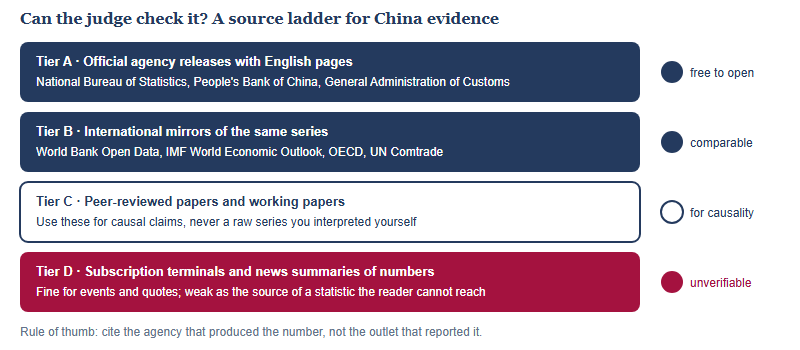
| Source | Best used for | How to cite it | Caveat to state |
|---|---|---|---|
| National Bureau of Statistics of China | National accounts, prices, employment surveys, the Statistical Yearbook | Agency, release title, release date, table number | Give the series name and check the agency's methodology note for coverage and definitions |
| People's Bank of China | Monetary aggregates, credit and financial statistics | Agency, statistical release, period covered | Definitions of aggregates differ across countries — say which one you use |
| General Administration of Customs | Trade values and volumes by partner and product | Agency, monthly or annual release, date | Bilateral trade data rarely match the partner country's mirror figures |
| World Bank / IMF / OECD / UN Comtrade | Cross-country comparison on a consistent basis | Database name, indicator code, access date | Harmonisation can differ from the national release — do not mix the two in one comparison |
| Academic papers using Chinese microdata | Causal claims and identified effects | Full reference in Chicago or APA | Working papers are not peer reviewed — say so |
Two habits protect you further. First, cite the vintage: statistical agencies revise series, so a number without a release date invites a reader to assume you took it from a headline. Second, never let a translated figure travel without its original series name; if you converted or re-based anything yourself, say so in a footnote. Because the stated word limit excludes references and footnotes, that transparency is close to free — a point we develop in our guide to writing the 1,500-word essay.
The three-sentence translation rule
Institutional detail is your advantage only if the reader can use it. The rule we apply in editing: any China-specific institution gets at most three sentences, in this order — name it, say what it does in one line, then say why it matters for your mechanism. If it cannot earn all three, it does not belong in a 1,500-word essay.
Worked pattern, using the household registration system:
- Name. “China's household registration system (hukou)…”
- Function, one line. “…ties eligibility for some local public services to a registered place of residence, with rules that vary by city.”
- Why it matters here. “…which means internal migration can raise measured productivity without a matching rise in local service take-up — the wedge this essay exploits.”
Notice what the third sentence does: it converts background into analysis. Without it you have written an encyclopaedia entry; with it you have given the reader the piece of context your argument actually needs. The same pattern works for local government financing vehicles, provincial fiscal transfers, policy banks, or state-owned commercial banks — and any specific claim in the “function” line should carry a citation, since institutional rules change and vary locally.
A discipline that follows from the rule: pick one institution. A 1,500-word essay can afford one translated institution doing real work. Two produces an essay about Chinese institutions rather than an answer to the prompt — the judgement call our guide to choosing your prompt by strength is designed to force early.
From country description to testable mechanism
The single largest upgrade available to a China-based entrant is to stop describing the country and start testing a mechanism in which China is the evidence. The prompt is never “tell me about an economy”; it asks a question, and your case study is how you answer it.
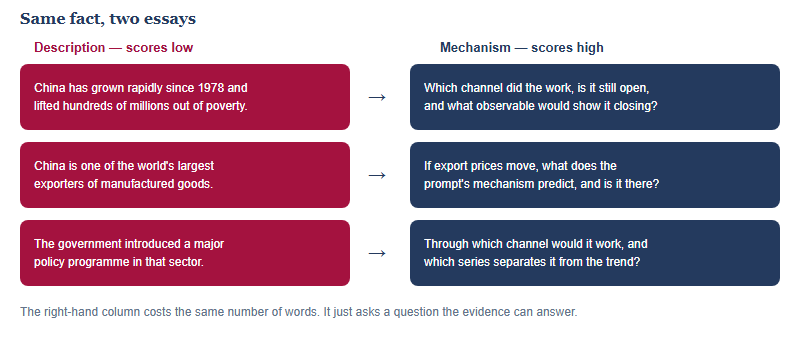
A comparator sharpens this further. One country in isolation shows a pattern; two cases show whether the mechanism travels. You do not need a formal cross-country study — a single well-chosen contrast, cited properly, is enough to demonstrate that you are testing an idea rather than narrating a nation.
| Weak framing | Stronger framing | Why the second works |
|---|---|---|
| “China's experience shows that industrial policy works.” | “China's experience is consistent with industrial policy working where X held; the same policy in [comparator] lacked X.” | Names the condition, so the claim can be tested rather than believed |
| “As the world's second-largest economy, China matters for this question.” | “China is the useful case here because it varies on the one dimension the prompt asks about.” | Justifies the case selection analytically instead of by size |
| “Chinese data show a sharp increase after 2015.” | “The series rose after 2015; the rival explanation predicts the same path, so I use [second series] to separate them.” | Anticipates the confounder instead of leaving it to the reader |
Your context budget, your register, and a final check
Context is expensive. In a strict 1,500-word essay where anything past the limit is truncated, we budget it explicitly:
| Element | Body-text budget | What to do with the rest |
|---|---|---|
| Institutional translation (one institution, three sentences) | 60–80 words | Extra definitional detail goes in a footnote |
| Data description (series, period, source signal) | 40–60 words | Full citation sits in references, which the rules exclude |
| Comparator case | 80–120 words | Keep to the one dimension being compared |
| Country background (history, scale, narrative) | 0–30 words | Cut it — this is the first thing to go when you are over the limit |
Register matters as much as budget. Your readers are economics readers: they are evaluating whether the mechanism is right and the evidence supports it. Positive analysis — what the policy does, through which channel, with what trade-offs and what evidence — travels to any reader in any country. Advocacy, in either direction, invites the reader to weigh their priors instead of your argument. Describe the policy, name the trade-off, attribute the claim, and let the evidence carry the judgement. This is standard practice for writing about any country's economy in a competitive essay, and it is what the analytical criteria reward.
Before you submit, run the China-case check:
- Could a reader who has never been to China follow every institution I mention?
- Is every statistic traceable to an agency or database the reader can open, with a release date?
- Does my case study answer the prompt, or does it describe a country?
- Have I limited myself to one translated institution and one comparator?
- Is any specific institutional rule I state supported by a citation rather than by my own experience?
- Would the essay still have a thesis if the word “China” were replaced by “Country A”?
That last question is the one worth sitting with. If the answer is no, the essay is about a place. If the answer is yes — the argument survives, and China is the evidence that tests it — then your home-market knowledge is doing exactly the work it should. For the wider picture of what the competition asks for and how it is judged, start with our overview of what HIEEC is, and confirm all current rules, fees and deadlines on thehuea.org.
Frequently asked questions
Can I write my HIEEC essay about China?
Usually, but check the prompt first. There is no country requirement in the prompts we have seen; what governs case selection is the prompt itself, which is reissued each cycle and can be scoped to a particular question or region. Read this cycle's four prompts on thehuea.org.
Can I cite Chinese-language sources?
Prefer an official English release or an international mirror of the same series, so the judge can verify the number themselves.
How much background context should I include?
Very little. Budget 60–80 words for one institution and push definitions into footnotes, which the stated limit excludes.
Is a China case study a disadvantage with overseas judges?
No — an unexplained one is. Translate each institution in three sentences and every reader can follow the mechanism.
This is an independent guide operated by Hanlin Education for China-based international-school students. We are not affiliated with, endorsed by, or sponsored by the Harvard Undergraduate Economics Association (HUEA), the Harvard College Economics Review, or Harvard University. Data definitions, institutional rules and competition requirements change — verify statistics with the publishing agency and confirm current competition details on thehuea.org. Factual errors reported to our editorial desk are corrected within 7 working days.