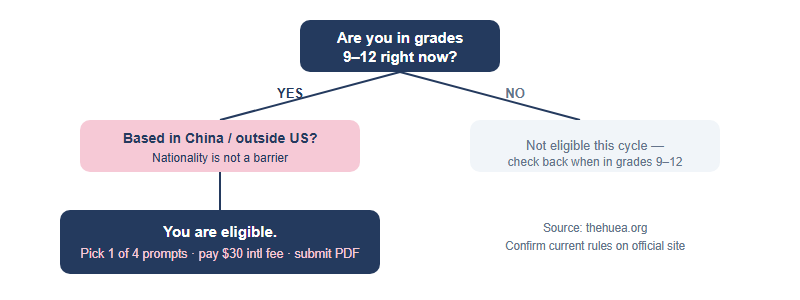
International and China-based students enter HIEEC the same way as any other high schooler: there is no nationality restriction. Per thehuea.org, the contest is open to students in grades 9–12, you choose one of four prompts, write a strict 1,500-word essay in Chicago or APA style, pay a reading fee ($20 US / $30 international), and submit one PDF via an online form before the early-January EST deadline. HIEEC is run by HUEA, a Harvard student club — not Harvard University.
Who can enter from China — and who runs HIEEC
First, the positioning that trips up most families. HIEEC stands for the Harvard International Economics Essay Competition (also styled as HUEA's “Fall Essay Contest”). It is organised by the Harvard Undergraduate Economics Association (HUEA), which describes itself as a student organisation that “strives to create a more inclusive economics community at Harvard and beyond.” HUEA is a student-run undergraduate club based at the Student Organization Center at Hilles in Cambridge, MA. It is not Harvard University's admissions office, and entering HIEEC does not create any relationship with the University. We say this plainly because the word “Harvard” in the title leads some to imply more than the official source supports. Treat it as a respected student-run essay contest with a Harvard professor in the final judging loop — nothing more, nothing less.
On eligibility, the official page is refreshingly simple: grades 9–12 are permitted, and the contest is open to high school students of any year. There is no clause excluding students outside the United States, no “must attend a US school” requirement, and no separate “international division.” A Year 11 student at a Shanghai or Shenzhen international school sits in exactly the same pool as a US 11th-grader. If you are in the IB, A-Level, or AP track and currently in grades 9–12, you qualify. The only line the official source draws is that the essay must be your own original work, not previously published, with one submission per person. For a fuller primer on what the contest is, see our companion piece, What Is HIEEC.
The format you must hit: 1,500 words, one prompt, PDF
HIEEC is a tight-format contest, and the constraints are non-negotiable. The official requirements, as listed on thehuea.org for the 2025–2026 cycle:
- Word limit: 1,500 words, strict. The count excludes references, footnotes, titles, headers, and footers — but anything beyond 1,500 in the body is truncated, so a 1,650-word essay simply loses its last 150 words (often your conclusion). Treat 1,500 as a hard ceiling, not a target you can overrun.
- Choose one of four prompts. Four prompts are released each cycle; you write on exactly one. We do not reproduce the current wording here because prompts change year to year — read them live on the official site, and see how to choose your HIEEC prompt for a selection framework.
- Citations: Chicago or APA. Pick one style and apply it consistently. For an economics essay, in-text data and source attribution matter, so build your reference list as you draft, not at the end.
- Format: PDF only. Export your final file as a PDF before submitting.
- One submission per person; original, unpublished work. You cannot enter twice or recycle an essay published elsewhere.
For international students specifically, the 1,500-word ceiling is the single biggest adjustment. If English is your additional language, the instinct is to over-explain — and over-explaining is exactly what burns your budget. The discipline that wins is one tight argument, well-evidenced, ruthlessly cut. Our full walkthrough on staying inside the limit lives at writing the 1,500-word HIEEC essay.
The fee and the deadline — in Beijing time
Two procedural facts matter most for China-based entrants, because they differ from the US experience: the fee tier and the timezone.
Fee. The reading fee is $20 for US applicants and $30 for international applicants, paid upon submission of the essay. If you are sitting at an international school in China, you are an international applicant: budget the $30. The official page notes that financial aid is available on request — the stated route is to email the organisers with a brief explanation (use the exact subject-line format the form specifies). Do not assume a fee waiver is automatic; it is requested, not granted by default.
Deadline and timezone. This is where international entrants lose essays every year. The official deadline for this cycle is January 5th, 11:59 PM EST, 2026. HIEEC runs on US Eastern Time, and China Standard Time (Beijing) is 13 hours ahead of EST. So the cutoff in Beijing is roughly 12:59 PM on January 6th — the morning after the date printed on the page. If you mentally file “January 5th” as your deadline and plan to submit on the evening of the 5th Beijing time, you are fine; but if you wait until late on January 6th Beijing time, you have already missed it. Always confirm the exact date and time on the official site each cycle, and convert it to your local time before you plan. Note too that there is a submission cap of 600 essays for the cycle — another reason not to leave it to the final hours.
| Item | US applicant | China-based / international applicant |
|---|---|---|
| Eligibility | Grades 9–12 | Grades 9–12 (same pool, no separate division) |
| Reading fee | $20 | $30 |
| Word limit | 1,500 words strict (excl. references/footnotes/titles/headers/footers) | |
| Prompts | Choose 1 of 4 (released each cycle) | |
| Citation | Chicago or APA | |
| File format | PDF only | |
| Deadline reference | Jan 5, 11:59 PM EST | Jan 5, 11:59 PM EST → ~Jan 6, 12:59 PM Beijing |
| Submissions | One per person; original, unpublished work | |
How you actually submit: the entry path, step by step
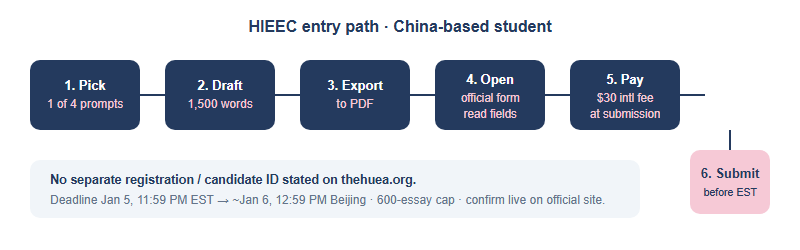
Here is the part where the fact-check matters most, so we will be precise about what the official source does and does not say. Based on thehuea.org, there is no separate “register first, then submit” step stated, and the page does not mention any candidate ID, registration number, or account creation. Submission is via an online form, and the reading fee is paid at the point of submission. If you have entered other competitions that issue a candidate ID at registration, do not assume HIEEC works the same way — it does not appear to, per the official instructions. Confirm the exact mechanics in the live form before you start.
A clean entry sequence for a China-based student:
- Read the four prompts on thehuea.org and choose one. This is a strategic choice, not a coin flip — pick the prompt where you have a genuine angle and accessible data.
- Draft to 1,500 words. Build your Chicago/APA references as you write. Cut hard; the limit truncates, it does not warn.
- Export to PDF. Check that footnotes and your reference list render correctly in the exported file.
- Open the official submission form and read every field carefully — the official site warns that failing to complete any step correctly may mean your submission is not considered.
- Pay the $30 international reading fee at submission. If cost is a genuine barrier, email the organisers in advance using the financial-aid subject-line format the form specifies, rather than missing the deadline.
- Submit before the EST cutoff — planned in Beijing time. Aim to finish a full day early; the 600-essay cap and the timezone gap leave no room for a last-minute scramble.
What happens after you submit — and a realistic take on value
Judging, per the official source, works in two stages: essays are judged by the HUEA board, and the top 10 are adjudicated by a Harvard economics professor. Recognition takes three published forms — the top three winning essays are published on the website, a finalists list is published, and a “Highly Commended” distinction is published. There is no separate international prize tier announced; everyone competes in one pool, which is precisely why a strong essay from a China-based student carries the same weight as one from anywhere else.
On the question every parent asks — is it “worth it” for admissions? Be honest with yourself. HIEEC is a credible, low-cost way to (a) practise writing a disciplined economics argument under a hard word limit, and (b) earn a verifiable distinction if you place. It is not an admissions guarantee to Harvard or anywhere else, and no essay contest is. The value is the writing reps and a line you can speak to in interviews, not a backdoor. As a first-party note on tutoring: our team has a strong record coaching students to wins in comparable economics essay competitions — including multiple John Locke Institute economics-essay placements (those are John Locke results, not HIEEC results). We mention that only to be transparent about where our coaching experience comes from; the skills transfer, but we never relabel one competition's wins as another's.
FAQ
Can students based in China enter HIEEC?
Yes. Per thehuea.org, the contest is open to high school students in grades 9–12 with no nationality restriction; China-based international-school students enter the same pool, paying the $30 international fee.
Do I need to register before submitting, or get a candidate ID?
The official site states no separate registration step or candidate ID — you submit your essay via an online form and pay the reading fee at submission. Always confirm in the live form.
What is the deadline in Beijing time?
The official cutoff is January 5th, 11:59 PM EST, 2026. Beijing is 13 hours ahead, so that is roughly 12:59 PM on January 6th Beijing time. Confirm the exact time each cycle.
Is HIEEC run by Harvard University?
No. HIEEC is run by HUEA, the Harvard Undergraduate Economics Association — a student-run undergraduate club, not Harvard University. A Harvard economics professor adjudicates the top 10.
This is an independent guide operated by Hanlin Education for China-based international-school students. It is not affiliated with, endorsed by, or sponsored by HUEA (the Harvard Undergraduate Economics Association), the Harvard College Economics Review, or Harvard University. Competition details change each cycle — always confirm current eligibility, fees, prompts, deadlines, and submission rules on the official site, thehuea.org. Confirmed errors are corrected within 7 working days.