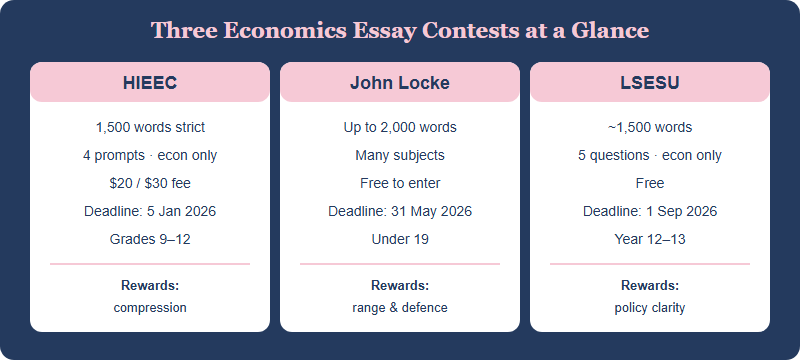
For economics-focused applicants in 2026, the three highest-profile essay routes differ most in length and what they reward. HIEEC (run by HUEA, a Harvard student club) is a strict 1,500-word, four-prompt contest with a $20/$30 fee and an early-January deadline. John Locke allows up to 2,000 words across many subjects and is free but far larger. LSESU is a free, 1,500-word, five-question contest aimed at Year 12–13 students. Pick by length discipline, subject focus, and timing.
The one-screen comparison (verified for 2026)
All three are genuine, well-regarded economics-writing opportunities — but they are not interchangeable. The fastest way to choose is to line up the rules side by side. Every figure below is taken from each organiser's own current pages; where a detail is fluid (prompt wording, exact prize values), we say so rather than guess.
| Feature | HIEEC | John Locke (Economics) | LSESU Essay Competition |
|---|---|---|---|
| Organiser | HUEA (Harvard Undergraduate Economics Association, a student club) + HCER — not Harvard University | The John Locke Institute (independent educational org, Oxford-linked) | LSESU Economics Society (LSE Students' Union student society) |
| Subject scope | Economics only — 4 set prompts | Multi-subject; Economics is one of several categories | Economics only — 5 set questions |
| Word limit | 1,500 strict (excludes references/footnotes/titles) | Up to 2,000 (excludes diagrams, data tables, endnotes, bibliography) | ~1,500 (excludes references) — confirm current rules |
| Eligibility | Grades 9–12 | Under 19; Junior and Senior judged separately | Year 12–13 / students entering university 2026–27 (incl. gap-year) |
| Choose | 1 of 4 prompts | 1 question within a subject | 1 of 5 questions |
| Referencing | Chicago or APA | As specified in entry rules — confirm on site | Harvard recommended |
| Entry fee | $20 (US) / $30 (international) reading fee | Free to enter (programme costs separate) | Free |
| 2026 deadline | 5 January 2026, 11:59 PM EST | 31 May 2026 (confirm on site) | 1 September 2026, 23:59 (GMT+1) |
| Format | PDF via Google Form on HUEA site | As per official portal | As per official portal |
| Judging | HUEA board screens; top 10 read by a Harvard economics professor | Examiners shortlist; final round interview for shortlisted authors | Society panel against published rubric |
If you are still deciding whether HIEEC belongs on your list at all, our overview of what HIEEC is and how it works walks through the format before you commit a draft.
What each contest actually rewards
Format tables tell you the rules; they do not tell you which essay wins. Reading published winners and each organiser's framing, the three contests reward noticeably different writing instincts.
- HIEEC rewards compression. A hard 1,500-word ceiling on a single set prompt means the best entries pick one clear thesis, defend it with one or two well-chosen mechanisms, and cut everything else. There is no room for a literature tour. Because the top 10 reach a Harvard economics professor, technical correctness and a defensible model matter more than rhetorical flourish.
- John Locke rewards intellectual range and nerve. The extra 500 words plus a final-round interview reward students who can take a contestable position, anticipate the strongest counter-argument, and hold their ground when questioned. It is the most “Oxbridge supervision” of the three in spirit.
- LSESU rewards policy clarity for a broad readership. Set by an LSE student society and pitched at Year 12–13, the questions tend to reward a clean argument that a smart non-specialist can follow, with evidence handled honestly.
A useful first-party observation from coaching essay writers: students who treat HIEEC's 1,500 words as the constraint that does the work — rather than a paper they must trim afterwards — consistently produce tighter arguments. Our guide to writing the 1,500-word HIEEC essay goes deep on that word budget.
Naming and affiliation: read this before you tell people what you entered
Two of these contests carry university names that are easy to overstate, and admissions readers know the difference. Being precise is part of writing a credible application.
- HIEEC is run by HUEA, a Harvard undergraduate student club, with HCER — it is not a Harvard University programme. Describe it accurately as a student-organisation contest. The economics quality is real (a Harvard professor reads the top 10), but “Harvard official” is not a claim you can make.
- LSESU is the LSE Students' Union Economics Society — a student society, not LSE's academic departments awarding a degree credential.
- John Locke is an independent educational institute with Oxford connections; it is not “the University of Oxford.”
None of this lowers their value. It just means you should write “Harvard Undergraduate Economics Association essay contest,” not “Harvard essay prize,” on your activities list.
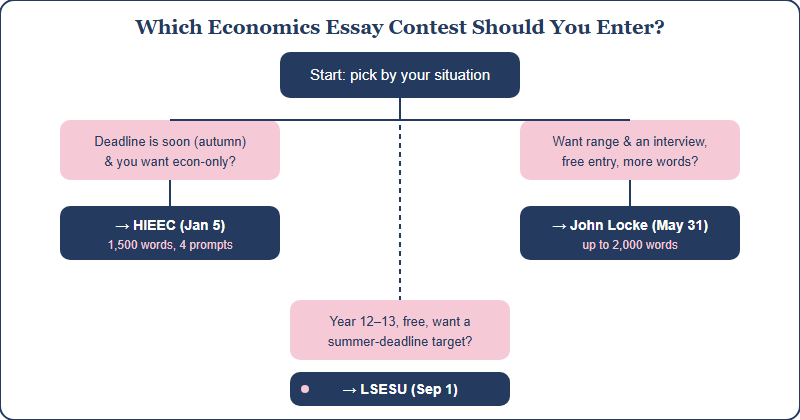
Which one fits you? A simple decision path
Most students should not enter all three blindly. Use timing and your strengths to sequence them.
Three honest rules of thumb:
- If you can only do one this winter, HIEEC is the natural autumn target because its early-January deadline lands before John Locke and LSESU open in earnest. A polished HIEEC essay also becomes raw material you can re-angle later.
- If you thrive in a viva, lean John Locke — the final-round interview rewards students who can defend ideas live, not just on paper.
- If budget matters, LSESU and John Locke are free; HIEEC charges a reading fee ($20 US / $30 international). That is a fair filter if you are entering several contests.
On tutoring track records — an honest note
A fair question from parents is whether coaching “works” for contests like these. We answer it transparently. Our editorial desk is operated by Hanlin Education, and our most directly verifiable economics-essay results come from the John Locke Global Essay Prize, where Hanlin-mentored students have earned competition wins and commendations. We attribute those results to John Locke specifically — we do not relabel them as HIEEC or LSESU outcomes, because that would be dishonest and admissions officers can check.
The transferable lesson, not the trophy, is what matters: the disciplines that win John Locke essays — a sharp thesis, one or two rigorously developed mechanisms, honest evidence, clean Chicago/APA or Harvard referencing — are exactly the disciplines HIEEC's 1,500-word format rewards. No reputable coach can or should promise a prize or an admissions outcome; what good coaching does is shorten the distance between a capable student and a publishable essay. If you want help choosing among the four HIEEC prompts before drafting, start with our guide on how to choose your HIEEC prompt.
Frequently asked questions
Is HIEEC the same prestige as John Locke?
They differ. John Locke is larger and multi-subject with an interview; HIEEC is a focused economics contest run by a Harvard student club. Both are credible; neither guarantees admission.
Can I reuse one essay for all three contests?
Not directly — word limits, prompts and referencing differ. You can reuse research and a core argument, but you must re-cut each essay to that contest's exact rules.
Which has the earliest 2026 deadline?
HIEEC, on 5 January 2026 (11:59 PM EST). John Locke is around 31 May and LSESU is 1 September 2026 — always confirm on each official site.
Does HIEEC really involve Harvard?
It is run by HUEA, a Harvard undergraduate student association (with HCER), not Harvard University. The top 10 essays are read by a Harvard economics professor. Describe it accurately on applications.
This is an independent guide operated by Hanlin Education for China-based international-school students. It is not affiliated with, endorsed by, or sponsored by HUEA (the Harvard Undergraduate Economics Association), the Harvard College Economics Review, or Harvard University, nor with the John Locke Institute or the LSESU Economics Society. Competition rules, fees, deadlines and prizes change — always confirm current details on the official sites (thehuea.org and each organiser's own pages) before entering. We correct confirmed errors within 7 working days.