The fastest way to lift a HIEEC essay from “well-informed” to “competitive” is to use economic theory that does real work. Because the strongest entries are ultimately judged by a Harvard economics professor, the reader can tell instantly whether you have named the right model and applied it correctly — or dropped a term for effect. This guide shows which models to reach for, how to make one model carry your argument inside a strict 1,500 words, and the theory errors that quietly sink otherwise capable writers.
Why theory is the highest-leverage part of the essay
HIEEC does not publish a point-by-point rubric, so the practical question is: what does an expert economist reward? Across the four pillars of a strong essay — thesis, theory, evidence, structure — theory is the one most students get wrong, which makes it the highest-leverage place to improve. A clear thesis and tidy structure are table stakes; plenty of entrants manage those. What separates a finalist is an argument that runs on a specific economic model, applied accurately, rather than an essay that gestures at “supply and demand” and then argues from intuition. The judge is reading for the question: does this writer actually think like an economist? Theory is how you answer it.
A useful test before you write: state, in one sentence, which single model your argument depends on. If you cannot — if the honest answer is “a bit of everything” — your essay will read as a current-affairs commentary with economic vocabulary sprinkled on top. If you can (“this argument turns on the price elasticity of demand for the taxed good”), you have a spine. Our companion guide on choosing your HIEEC prompt by strength covers picking a prompt where you genuinely have the theory; this guide is about deploying it once you have chosen.
A toolkit of models — and the questions they answer
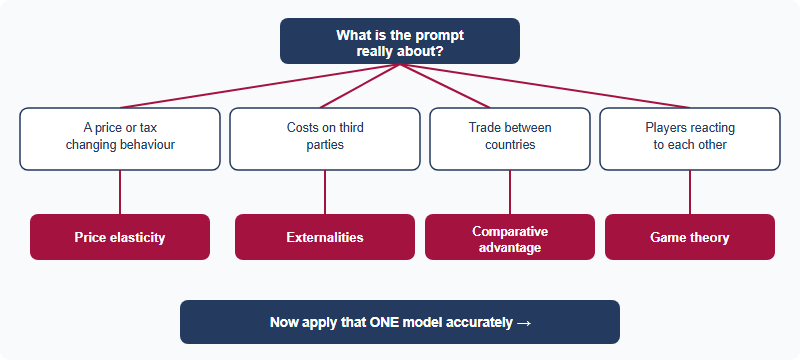
You do not need a wide toolkit. You need one model that fits your prompt, plus the judgement to know when it applies. The table below maps the workhorse models a high-school economics essay can use to the kind of question each one answers well. Match the model to your prompt’s underlying mechanism, not to its surface topic.
| Model / concept | Answers questions about… | Typical HIEEC use |
| Price elasticity (demand & supply) | How much quantity responds to a price change | Taxes, subsidies, minimum prices, who bears a cost |
| Externalities & social cost | Costs/benefits that fall on third parties | Pollution, congestion, vaccines, education, carbon pricing |
| Comparative advantage | Who should produce what, and gains from trade | Tariffs, trade policy, supply-chain reshoring |
| Game theory (dominant strategies, Nash) | Strategic choices when players react to each other | Cartels, price wars, climate negotiations, regulation |
| Information asymmetry | One side knowing more than the other | Insurance, used markets, credit, platform trust |
| Marginal analysis (MC = MR) | The “one more unit” decision | Firm output, public spending, optimal level of an activity |
| Market structure (monopoly, oligopoly) | How competition shapes price and quantity | Big tech, utilities, pricing power, antitrust |
Notice that the same prompt can be approached through different models. A prompt on a sugar tax could run on elasticity (how much consumption falls), on externalities (the health cost imposed on the system), or on incidence (whether firms or consumers actually pay). Choosing which lens to lead with is the analytical decision — and committing to one, rather than touching all three shallowly, is what reads as discipline.
How to apply one model accurately (the part that wins)
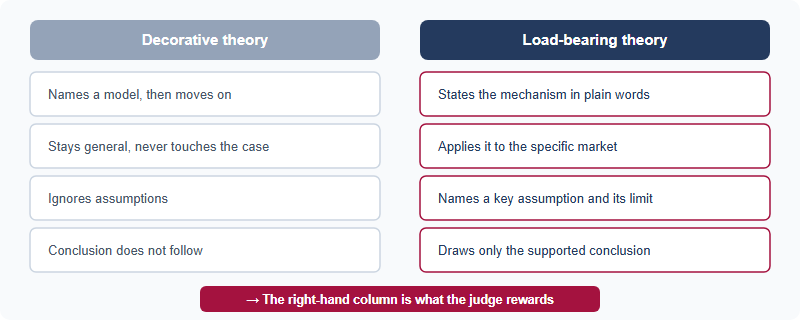
Naming a model is easy; applying it is where essays are won and lost. A reliable four-move sequence keeps your theory load-bearing rather than decorative:
- State the mechanism in plain words. Before any jargon, say what the model predicts: “When a good is taxed, the share of the tax paid by consumers versus producers depends on which side is less responsive to price.” A judge wants to see you understand the causal story, not just the label.
- Apply it to the specific case. Translate the general model into this prompt’s facts: which good, which market, which actors. Generic theory plus a generic conclusion is the most common weakness.
- Acknowledge an assumption or limit. Every model rests on assumptions (rational actors, no spillovers, fixed supply). Naming the one most likely to bend in your case — and what that does to your conclusion — is exactly the critical move an economist rewards.
- Draw the conclusion the model supports — and only that. Do not overclaim. If elasticity tells you who bears a tax, it does not also tell you whether the tax is “good.” Keep the conclusion inside what your theory can actually deliver.
Done well, those four moves take perhaps 250–400 of your 1,500 words and form the analytical core of the essay. Everything else — the introduction, the evidence, the structure covered in our guide to writing to 1,500 words — exists to set up and support this core. If you are unsure whether a paragraph belongs, ask whether it helps the reader follow your one model from mechanism to conclusion.
A worked illustration: one model, four moves
To make the sequence concrete, here is how the four moves look on a hypothetical prompt about a tax on a high-sugar product. (The prompt wording and topic are illustrative — your real prompts come from the official site each year.)
- Mechanism in plain words: “When a good is taxed, the burden splits between buyers and sellers according to relative elasticity — the side less able to change its behaviour ends up paying more of it.”
- Apply to the case: “Demand for sugary drinks is relatively inelastic for habitual consumers, so we should expect a large share of the tax to be passed through to consumers in higher prices, with consumption falling only modestly.”
- Acknowledge an assumption: “This rests on demand being stable in the short run. If close substitutes are available — diet versions, other drinks — demand becomes more elastic, the pass-through weakens, and consumers switch rather than pay, changing both the revenue and the health effect.”
- Conclusion the model supports: “On elasticity grounds, the tax is likely to raise revenue reliably but cut consumption less than its advocates claim — which is a different conclusion from whether the tax is, on balance, good policy.”
Notice what that compact passage achieves: it commits to one model, shows the writer understands the mechanism rather than the label, ties it to specifics, flags the assumption most likely to bend, and stops at the conclusion the theory can actually deliver. That is the texture of an essay that reads as economics rather than commentary — and it is reproducible across almost any prompt once you internalise the four moves.
Theory mistakes that quietly cost strong writers
Most theory failures are not ignorance; they are misapplication by capable students. Watch for these:
| Mistake | What it looks like | Fix |
| Name-dropping | “This relates to game theory” — then no actual game, players, or payoffs | Either build the model properly or cut the term entirely |
| Too many models | Elasticity, then externalities, then market structure — each one paragraph deep | Lead with one; mention others only if they sharpen the main argument |
| Theory with no case | Correct textbook explanation that never touches the prompt's facts | Apply every general claim to this specific market and actors |
| Ignoring assumptions | Treating the model as the literal truth of the world | Name the key assumption and what happens when it fails |
| Overclaiming | A positive model (what is) used to settle a normative question (what ought) | Separate analysis from judgement; let the model do only its job |
If you read your draft hunting only for these five, you will catch the difference between an essay that mentions economics and one that does economics. That difference is what a Harvard economics professor is trained, in seconds, to see.
A first-party note for China-based students
Working with international-school students in China, we see a consistent pattern: strong candidates often arrive with excellent factual recall — they know the policies, the figures, the recent events — but treat theory as a box to tick rather than the engine of the argument. The honest correction is rarely “learn more economics.” It is “do less, deeper“: pick one model, build it properly, and resist the urge to demonstrate breadth. An IB or A-Level economics syllabus already gives you more than enough theory for HIEEC; the competitive edge is judgement about which model to use and the discipline to apply it fully. If your school course has covered elasticity, externalities, and market structure, you are equipped — the work now is selection and application, not accumulation. For how this fits the wider entry, see our overview of what HIEEC is and how it works.
Frequently asked questions
How much economic theory should a HIEEC essay contain?
Lead with one model applied in depth, roughly 250–400 words of genuine analysis. Breadth across many models reads as weaker than one model used correctly and fully.
Do I need university-level economics to be competitive?
No. A strong IB or A-Level grounding in elasticity, externalities, and market structure is enough. The edge is choosing the right model and applying it accurately, not knowing advanced theory.
Can I use a diagram in my HIEEC essay?
The essay is a written argument; check current formatting rules on the official site before relying on diagrams. Either way, you must be able to explain the mechanism clearly in words.
What is the most common theory mistake?
Name-dropping — citing a model like game theory without actually building it. Either develop the model properly with its players and logic, or remove the reference entirely.
This is an independent guide to the Harvard International Economics Essay Competition, operated by Hanlin Education for China-based international-school students. We are not affiliated with, endorsed by, or sponsored by the Harvard Undergraduate Economics Association, the Harvard College Economics Review, or Harvard University. Prompts, eligibility, fees, formatting and dates change by year — always confirm the current details on the official HUEA site. Confirmed errors are corrected within 7 working days.