Is HIEEC worth it for college applications? Honestly: it can be a useful signal for economics, PPE and business applicants — but it is not a guarantee of admission, and an unplaced entry alone changes little. The Harvard International Economics Essay Competition (HIEEC) is run by the Harvard Undergraduate Economics Association (HUEA), a student club — not Harvard University. Its value comes from the 1,500-word essay you produce and how you use it, not the name.
What an HIEEC result actually signals (and what it does not)
Admissions readers do not give “points” for a single competition. What a placement or commendation in HIEEC does is supply evidence for claims you are already making elsewhere in your application: that you read economics for pleasure, that you can build an argument under a strict word budget, and that you cite sources like a first-year undergraduate rather than a forum commenter. That evidence is real, but it is also narrow — it speaks to one analytical skill, on one prompt, at one moment.
It helps to be precise about the competition’s structure, because the structure is what an admissions reader implicitly trusts. Per the official HUEA page (thehuea.org), HIEEC asks Grades 9–12 students worldwide to answer one of four prompts within a strict 1,500-word limit (references, footnotes, titles, headers and footers excluded), formatted in Chicago or APA. Essays are first judged by the HUEA board, and the top 10 are adjudicated by an economics professor at Harvard. There are no cash prizes; instead, the top three essays are published (with permission), alongside a finalists list and “Highly Commended” recognition. The 2025–26 cycle caps entries at 600 and closes on January 5th, 11:59 PM EST, 2026. (Always confirm the current cycle on thehuea.org — dates, caps and fees change year to year.)
Three things follow from that structure. First, a Harvard professor reads only the final 10 — so for the overwhelming majority of entrants, the “Harvard” element in practice is the HUEA student board, not the university. Second, because there is no cash prize and the entry fee is low ($20 for US applicants, $30 for international), the barrier to entry is deliberately modest, which means an unplaced entry carries little distinguishing weight on its own. Third, the deliverable is a polished analytical essay you keep regardless of result — and that essay is where the durable application value lives. For the full mechanics, see our companion piece, What Is HIEEC.
Where HIEEC fits in an economics / PPE application
Different destinations read the same line on your CV differently. UK economics and PPE courses (LSE, Oxford, Cambridge, UCL, Warwick) are academic-fit-driven: they care that a competition is economics, that it is written, and that it maps onto the analytical reading and essay skills the course demands. A US-style holistic file treats HIEEC as one “spike” data point that should cohere with the rest of your narrative — coursework, a research project, an economics club, a strong recommender. In both cases, HIEEC is a supporting actor, not the lead.
| Application context | What HIEEC signals well | What it cannot do | Pair it with |
|---|---|---|---|
| UK economics / PPE (LSE, Oxbridge, UCL, Warwick) | Subject commitment + ability to argue economics in formal prose | Replace strong predicted grades or admissions-test scores (e.g. TMUA) and the personal statement | A super-curricular reading list referenced in the personal statement |
| US holistic (econ / business major) | One coherent intellectual “spike” with a tangible output | Carry the file alone or offset a thin academic record | Research, an econ-club role, an aligned recommender |
| Scholarship / honours-program essays | A reusable 1,500-word writing sample produced under constraint | Function as a credential if unplaced and unmentioned | A reflection on what the topic taught you |
| Recommendation-letter evidence | A concrete moment a teacher can cite specifically | Write the letter for them | A teacher who actually saw you draft and revise |
The honest math: how selective is it, really?
Be realistic about the odds, because admissions officers are. HUEA caps the 2025–26 cycle at 600 submissions, and only the top three essays are published, with two further recognition bands (a finalists list and “Highly Commended”). That makes a top-three placement genuinely rare and worth highlighting — but it also means most entrants will finish unrecognised, and an unrecognised entry is, frankly, invisible to a reader unless you do something with the work itself.
This is the core honesty of the “is it worth it” question. The competition’s worth is front-loaded into the writing process and back-loaded only for a small group via recognition. So the durable, near-universal payoff is the essay; the rare bonus is the placement. Plan for the first and treat the second as upside. If you are still deciding which of the four prompts gives you the best chance to say something original, our guide to how to choose your HIEEC prompt walks through the trade-offs.
A note on the “Harvard” name. HIEEC is organised by HUEA, a Harvard student association, with final-round adjudication by a Harvard economics professor for the last 10 essays. It is not a Harvard University admissions credential, and presenting it as one would be inaccurate — something experienced readers spot immediately. Enter it on its own merits as a rigorous economics writing contest, not as a back-door Harvard signal.
Four steps to make an HIEEC result count
Whether or not you place, here is how to convert the work into application value. None of this requires winning.
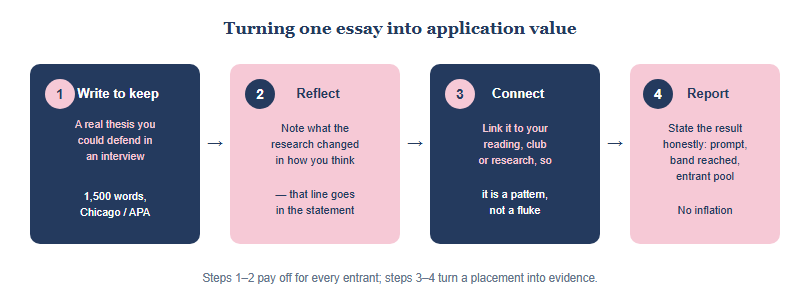
1. Write to keep, not just to win. Choose a prompt where you can stake a genuine, defensible claim and support it with real evidence inside 1,500 words. An essay you could defend aloud in an Oxbridge-style interview is far more useful long-term than one engineered only to please a rubric. Our walkthrough on writing the 1,500-word HIEEC essay covers how to fit a serious argument into that strict budget.
2. Reflect in writing. The moment you finish, jot down one or two sentences on what the research changed in how you understand the topic — a model you now distrust, a trade-off you had not seen. That reflection, not the certificate, is what becomes a strong personal-statement line.
3. Connect it to a pattern. A single competition reads as a one-off. The same competition sitting alongside an economics reading list, a school econ society, or an independent research note reads as commitment. Build the surrounding context so HIEEC is a node in a network, not an isolated trophy.
4. Report it honestly. If you place or are commended, say exactly what you achieved — the prompt, the recognition band, and the scale of the entrant pool. If you do not place, simply lead with the essay and what you learned. Inflating an unplaced entry into “Harvard recognition” is both inaccurate and easy for readers to see through.
How HIEEC compares with other essay routes
HIEEC is one of several essay competitions a humanities-leaning applicant might consider. Each rewards a slightly different muscle, and a thoughtful applicant picks the one that matches their strengths and timeline rather than entering everything.
| Route | Discipline focus | Format (per official sources) | Best for |
|---|---|---|---|
| HIEEC (HUEA) | Economics | 1,500 words strict, choose 1 of 4 prompts, Chicago/APA, $20 US / $30 international, ~early-January deadline | Econ / PPE / business applicants who want a tight analytical essay |
| John Locke (economics question) | Economics & social science | Longer word limit; broad prompt set — confirm current rules on the official site | Writers who prefer a longer, more discursive argument |
| Subject olympiads (e.g. maths/econ) | Quantitative | Timed problem-solving, not essays | Quantitatively strong applicants |
On the tutoring question many families ask: rigorous coaching on argument structure, evidence and citation transfers across all of these formats. Our own essay-coaching track record sits in the John Locke economics competition, where Hanlin-supported students have earned wins and commendations — we cite that honestly and do not relabel it as HIEEC success, because the two are different competitions. The point is that the underlying skill — disciplined academic writing under a word limit — is what compounds across applications, whichever contest you enter.
So — worth it or not?
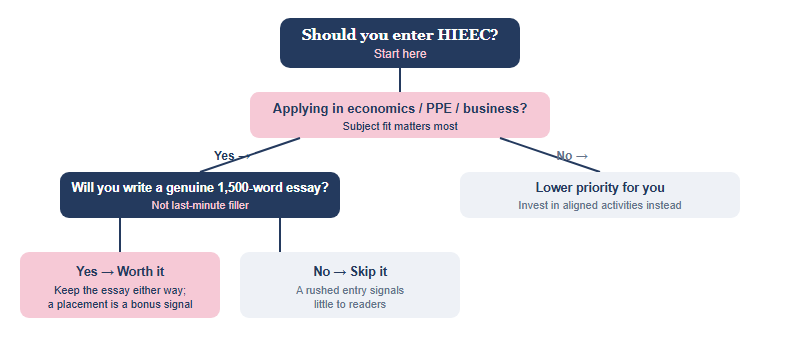
For a student genuinely heading toward economics, PPE or business, HIEEC is worth it if you treat the essay as the prize and any placement as a bonus. The low fee and pure-economics focus make it a clean, defensible addition to a coherent file. It is not worth it as a rushed line-item, as a substitute for grades and core academics, or as a way to borrow the Harvard name. Enter for the writing you will keep, and let the rest be upside.
Frequently asked questions
Does winning HIEEC get me into Harvard?
No. HIEEC is run by HUEA, a student club, and is not a Harvard admissions credential. It is one supporting signal for economics-leaning applications, never a guarantee.
Is HIEEC worth it if I do not place?
Yes, if you write a genuine 1,500-word essay. The durable value is the writing and reflection you keep and reuse in personal statements; placement is the rare bonus.
How selective is HIEEC?
HUEA caps 2025–26 entries at 600 and publishes only the top three, plus finalist and “Highly Commended” bands. Confirm current figures on thehuea.org before relying on them.
Which colleges value HIEEC most?
It maps best onto economics, PPE and business applications — UK courses read it as subject fit, US holistic files as one coherent intellectual “spike.” Always pair it with aligned activities.
This is an independent guide operated by Hanlin Education for China-based international-school students. It is not affiliated with, endorsed by, or sponsored by the Harvard Undergraduate Economics Association (HUEA), the Harvard College Economics Review, or Harvard University. Competition details (word count, prompts, fees, deadlines, prizes and judging) change year to year — always confirm current information on the official site, thehuea.org. Confirmed factual errors are corrected within 7 working days.