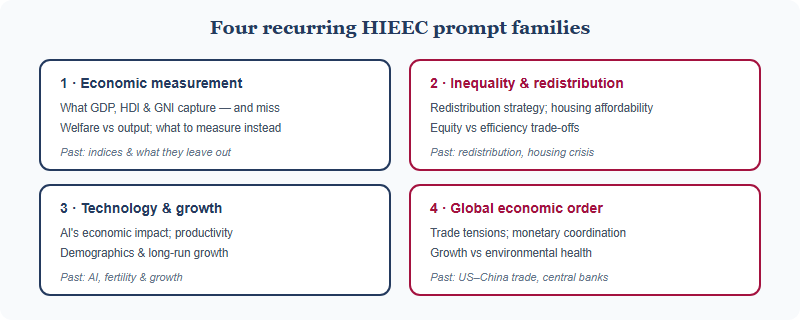
HIEEC releases four prompts each cycle and asks you to answer exactly one. While the wording changes every year and you must never assume next year’s questions, the themes recur: across past competitions, prompts have clustered into four families — economic measurement, inequality and redistribution, technology and growth, and global economic order. Recognising these families lets you build evidence and theory before the prompts even drop.
Why categories matter when the wording always changes
A common mistake is to wait for the prompts, then scramble to learn the economics from scratch. The smarter move is to notice that HIEEC — run by HUEA, the Harvard Undergraduate Economics Association (a Harvard student club, not a Harvard University office) with the Harvard College Economics Review — keeps returning to the same big debates in applied economics. You cannot predict the exact 2026 questions, and you should confirm the live prompts on thehuea.org before writing a word. But you can arrive with reading already done in each family.
The four families below are inferred from the kinds of topics economics essay competitions tend to probe — for example, AI and the economy, measurement indices (GDP, HDI, GNI), income redistribution, trade, fertility and growth, housing affordability, growth versus the environment, and central-bank coordination. These are illustrative of the debates, not a list of confirmed HIEEC prompts — confirm any past-prompt archive on thehuea.org. Treat them as a study map, not a forecast.
Family 1 — Economic measurement
Measurement prompts ask whether the numbers we use to describe an economy actually describe what matters. Past topics have probed the limits of indices such as GDP, the Human Development Index (HDI), and Gross National Income (GNI). The trap is to write a definitions essay; the reward is to take a position on a genuine trade-off.
- The real question: does the metric measure output, welfare, or something in between — and what gets distorted when policymakers optimise for it?
- What to pre-read: the construction of GDP vs HDI vs GNI, and well-known critiques (non-market work, distribution-blindness, environmental externalities).
- Strong move: propose a specific, defensible alternative or supplement and argue its costs honestly — not “GDP is bad,” but “for question X, this measure misleads, and here is why a better proxy is Y.”
Family 2 — Inequality and redistribution
These prompts sit on the oldest fault line in economics: the equity–efficiency trade-off. Past sets have included income-redistribution strategy and the US housing-affordability crisis. The strongest essays do not pick a side morally; they reason about mechanisms and unintended consequences.
- The real question: which policy lever achieves the stated goal at the lowest deadweight cost, and who bears the incidence?
- What to pre-read: tax-and-transfer design, supply-side constraints in housing (zoning, elasticity), and how incentives shift behaviour.
- Strong move: name the trade-off explicitly and quantify it where you can, rather than asserting that a policy is simply “fair” or “unfair.”
Family 3 — Technology and growth
Growth prompts ask what moves an economy’s long-run trajectory: technology, demographics, productivity. Past topics span artificial intelligence’s economic impact and the link between fertility rates and growth. Because these are fashionable subjects, the field crowds in — which means your edge is rigour, not enthusiasm.
- The real question: through which channel does the force act (labour, capital, total factor productivity), and over what horizon?
- What to pre-read: the basics of growth accounting, automation-and-labour debates, and demographic-transition effects on the dependency ratio.
- Strong move: resist hype. An essay that calmly traces AI’s effect through a specific mechanism beats one that predicts revolution without a model.
Family 4 — Global economic order
These prompts zoom out to how economies interact: trade, exchange rates, and coordination. Past topics include the US–China trade order and central-bank monetary-policy coordination, plus the growth-versus-environment tension that is inherently cross-border. For a China-based writer, this family is an opportunity — you can bring informed regional context without overclaiming.
- The real question: what is the strategic interaction, and what does standard theory (comparative advantage, policy spillovers) predict versus what we observe?
- What to pre-read: trade-war literature, the logic of monetary spillovers, and the economics of climate policy as a global commons problem.
- Strong move: use a framework (game theory, externalities) to discipline a topic that otherwise drifts into opinion.
The China-based angle: when “global order” is your home turf
For a student writing from a Chinese international school, the global-economic-order family is the one where you can add genuine first-hand context that many applicants cannot. Past prompts touching the US–China trade order, monetary coordination, and growth-versus-environment debates all benefit from a writer who understands the region beyond headlines. The opportunity is real — but so is the temptation to over-claim.
- Bring context, not advocacy. A judge wants disciplined analysis, not a national-interest argument. Use your regional knowledge to make the economics more precise, not to take a political side.
- Ground claims in data. “China’s export structure shifted toward X” is far stronger when attached to a citable figure than when asserted from general awareness.
- Stay inside the economics. The fastest way to weaken a global-order essay is to let it drift into geopolitics with no model behind it — exactly the failure mode flagged in the table above.
This is also why the family matters more than the headline: two students could pick the same trade prompt, but the one who frames it through comparative advantage and policy spillovers — rather than current events — writes the essay that survives the top-10 cut.
Turning a family into a thesis
Recognising the family is step one; the harder move is converting a broad theme into a narrow, arguable thesis that fits 1,500 words. A prompt in any family is usually too big to answer fully, so your job is to carve out a defensible slice and argue it well rather than survey the whole topic thinly.
- Narrow the question. Instead of “Is AI good for the economy?”, argue “AI’s near-term effect on labour markets runs primarily through task displacement in routine cognitive work.” One channel, defended, beats a panoramic overview.
- Commit to a position. A measurement essay should conclude that a specific index does or does not mislead for a specific purpose — not that “all metrics have limitations.”
- Anticipate the counter-argument. The best essays name the strongest objection to their thesis and answer it, which is what distinguishes analysis from assertion.
If you want to ground that thesis in evidence rather than opinion, pair this with our overview in What Is HIEEC? and build your data base around the single claim you have chosen to defend.
How to use the families before prompts drop
| Family | Core trade-off to master | One framework to bring | Where students go wrong |
|---|---|---|---|
| Measurement | Output vs welfare | Index construction & critique | Writing definitions, not an argument |
| Inequality | Equity vs efficiency | Tax-and-transfer incidence | Moralising instead of modelling |
| Technology | Short-run cost vs long-run gain | Growth accounting | Hype without a channel |
| Global order | National interest vs cooperation | Game theory / externalities | Geopolitics with no economics |

Once the real prompts appear, the decision shifts from “which topic is exciting?” to “which can I argue most rigorously in 1,500 words?” Our guide on how to choose your HIEEC prompt by strength walks through that judgement, and if you are new to the competition, What Is HIEEC? covers the rules and stakes first.
A pre-season reading plan across the four families
You do not need to become an expert in all four families — but a few hours of structured reading in each, before the prompts are released, removes the panic of a cold start. The aim is familiarity with the core debate and one workable framework per family, so that whichever prompts appear, you already have a foothold.
| Family | Read for the debate | Read for the framework |
|---|---|---|
| Measurement | Critiques of GDP as a welfare proxy | How HDI and GNI are constructed |
| Inequality | The equity–efficiency trade-off | Tax-and-transfer incidence basics |
| Technology | Automation-and-jobs and demographic debates | Growth accounting fundamentals |
| Global order | Trade-war and monetary-spillover discussions | Comparative advantage; externalities |
Spread this over the weeks before prompts drop rather than cramming it after. A student who has already thought about how growth accounting works will write a sharper technology essay than one meeting the concept for the first time under deadline pressure — and that depth is exactly what separates a finalist from an also-ran.
One discipline to keep throughout: resist the pull toward whichever topic feels most current or exciting in the news. The family that earns you the strongest essay is the one where your framework and evidence are deepest, not the one with the catchiest headline. When the four prompts finally land, that preparation converts directly into the calm, argued writing the judges reward.
Frequently asked questions
Can I predict the 2026 HIEEC prompts from past years?
No. The themes recur, but exact wording changes every cycle. Use the four families to prepare, and confirm the live prompts on thehuea.org.
How many prompts does HIEEC give and how many do I answer?
HIEEC releases four prompts and you answer exactly one, in 1,500 words or fewer (excluding references).
Which prompt family is easiest?
None is objectively easiest. The right family is the one where you can bring a real framework and evidence, not the topic that sounds most current.
Do I need university-level economics to answer these?
No, but you need a disciplined argument. Strong essays apply a clear framework to one trade-off rather than surveying everything.
This is an independent guide operated by Hanlin Education for China-based international-school students. It is not affiliated with, endorsed by, or sponsored by HUEA, the Harvard College Economics Review, or Harvard University. Prompt themes are inferred from publicly listed past topics and may not recur; always confirm the current year’s prompts and rules on the official site, thehuea.org. We correct any reported errors within 7 working days.