To enter the Harvard International Economics Essay Competition (HIEEC), you submit one PDF essay through a Google Form, pay a fee of US$20 (US applicants) or US$30 (international applicants), and beat the deadline of January 5th, 11:59 PM EST, 2026. Entries are capped at 600 submissions. This guide walks China-based international-school students through every logistical step so a missed timezone or wrong file format never costs you the entry.
The one-page logistics map
Most students lose marks (or the entry entirely) not on economics, but on process. HIEEC is run by HUEA, the Harvard Undergraduate Economics Association — a Harvard student club, not a Harvard University office — together with the Harvard College Economics Review (HCER). Their rules are precise and enforced literally, so treat the checklist below as binding and re-confirm every value on thehuea.org before you submit.
| Item | Requirement (2026) | What trips students up |
|---|---|---|
| Eligibility | High-school students, grades 9–12, US & international | Assuming you must be in a specific country — you don’t |
| Word limit | 1,500 words, strict; anything beyond is truncated | Forgetting that references/footnotes/titles/headers/footers are excluded |
| Prompts | Four released; choose exactly one | Trying to blend two prompts into one essay |
| Referencing | Chicago or APA; references required | Mixing the two styles in one paper |
| File format | PDF only | Uploading .docx — rejected, no refund |
| Submission | Google Form portal | Leaving it to the last hour when the form closes hard |
| Fee | $20 (US) / $30 (international) | Not budgeting the international rate |
| Entries per person | One; only the first submission is read | Submitting a “fixed” version later — it is ignored |
| Deadline | Jan 5, 11:59 PM EST, 2026 | Reading EST as Beijing time |
| Cap | 600 submissions maximum | Assuming the form stays open until the date |
If you are still deciding whether to enter at all, start with our overview, What Is HIEEC?, then come back here once you have committed to a prompt.
Decoding the deadline: EST to Beijing time
The single most expensive mistake a China-based student can make is treating “January 5th, 11:59 PM EST” as a local time. Eastern Standard Time in January runs at UTC−5; Beijing is UTC+8. That is a 13-hour gap, and it falls in your favour — the cutoff lands on the afternoon of January 6th in China.
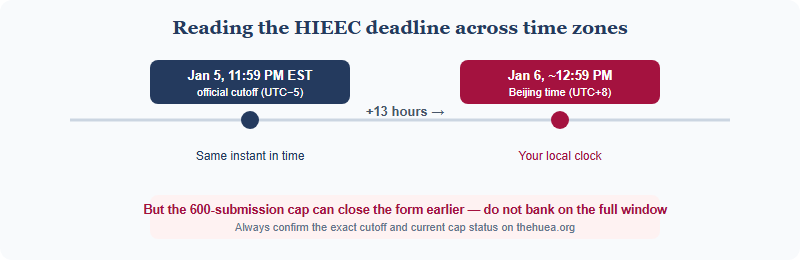
Two cautions. First, the timezone conversion above is a guide, not a promise: the United States can shift its clocks and the organiser may state the cutoff differently in a given cycle, so verify on the official site before you rely on the extra hours. Second — and more important — the deadline is not the only thing that closes the form.
The 600-submission cap changes your strategy
HIEEC states a maximum of 600 submissions. That is a meaningful constraint: it means the form can close before January 5 if the cap fills. A student who plans to submit “the night of the deadline” is gambling that a global field of economics-keen teenagers all wait until the last hour too — which they do not.
- Submit days early, not hours early. Once your essay has been proofread and your references are clean, there is no upside to waiting.
- Have your PDF ready before you open the form. The Google Form is a delivery mechanism, not a drafting tool — do not start writing once it is open.
- Treat “the cap” and “the date” as two separate deadlines and aim to beat the earlier of them.
If you are still tightening the essay itself against the 1,500-word ceiling, our companion guide on writing the 1,500-word HIEEC essay covers how to cut without losing your argument.
Fees, financial aid, and the PDF rule
The submission fee is US$20 for US applicants and US$30 for international (non-US) applicants — so most students reading this in China pay the $30 rate. The organiser notes that financial-aid requests are available on email request; the specifics of who qualifies and how are for HUEA to define, so ask them directly through the contact channel on their site rather than assuming a process.
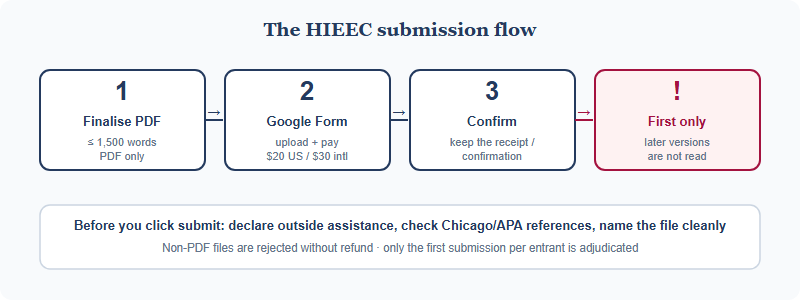
The “first submission only” rule is the quiet killer. If you upload, then notice a typo and re-submit a corrected file, the corrected file is not read — the original stands. So the workflow is the reverse of how students usually treat online forms: finish first, submit once.
Paying the fee from China without friction
The fee is collected at the point of submission through the Google Form portal, which means payment and upload happen together — you cannot reserve a slot now and pay later. For China-based families, the practical issue is having an internationally-usable payment method ready before you open the form, because a card that is declined at 11:30 PM on the deadline is functionally a missed entry.
- Confirm your payment method works internationally in advance. A US$30 charge in US dollars is small, but a domestic-only card will fail. Test that the card or account can process a foreign-currency online payment days ahead.
- Keep the currency in mind. The stated fees are in US dollars ($20 / $30); your statement will show the local-currency equivalent plus any bank conversion margin. Budget a little above the headline figure.
- Save every confirmation. Screenshot or download the payment receipt and the form’s submission confirmation. If a dispute over whether you entered ever arises, that record is your proof.
- If cost is a barrier, ask early. The organiser notes financial-aid requests are available by email — but a waiver process takes time, so raise it well before the deadline rather than the night of.
Because the portal rejects non-PDF files “without refunds,” a failed upload of the wrong format means you have paid and still not entered validly. Confirm the file is a true PDF (not a renamed document) before you reach the payment step.
What actually gets an entry rejected
It is worth being blunt about the ways students forfeit an entry they paid for. None of these are about the quality of the economics — they are pure process failures, and they are entirely avoidable.
| Failure mode | Consequence | The fix |
|---|---|---|
| Non-PDF file (.docx, Pages, screenshot) | Rejected, no refund | Export to PDF and open it to confirm before uploading |
| Over 1,500 words in the body | Text beyond the limit is truncated | Word-count the body only; references/footnotes don’t count |
| Re-submitting a “corrected” version | Only the first submission is read | Finalise before submitting once |
| Mixing Chicago and APA | Signals carelessness to judges | Pick one style and apply it throughout |
| Waiting for the date when the cap fills | Form closes early; no entry | Submit days ahead of January 5 |
| Undeclared outside assistance | Integrity breach → disqualification | Declare any help honestly in the entry |
Notice the pattern: every row is something you control completely before you ever click submit. Treating the logistics with the same seriousness as the writing is the cheapest way to protect months of work.
The integrity declaration is part of the logistics
HIEEC requires that outside assistance be declared, treats plagiarism as grounds for disqualification, and limits entrants to one essay. None of this is bureaucratic noise — it is the eligibility floor. Practically:
- Declare help honestly. A teacher’s feedback or a mentor’s structural notes are normal; passing off others’ writing or undisclosed assistance is not.
- Do not outsource the writing to AI. Beyond the integrity rules, an essay that reads as machine-generated has no original voice — which is exactly what the prompt-selection and judging stages reward.
- Keep your own evidence. Save your drafts and data sources; if a question of originality ever arises, your version history is your defence.
A China-based timeline that respects both deadlines
Because the form can close on either the date or the cap, build in slack. A workable backward plan from a January cycle:
| When | Action |
|---|---|
| Prompts released (autumn) | Read all four; shortlist the two you could argue best |
| ~6 weeks out | Lock one prompt; build your evidence base and outline |
| ~3 weeks out | Full draft at or under 1,500 words; first round of cuts |
| ~10 days out | Reference pass (Chicago or APA), proofread, export clean PDF |
| ~7 days out | Submit. Do not wait for January 5 — beat the cap |
Exact prompt-release timing varies by cycle, so confirm the current calendar on the official site rather than assuming last year’s dates repeat.
Frequently asked questions
How much does it cost to enter HIEEC from China?
The international (non-US) submission fee is US$30; US applicants pay US$20. Financial-aid requests are available by email per the organiser.
What is the HIEEC deadline in Beijing time?
The cutoff is Jan 5, 11:59 PM EST, 2026, which is roughly midday Jan 6 in Beijing. Confirm on thehuea.org, and submit early because of the 600-cap.
Can I resubmit a corrected essay before the deadline?
No. Only your first submission is read; later versions are ignored. Finalise the PDF before you submit once.
What file format does HIEEC accept?
PDF only. Other formats are rejected without a refund, so export and check your PDF before uploading via the Google Form.
This is an independent guide operated by Hanlin Education for China-based international-school students. It is not affiliated with, endorsed by, or sponsored by HUEA, the Harvard College Economics Review, or Harvard University. Competition details change between cycles — always confirm current rules, fees, deadlines, and the submission cap on the official site, thehuea.org. We correct any reported errors within 7 working days.