The single hardest thing in an HIEEC essay is not the economics or the referencing — it is saying something a judge has not already read nine times. With a stated cap of up to 600 essays spread across four prompts (per thehuea.org), the obvious answer to each prompt arrives in bulk. Originality is not a flourish here; it is the differentiator that a Harvard economics professor rewards when ranking the top essays. This is a method for finding that original angle on purpose, not by luck.
Why originality is the tiebreaker, not a bonus
Think about the arithmetic of the reading pile. Four prompts, hundreds of entries: for any given prompt, the most natural argument is written dozens of times, usually with the same two examples and the same model. Those essays can be competent — clear thesis, correct theory, clean citations — and still be interchangeable. When a specialist reader is putting ten strong essays in order, “correct but predictable” loses to “correct and genuinely insightful” every time.
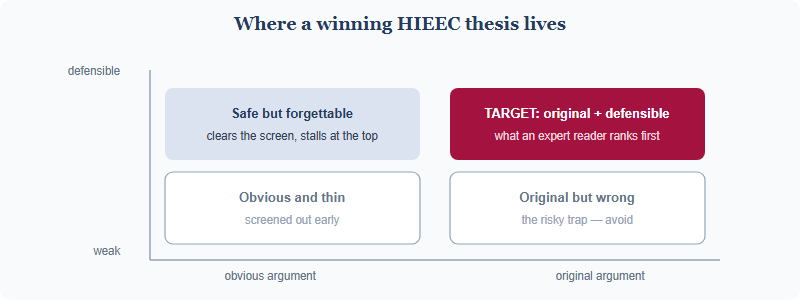
This is why originality sits at the top of what expert readers reward. It is also why chasing it recklessly is dangerous: an original-but-wrong argument is worse than an obvious-but-right one. The goal is a thesis that is non-obvious and defensible — a claim most entrants will not make, that you can nonetheless support with sound economics. Everything below is about reaching that narrow, valuable zone.
Five moves that generate a non-obvious thesis
Originality feels like inspiration, but it is mostly technique. Each move below is a way to interrogate the prompt until a less-travelled angle appears. Run them after you have chosen a prompt you can command — for that step, see our test for choosing your HIEEC prompt by strength.
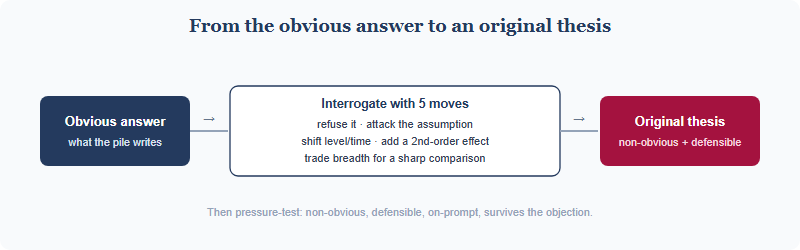
- 1. Write the obvious answer first — then refuse it. Spend five minutes drafting the argument you would give with no preparation. That is the essay the pile is full of. Your job is now to find what it misses, oversimplifies, or takes for granted. Your thesis often lives in that blind spot.
- 2. Attack the hidden assumption. Most prompts smuggle in an assumption (“policy X helps group Y”). Name it, then ask under what conditions it fails. An essay that shows when and why the standard answer breaks down is instantly more interesting than one that repeats it.
- 3. Change the level or the timeframe. If everyone argues the short-run effect, take the long-run seriously. If everyone reasons at the national level, look at the firm or the household. A shift in scale frequently reverses the conclusion — and a reversal you can defend is gold.
- 4. Introduce a second-order effect. The first-order effect is what everyone writes. The interesting economics is usually the feedback: the behavioural response, the incentive that the policy quietly creates, the market that adjusts. Tracing one well-chosen second-order effect is a reliable route to a fresh claim.
- 5. Trade breadth for a sharper comparison. Instead of listing three causes, contrast two carefully and show which dominates and why. A disciplined comparison reads as insight; a list reads as a survey.
A worked illustration: turning one move into a thesis
To see how mechanical this is, take a generic prompt shape — “should a government subsidise a strategically important industry?” — and run move two, attack the hidden assumption. The obvious essay argues yes-because-jobs or no-because-cost, and the pile is full of both. The smuggled assumption in most of those essays is that the subsidy reaches the intended firms and stays there.
Interrogate that assumption and a fresher thesis appears: a subsidy changes the incentives facing firms, so part of it may be captured as higher costs, absorbed by incumbents who lobby to keep rivals out, or competed away rather than invested. Your original but defensible claim becomes “the case for the subsidy turns less on whether the industry deserves support and more on whether the policy is designed to survive its own second-order effects.” That is one prompt, one move, and a thesis most entrants will not write — carried by a mechanism (incentive response, regulatory capture) you can defend. Note what the move did not require: no exotic model, just a hard look at what the standard answer assumed. That is the entire technique.
Pressure-testing your angle before you commit
An original thesis is only worth writing if it survives scrutiny — otherwise you have wandered into the “original but wrong” box. Before you build 1,500 words on an angle, run it through four fast checks.
| Check | Ask yourself | Fail signal |
|---|---|---|
| Non-obvious? | Would most entrants on this prompt make a different claim? | You have basically restated the prompt’s implied answer. |
| Defensible? | Can I support each step with a correctly applied model or figure? | The argument only works if the reader accepts a leap on faith. |
| On-prompt? | Does this still answer the exact question asked? | You have written an interesting essay about a different question. |
| Survives the objection? | What is the strongest counter, and can I answer it? | You cannot name a serious objection — usually a sign it is untested. |
The fourth check is the most revealing. If you cannot state the best argument against your thesis, you probably have not thought hard enough to earn a top rank — and naming that objection inside the essay is itself a mark of the analytical depth expert readers look for. Because your angle has to be delivered through precise economics, pair this with our guide on using economic theory in your HIEEC essay: an original claim carried by a sloppy model still fails at the professor stage.
Originality within a strict 1,500 words
Insight has to fit the format. A hard limit of 1,500 words (references, footnotes, titles, and headers excluded, per thehuea.org) is not the enemy of an original argument — it is what forces you to commit to one. You do not have room for three theses, so the discipline of the word budget and the discipline of originality push in the same direction: pick the sharpest angle and defend it fully.
- Front-load the claim. State your non-obvious thesis in the opening 150 words. A fast screen reader should see immediately that you are not writing the default answer.
- Spend words on the mechanism, not the setup. Trim background everyone already knows; give the space to the step that makes your argument distinctive.
- Let the objection earn its lines. Devote a genuine passage to the strongest counter-argument and your reply. This is where an original essay proves it is also a rigorous one.
For the sectional word allocation that makes this fit, our method for writing the 1,500-word HIEEC essay gives a budget you can adapt to an argument-led structure.
A first-party note for China-based students
A recurring pattern in strong China-based drafts is what we call the “textbook-perfect” essay: an immaculate restatement of the standard model, well-cited and cleanly written, that answers the prompt exactly as an exam would. Those essays clear the HUEA screen comfortably and then plateau, because a specialist ranking the top entries has read the same well-drilled answer many times. The training that makes students excellent at exams can quietly push them toward the obvious.
The fix is a habit, not a talent: after your first clean draft, deliberately ask “what would most entrants say here — and what are they missing?” Then rebuild around the gap. Students who add this one step tend to move from “clearly competent” to “worth reading twice.” Keep it honest — an original angle you cannot defend is a step backward, and all competition rules, prompts, and figures should be confirmed on thehuea.org before you rely on them.
Frequently asked questions
How original does an HIEEC essay really need to be?
Original enough that most entrants on your prompt would argue differently, while still being fully defensible. With up to 600 essays, a predictable argument rarely ranks at the top.
Isn’t an unusual argument risky?
Only if it is not defensible. Aim for non-obvious and provable. Pressure-test your thesis against the strongest objection before committing 1,500 words to it.
Can I be original without advanced economics?
Yes. Originality comes from how you interrogate the prompt — attacking an assumption or tracing a second-order effect — not from citing exotic models. One model applied precisely is enough.
Where can I confirm the rules and prompts?
On the official site, thehuea.org. The word limit, four prompts, fees, and judging process are set by HUEA and can change each cycle, so verify before you write.
This is an independent guide operated by Hanlin Education for China-based international-school students. It is not affiliated with, endorsed by, or sponsored by HUEA, the Harvard College Economics Review, or Harvard University. The word limit, prompts, fees, deadline, and judging process are set by the organiser and can change; always confirm current details on the official site, thehuea.org. We correct any reported errors within 7 working days.