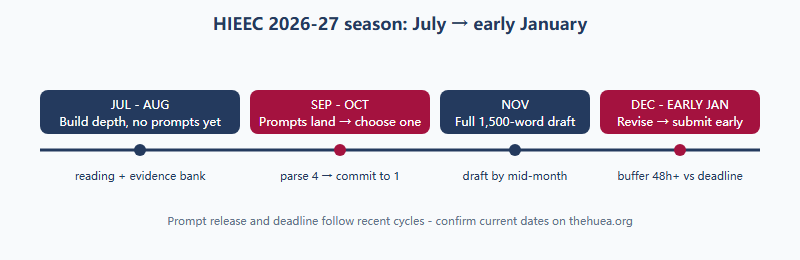
The smartest way to plan your HIEEC season is to work backwards from the deadline, which in recent cycles has fallen in early January (always confirm the current date on thehuea.org). That gives you roughly six months from mid-July: two for background building, two for prompt selection and drafting, and two for revision, referencing and submission logistics. This article turns that arc into a concrete month-by-month plan for international-school students in China.
The shape of the HIEEC season
HIEEC — the Harvard International Economics Essay Competition — is run by HUEA, the Harvard Undergraduate Economics Association (a student organisation, not Harvard University itself), together with the Harvard College Economics Review. The contest asks high-school students to answer one of four released prompts in an essay capped at a strict 1,500 words, referenced in Chicago or APA style, with an entry fee of $20 for US entrants and $30 for international entrants. If HIEEC is entirely new to you, start with our complete guide to what HIEEC is before planning your calendar.
Two structural facts should anchor your planning. First, the essay prompts are not available all year: in recent cycles they have been released in the autumn, with the submission window closing in early January (treat both as “typical pattern” — confirm the current cycle's dates on the official site). Second, the word cap is unforgiving. A 1,500-word ceiling means the quality bottleneck is rarely typing speed; it is the depth of thinking you bring to the page. That is why the months before the prompts appear matter more than most students expect.
One more planning note for students in China: published deadlines for international competitions are usually stated in a US time zone. Do not assume the closing time converts comfortably to Beijing time — a US East Coast evening deadline is the following morning in China. Verify the stated time zone on thehuea.org and set your personal deadline at least 48 hours earlier.
July–August: build depth while there are no prompts to chase
Summer is the phase most entrants waste, because there is nothing HIEEC-specific to react to yet. That is precisely its value. With no prompt to anchor on, you can build the general-purpose assets that every strong essay draws on:
- Economic literacy. Read one accessible economics book and skim current-affairs coverage (central bank statements, IMF or World Bank commentary) weekly. You are collecting mental models and live examples, not memorising facts.
- An evidence habit. Keep a running note file: every time you meet a striking statistic, policy episode or natural experiment, log it with its source. In December you will be grateful for a personal bank of citable material.
- Writing reps. Once in July and once in August, write a 700-word argued piece on any economic question and cut it to 500 words. The cutting is the training — HIEEC rewards compression.
If you are choosing between competitions this summer, this is also the window to decide whether HIEEC fits your profile and calendar at all, before school workload returns in September.
September–October: the prompt window — scout, choose, outline
When the new cycle's prompts appear (watch thehuea.org from early autumn; do not rely on third-party reposts), resist the urge to start writing the same week. Your first job is selection. HIEEC offers four prompts and you answer exactly one, so the choice is a genuine strategic decision: the right prompt for you is the one where your existing knowledge, your school coursework and your summer reading overlap most. We walk through a full selection method in how to choose your HIEEC prompt by strength.
Spend the first two weeks after release on three tasks:
- Parse all four prompts. For each, write one sentence stating what the question is really asking and one sentence on what evidence would be needed to answer it well.
- Run a 48-hour test drill. For your top two candidate prompts, spend two days gathering sources. The prompt where credible evidence comes easily is usually the better pick.
- Commit and outline. By late October, lock your prompt and produce a one-page skeleton: thesis, three supporting moves, one counterargument you will address, and the evidence slot for each section.
November: draft the full 1,500 words
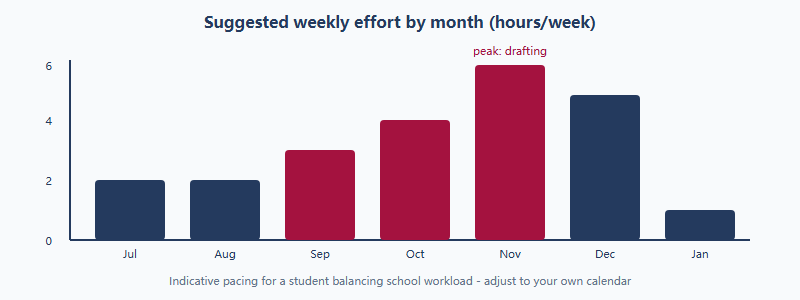
November is the drafting month, and the most common failure here is perfectionism at the paragraph level. Write a complete, imperfect draft early in the month — even 1,900 loose words — and then work it down. A full draft exposes structural problems (a thesis that drifts, a section that duplicates another) that no amount of polishing an introduction will reveal. Our guide to writing the 1,500-word HIEEC essay covers the paragraph-by-paragraph word budget in detail; the season-planning point is simply that the full draft should exist by mid-November, leaving two full revision cycles before winter break.
Keep referencing live as you draft. Inserting Chicago or APA citations retroactively in December is slow and error-prone; capturing the full source details the moment you use a claim costs seconds.
December: revision, referencing, and a second pair of eyes
Plan two distinct revision passes. The first is an argument pass: does every paragraph advance the thesis, is the counterargument handled honestly, does the evidence actually support the claims attached to it? The second is a compression-and-style pass: cut hedging, merge overlapping sentences, and bring the count under the strict 1,500-word cap with room to spare — do not gamble on how the organisers count words; check the current rules on thehuea.org for what the cap includes and excludes.
December is also when a teacher or peer read is most useful — early enough that you can act on feedback, late enough that the draft is worth reading. Ask your reader two questions only: where did you stop being convinced, and where were you bored? Their answers locate your weakest 200 words.
Finally, verify the administrative details while offices and teachers are still reachable before the holidays: the entry fee ($20 US / $30 international in recent cycles — confirm current amounts), the file format required, and any identity or school information the submission form asks for.
Late December–early January: submission logistics without drama
The final fortnight should contain no writing surprises — only mechanics. Build in slack for three risks that disproportionately hit international entrants: payment friction on an international card, time-zone confusion on the closing time, and holiday travel separating you from the laptop with your final file. The fix for all three is the same: submit at least several days early. A finished essay submitted five days before the deadline beats a marginally better one submitted at 11:58 pm.
| Month | Phase | Concrete output by month-end |
|---|---|---|
| July | Foundation | 1 economics book read; evidence note file started; one 700→500-word cutting drill |
| August | Foundation | Weekly current-affairs notes; second cutting drill; decision that HIEEC is on your calendar |
| September | Prompt scouting | All four prompts parsed (once released — confirm timing on thehuea.org); two candidates shortlisted |
| October | Selection & outline | Prompt locked; one-page skeleton with thesis, moves, counterargument, evidence slots |
| November | Drafting | Complete full draft by mid-month; citations captured in Chicago or APA as you write |
| December | Revision | Argument pass + compression pass; external read; word count safely under 1,500 |
| Early January | Submission | Fee paid, format checked, essay submitted days before the published deadline |
How to adapt the plan if you start late
Not everyone reads this in July. The plan compresses, but the sequence does not change — and the items you protect are always the same three: prompt selection time, one complete early draft, and a real revision pass.
- Starting in October: skip the general reading phase and go straight to prompt parsing, but front-load a one-week evidence sprint on your chosen prompt before outlining. Everything else shifts two weeks later.
- Starting in November: choose your prompt within five days using the 48-hour evidence drill, draft within two weeks, and accept one combined revision pass instead of two. Tight but workable.
- Starting in December: be honest about the trade-off. A rushed HIEEC entry is still useful writing practice, but if the draft cannot get an external read and a compression pass, consider whether your hours are better invested in a later-deadline contest — and enter HIEEC properly next cycle.
FAQ
When are HIEEC prompts released?
In recent cycles prompts have appeared in the autumn, ahead of an early-January deadline. Exact dates change by cycle, so watch thehuea.org directly rather than third-party reposts.
How early before the deadline should I submit?
Aim for at least several days early. International entrants face card-payment friction and time-zone conversion risks; a 48-hour-plus buffer removes both from the equation.
Is six months really necessary for a 1,500-word essay?
The writing itself takes weeks, not months. The six-month arc exists because background reading and evidence-gathering — which happen before prompts exist — are what separate generic essays from competitive ones.
What if my school exams collide with the December revision window?
Shift the full draft earlier into late October or early November. The plan's only fixed points are the prompt release and the deadline; every other block can slide forward.
This is an independent guide operated by Hanlin Education for China-based international-school students. It is not affiliated with, endorsed by, or sponsored by HUEA, the Harvard College Economics Review, or Harvard University. Competition details change by cycle — always confirm current dates, fees and rules on thehuea.org. Errors brought to our attention are corrected within 7 working days.