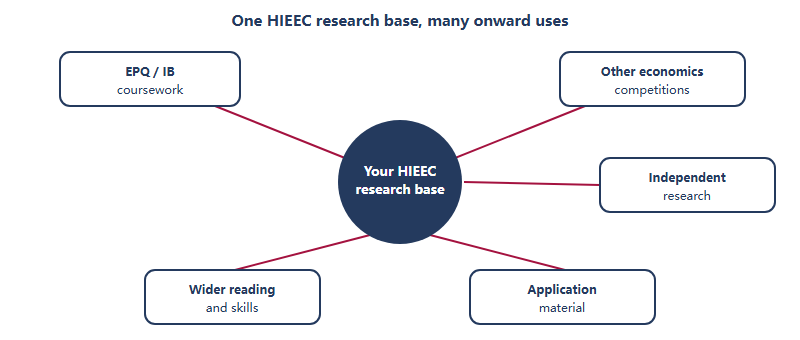
You spent weeks reading, arguing and cutting to 1,500 words — so do not let that work end at submission. A single HIEEC essay is a research asset you can extend into an EPQ or IB coursework, adapt for other economics competitions, or grow into genuine independent study. This guide maps the honest, high-value ways to reuse the effort, and the lines you should not cross.
One Essay, Many Uses
The 1,500-word essay you submitted is fixed, but the machinery behind it is not: the question you framed, the sources you read, the data you gathered, and the argument you built are all reusable. Most students treat submission as an ending. Treated instead as a milestone, that research base can feed several later projects with a fraction of the start-up cost, because the hardest part — understanding a real economic problem deeply — is already done.
One caution before you reuse anything: HIEEC and other programmes have their own rules about original and previously submitted work, and school qualifications have academic-integrity policies of their own. Reusing your research is almost always fine; reusing identical text across submissions may not be. When in doubt, rewrite and cite your earlier work. For a refresher on the competition's own framing and rules, see What Is HIEEC.
It helps to save your materials properly the moment you submit. Keep one folder with your final essay, your notes, your source list with working links, and any data files. Repurposing is far easier months later when you are not reconstructing where a figure came from — and a clean source list is what lets you cite your own earlier work honestly when a later programme requires it.
Extend It Into School Coursework
The most natural next home for HIEEC research is a longer piece of independent school work — an EPQ, an IB Extended Essay, or an economics Internal Assessment. These deliverables reward exactly what a strong essay competition builds: a focused question, a literature base, and evidence handled with care. Your 1,500-word HIEEC piece can become the seed of a 3,000- to 5,000-word investigation, with room to add the nuance the word limit forced you to cut.
| Deliverable | How HIEEC feeds it | Watch-outs |
|---|---|---|
| EPQ (5,000 words) | Question, sources and argument transfer; expand the analysis | Meet EPQ criteria; write new text; log your process |
| IB Extended Essay | Economics topic and research question can carry over | Follow IB subject rules; avoid duplicate submission |
| Economics IA | Real-world material and data skills reapply | IA has its own prescribed format and commentary |
| School journal / blog | Turn the argument into an accessible article | Cite your sources; keep claims verifiable |
The key rule across all of these is simple: reuse the thinking, produce new writing tailored to each brief, and never submit the same words to two assessments that forbid it. Each qualification publishes its own academic-integrity and duplication rules — read them before you reuse anything, because the penalties for getting it wrong are serious.
Concretely, expanding a 1,500-word essay into a longer EPQ is mostly about adding the depth the competition forced you to cut. A fuller literature review can situate your argument among named economists and schools of thought. A methodology section can explain how you selected and handled your evidence. Extra case studies or a second country can test whether your claim generalises, and a proper counter-argument section can engage the strongest objections instead of dismissing them in a single sentence. The core question stays; the scaffolding around it grows.
Adapt It for Other Economics Opportunities
The economics-competition calendar runs all year, and different contests ask for different lengths, styles and questions. The underlying question and evidence you developed for HIEEC can often be reshaped for another opportunity — but reshaped is the operative word. A 1,500-word HIEEC essay is not a 2,000-word essay for a different competition; it is raw material you must rewrite to each new brief, tone and rubric.
Two rules protect you here. First, many competitions require original, unpublished work and prohibit submitting the same piece elsewhere — so check each contest's official rules before you resubmit anything, and confirm on their own sites rather than assuming. Second, adapt genuinely: change the framing, update the evidence, and answer the new prompt on its own terms. Choosing a prompt that truly suits your material matters just as much the second time; the thinking in our guide to choosing your HIEEC prompt transfers to picking questions for other contests too.
Be realistic about how much adaptation each move needs. A change in word limit alone changes what you can argue: 1,000 words forces a single sharp claim, while 3,000 invites a fuller survey. A different audience — a policy competition versus an academic one — shifts the tone and the balance of theory and application. Treat each new brief as its own commission, and the shared research base becomes a genuine advantage rather than a shortcut that shows.
Grow It Into Real Independent Research
The highest-value reuse is not lateral but deeper. A competition essay, by design, only scratches a question — 1,500 words leaves little room for the papers you skimmed or the counter-arguments you set aside. Turning back to those is where genuine expertise is built. Read the studies you cited in full rather than from their abstracts. Try to replicate a simple data exercise yourself. Follow the open questions your essay raised but could not answer.
Make that concrete. If your essay leaned on a headline finding from one paper, a strong next step is to find that paper, read its data section, and try to reproduce a single figure in a spreadsheet from the same public dataset. You will quickly learn what the number really rests on — the assumptions, the sample, the definitions — and you may surface a follow-up question worth a whole new project. That kind of hands-on replication is exactly what distinguishes a student genuinely curious about economics from one collecting competition entries.
This is also where the writing habits from HIEEC compound. The discipline of arguing in 1,500 words, sourcing every claim, and reasoning honestly with data (skills our guide on writing the 1,500-word essay drills) transfers to any serious research project. A student who keeps pulling one economics thread — essay, then coursework, then a self-directed study — ends up understanding a corner of the field far better than a peer who chases one competition after another. Depth, not breadth, is what mature economic thinking looks like.
Use It in Your Application, Carefully
A serious HIEEC essay is legitimate intellectual work, and it can inform a supplemental essay or an interview answer as concrete evidence of your interest in economics. The emphasis is on evidence: talk about the question you wrestled with, what you found, and what you would do differently — not about the competition's name as a trophy. No essay competition guarantees an admissions outcome, and readers value honest, specific reflection over inflated claims. Describe what you actually did, and never imply a result you did not receive.
A good test for any application mention: could you talk about it for two minutes in an interview without exaggerating? If the honest version is that you entered, learned a great deal, and can say what you would do differently, then say exactly that. Admissions readers have seen every inflated competition claim; specific, modest, genuinely reflective descriptions are both more credible and more memorable.
Repurposing Without Crossing Lines
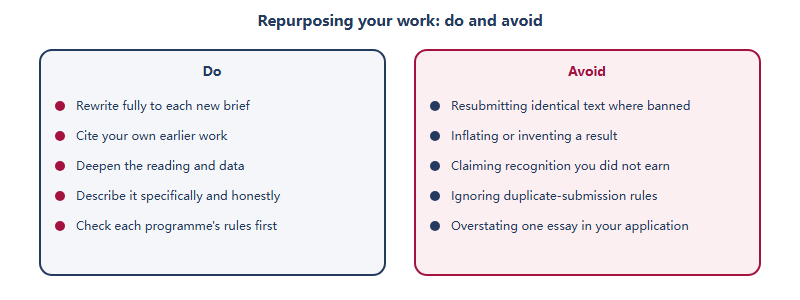
Reuse is powerful, but a few integrity rules are non-negotiable. Get these right and everything above is safe.
- Never submit identical text to two contests or assessments that prohibit duplicate work — check each programme's rules first.
- If a qualification requires it, cite your own prior essay as a source rather than silently reusing it.
- Never overstate your outcome: report only recognition you genuinely received, and confirm any award details before you cite them.
- Adapt honestly — rewrite to each brief instead of lightly editing the same file.
- When a rule is unclear, ask the organiser or your school, and default to writing something new.
Can I submit my HIEEC essay to another competition too?
Only if both sets of rules allow it. Many competitions require original, unpublished work, so reuse the research but check each official site before resubmitting anything.
Can my HIEEC topic become my EPQ or IB Extended Essay?
Often yes, because the reading and question transfer well, but you must meet each programme's requirements, write new work, and follow its academic-integrity rules.
Is reusing my own writing self-plagiarism?
It can be if a programme forbids duplicate submission. When in doubt, write fresh text for each purpose and cite your earlier work where the rules require.
What is the highest-value way to reuse the essay?
Usually deepening it: reading the papers you cited and pursuing the open questions builds genuine expertise rather than just recycling text.
This is an independent guide operated by Hanlin Education for China-based international-school students. It is not affiliated with, endorsed by, or sponsored by HUEA, the Harvard College Economics Review, or Harvard University. Competition details change each cycle, so always confirm current rules, dates and fees on thehuea.org. If you spot an error, we correct verified mistakes within 7 working days.