In the most recent published HIEEC cycle, one of the four prompts asked entrants to analyse the potential of universal basic income or data dividends as policy responses to technological inequality. That word — or — is where the essay starts, not the whole of it. The same prompt goes on to ask about the trade-offs of decoupling income from labour, the effects on long-term growth, innovation and social cohesion, and how different income groups and countries at varying levels of development would respond. Here is the toolkit.
The word “or” is where the essay starts, not where it ends
Most entries answering an inequality prompt make the same structural mistake. They spend 900 words establishing that technological change has widened gaps, 400 words describing universal basic income sympathetically, and 200 words concluding that “policymakers must act.” Nothing in that essay is wrong. Nothing in it is an argument either, because at no point does the writer commit to a comparison that could have come out the other way.
A prompt that names two instruments has already done half your framing for you. It has told you the outcome you are optimising (some measure of technologically driven inequality), and it has handed you two candidate levers. Your job is to take a clear position on their potential, on a criterion you state out loud, and to concede honestly what each instrument gives up — without dropping the other elements the prompt sets out.
The reason this matters is procedural as much as intellectual. HUEA’s published process for the most recent cycle has the board reading submissions first, with the top ten adjudicated by an economics professor at Harvard. A first reader working through a large pile is looking for the sentence that tells them what this essay claims. If your claim only appears on page four, you have made that reader work for it. Our companion guide on choosing your prompt by strength covers how to tell early whether this is the prompt you should be on at all.
Get the mechanism right before you get to policy
“Technological inequality” is not one phenomenon, and the instrument you end up preferring depends on which version of it you think is doing the work. Four mechanisms recur in the literature, and they are not interchangeable.
- Skill-biased technical change. New technology raises the marginal product of skilled labour relative to unskilled, widening the skill premium. The canonical framing runs through Katz and Murphy’s supply-and-demand treatment of the college wage premium.
- Task displacement. A sharper, more modern version: technology automates particular tasks, not whole occupations. Autor, Levy and Murnane’s routine-task framework and Acemoglu and Restrepo’s displacement-and-reinstatement model are the standard references, and they predict different things from a simple skill story.
- The factor shares story. If technology raises the return to capital relative to labour, the distribution shifts between factors rather than between workers. Karabarbounis and Neiman on the global decline in the labour share is the entry point here.
- Scale and market power. Digital goods have near-zero marginal cost, so small quality advantages produce enormous market shares. The “superstar firms” literature links industry concentration to falling labour shares.
Notice what this does to your policy choice. If you believe the problem is the skill premium, education and training policy is arguably the first-best answer and both named instruments are second-best. If you believe the problem is factor shares and data rents, a data dividend is aimed directly at the mechanism. If you believe the problem is volatility and displacement risk borne by individuals, a universal transfer is aimed directly at the consequence. Say which one you believe, and why, in your second paragraph.
Universal basic income: the three questions that decide your argument
UBI is unconditional, universal and periodic. Almost every serious disagreement about it reduces to three questions, and an essay that answers all three has effectively made its case.
How is it financed, and who bears the incidence? This is where most student essays quietly cheat. A transfer paid to everyone must be funded by someone, and the distributional effect of the package is the transfer minus the tax that funds it. A UBI funded by a flat consumption tax and a UBI funded by a progressive income tax are different policies with different winners. If you cannot say who pays, you have not evaluated the policy — you have described a gift.
What happens to labour supply? The theoretical prediction is ambiguous, because an unconditional grant produces an income effect that reduces hours while removing the withdrawal rates embedded in means-tested benefits, which can raise effective returns to work at the bottom. Because theory does not settle it, this is the part of the essay where evidence earns its place.
Universal or targeted? Universality buys administrative simplicity, near-total take-up and no stigma; targeting buys a larger transfer per pound of revenue. This trade-off is real and unresolved, which makes it excellent essay material.
For evidence, go to primary evaluations rather than news summaries. Finland’s randomised basic-income experiment for unemployed benefit recipients published an official evaluation; the reported headline was small employment effects alongside better self-assessed wellbeing, but read the actual report and note its design limits, because the treatment was not a full UBI. The Alaska Permanent Fund Dividend is the longest-running universal cash payment anywhere and has generated peer-reviewed work on employment effects. GiveDirectly’s long-horizon cash-transfer studies in Kenya and the Stockton guaranteed-income demonstration in California give you two more designs. Cite the study, the year and the design; a reader who knows this literature will spot a claim borrowed from a headline.
Data dividends: a different theory of the same problem
A data dividend starts from a claim about ownership rather than a claim about need. The argument runs: users generate the behavioural data that trains the models and targets the advertising that produces platform profits; that data is an input; inputs are normally paid for; therefore the current arrangement is not a market failure to be patched afterwards but a missing market to be created. Posner and Weyl’s “data as labour” framing in Radical Markets is the most-cited version, and California’s governor floated a state data dividend in 2019, which gives you a concrete political reference point rather than a purely theoretical one.
The instrument is genuinely different from UBI in three ways, and a strong essay makes all three explicit.
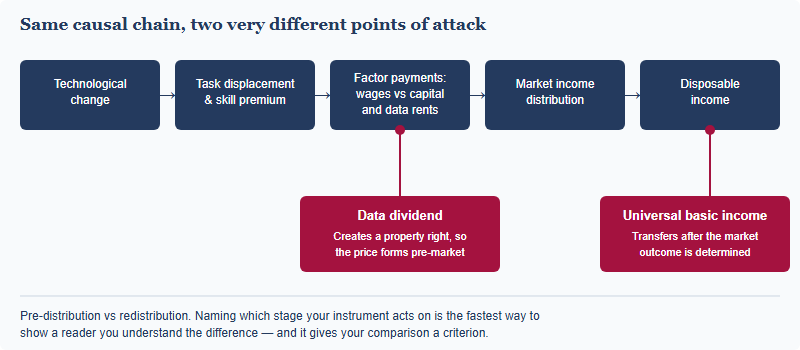
- It is pre-distributive. It alters factor payments before market income is determined, rather than transferring afterwards. If your diagnosis is that data rents accrue to capital, this is the aimed shot.
- The payer is identified. Platforms and data-consuming firms pay, not the general taxpayer. That is politically easier in some respects and much harder in others, since a levy on a mobile intangible invites avoidance and relocation.
- It has a valuation problem UBI does not. What is one person’s data worth? Data is non-rival, its value is enormously context-dependent, and the marginal record in a large training set may be worth almost nothing while the corpus is worth billions. Any dividend requires an administratively workable price, and the honest answer is that no jurisdiction has yet demonstrated one at scale.
That last point is not a reason to dismiss the instrument. It is the strongest single paragraph available to you if you are arguing for UBI, and the objection you must answer if you are arguing for the dividend.
| Dimension | Universal basic income | Data dividend |
|---|---|---|
| Theory of the problem | Individuals bear displacement risk and income volatility | An input is being used without being paid for; rents accrue to capital |
| Where it acts | Redistribution, after market incomes form | Pre-distribution, at the factor-payment stage |
| Who pays | Taxpayers, via whatever tax funds it — incidence depends entirely on that choice | Platforms and data-consuming firms, with possible pass-through to users or advertisers |
| Main efficiency worry | Labour-supply response and the deadweight cost of the funding tax | Under-investment in data-driven innovation; avoidance by mobile intangibles |
| Hardest measurement problem | Estimating behavioural response outside a pilot, at national scale | Valuing a non-rival input whose worth is contextual and mostly collective |
| Evidence you can actually cite | Finland’s evaluation, Alaska's dividend, GiveDirectly, Stockton | Almost no implementation evidence; argue from theory and analogy to resource dividends, and say so |
Fitting the comparison into 1,500 words
HUEA states that the 1,500-word limit must be strictly adhered to, and that references, footnotes, titles, headers and footers sit outside it. That ceiling is tight for a two-instrument comparison, which is exactly why a word budget written before you draft saves you a painful cut later.
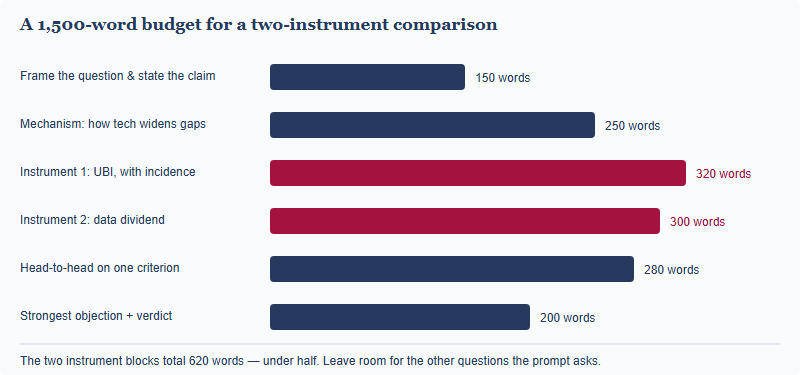
Two notes on using the budget. First, the “head-to-head on one criterion” block is the section students most often omit, and it is the section that turns two descriptions into an argument. Pick one criterion — effect on the measured outcome per unit of revenue, or political durability, or administrative feasibility — and run both instruments through it. Second, do not write the sections in this order. Draft the head-to-head first, while your thinking is sharpest, then write the two instrument blocks knowing exactly which features you will need to have introduced. Our method piece on writing the 1,500-word essay sets out the full drafting sequence.
Five angles that work, and three that sink
Angles with room in them. (1) Argue that the two instruments answer different diagnoses, then defend a diagnosis — this is the most sophisticated available structure. (2) Take the financing question seriously and show that a UBI’s distributional effect flips depending on the funding tax. (3) Attack the valuation problem head-on and propose a specific, imperfect, administrable price for data, conceding its arbitrariness. (4) Use the resource-dividend analogy carefully: Alaska pays a dividend from a rival, measurable, geographically fixed resource, and every one of those adjectives fails for data. (5) Argue that both instruments are second-best relative to competition policy or portable benefits, and cost that claim honestly.
Angles that sink. (1) The moral essay, which asserts that inequality is unjust and treats that as an argument. (2) The forecast essay, which predicts mass technological unemployment by a specific year on no model. (3) The pilot-generalisation essay, which takes a two-year experiment on a selected sample and treats its results as a national prediction — a mistake a professional reader will notice immediately.
If you are still deciding whether this competition suits you at all, start with our overview of what HIEEC is and how it runs. And before you write a word on any prompt, confirm the live prompt wording for the current cycle on thehuea.org — the four areas and their exact phrasing are set by the organisers each autumn and change from year to year.
Do I have to pick just one of the two instruments?
Read the live prompt. In the most recent cycle it asked you to analyse the potential of the two instruments rather than to pick a winner, so take a clear position but answer the other questions the prompt sets; confirm current wording on thehuea.org.
Can I argue against both UBI and data dividends?
Yes, if you propose a defensible alternative and cost it honestly. A disciplined argument beats agreement with the premise.
How many sources should the essay use?
Chicago or APA is required; no minimum count appeared in the rules we reviewed. Judge by whether every contestable claim is sourced.
Does the 1,500-word limit include references?
No. HUEA states the limit excludes references, footnotes, titles, headers and footers, and that it must be strictly adhered to.
This is an independent guide operated by Hanlin Education for China-based international-school students. We are not affiliated with, endorsed by, or sponsored by the Harvard Undergraduate Economics Association, the Harvard College Economics Review, or Harvard University. Prompt areas, wording, word limits, fees and deadlines are set by the organisers and change each cycle — confirm current details on thehuea.org before you write. Factual corrections are made within 7 working days.