HUEA runs two high-school competitions, not one. HIEEC is a global essay contest you enter from anywhere in the world; HPEC is an in-person quiz competition held at Harvard covering AP Micro and Macro. They test close to opposite skills, sit in different halves of the academic year, and carry wildly different travel costs. For most China-based students, the choice is more constrained than it looks.
Same organiser, opposite skills
Families usually discover the Harvard Undergraduate Economics Association through one of its contests and then assume “the Harvard economics competition” is a single thing. It is not. HUEA describes itself as a student-led bridge between Harvard undergraduates and the Department of Economics, aspiring economists worldwide, and their peers, and under that umbrella it lists two separate high-school programmes: HIEEC, which it calls a global essay contest, and HPEC, which it calls a quiz bowl.
Two things follow from that sentence, and both matter before you spend a term preparing.
First, this is a student organisation. HUEA is run by Harvard undergraduates and works closely with the economics department, but it is not a university admissions programme and not a departmental initiative. Neither contest is a Harvard University credential, and describing either one that way on an application is a misrepresentation rather than a flourish. Our overview of what HIEEC is and who actually runs it sets out that distinction in more detail.
Second, the two contests reward almost non-overlapping abilities. HIEEC asks you to hold a single economic argument together across roughly 1,500 words, with sources, over a period of weeks. HPEC asks you to retrieve economics quickly and accurately in live rounds. A student can be excellent at one and mediocre at the other, and that is the normal case rather than the exception.
What each contest actually tests
Here is the comparison stripped of marketing. Where a row is marked “confirm”, the official pages we reviewed did not state it plainly, so treat it as something to check rather than a fact to plan around.
| Dimension | HIEEC | HPEC |
|---|---|---|
| Format | Written essay, around 1,500 words, responding to one published prompt | Quiz competition with individual and team rounds |
| Where | Entered and judged remotely, from anywhere in the world | In person at Harvard |
| Core skill | Sustained written argument; using theory and evidence under a hard word limit | Fast, broad recall and application under time pressure |
| Syllabus | No syllabus; the prompts set the territory each cycle | AP Micro and Macro, plus economic news, history, recent research and real-world applications |
| Solo or team | Individual; the essay must be your own work | Both — individual and team rounds (confirm team size) |
| Time of year | Prompts in autumn, submission in January, results in spring | Spring (confirm the date each cycle) |
| Preparation shape | Reading, drafting, redrafting over 8–12 weeks | Content coverage plus timed practice and team drilling |
| What you end up holding | A finished piece of writing you can reuse and discuss | Competition experience and a team result |
| Main cost drivers | Reading fee (confirm the current amount) | Registration plus flights, visa and accommodation |
The row that decides most cases is the second one, and guide sites tend to skip past it.
The calendar does not force a choice
A common worry is that entering both means a collision. It does not, at least not on the published rhythm. HIEEC runs across the first half of the academic year: prompts appear in the autumn, submissions close in January, and results follow in the spring. HPEC sits in the spring, after HIEEC has already closed.
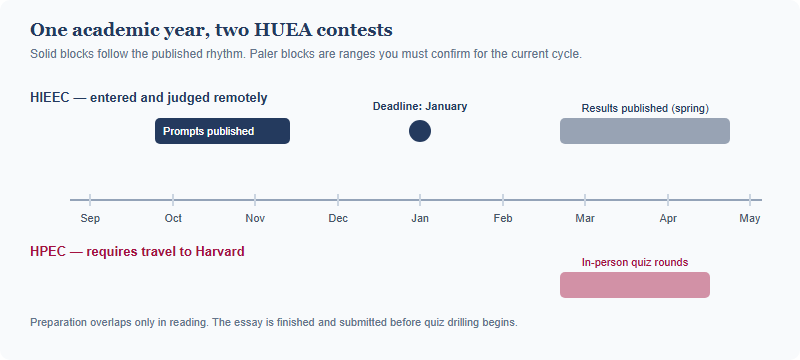
So the honest constraint is effort, not dates. An HIEEC entry in our coaching experience absorbs something like 30 to 45 hours spread across the autumn. HPEC preparation is a different kind of load: content coverage across two AP-level syllabuses plus current economics, then timed drilling with a team. Doing both well in one year is possible for an organised Grade 11 student. Doing both badly is the more common outcome, and a rushed essay is worse than no essay because you should confirm on thehuea.org whether a later submission can replace an earlier one.
The constraint most guides skip: one of them needs a flight
The official HPEC page describes an in-person quiz competition at Harvard. For a student in Shanghai, Shenzhen or Beijing, that is not a registration decision but a travel decision: flights, accommodation, a US visa appointment, and several days out of term, most likely during the spring examination run-up. Add it up honestly and the true cost of HPEC is an order of magnitude above an essay reading fee.
Some third-party guides mention a virtual participation option in certain years, and low registration fees. We could not confirm a virtual option on the official page we reviewed, which describes the event as in person. This matters enormously, because a remote option would change HPEC from a major family expenditure into a cheap afternoon. Do not plan around it on the strength of a guide site. Check the current cycle's own page, and if it is ambiguous, ask the organisers directly before booking anything.
If HPEC does look feasible, price the whole thing before committing, because registration is the smallest line in the budget. Flights from the mainland, several nights of accommodation, a visa appointment that may need booking months ahead, and the school days lost to travel all belong in the total. Then ask the harder question: would the same money and the same fortnight produce more if spent elsewhere this year? For some families the answer is plainly yes, and that is a legitimate reason to choose the essay — not a sign of having settled for less.
HIEEC has the opposite profile. There is nowhere to travel, no team to assemble and no fixed hour at which you must be awake in another time zone. You read, you write, you submit a file. For students in China without the budget or the visa runway for US travel, that asymmetry usually settles the question on its own.
Which one fits you
Set aside prestige for a moment, because the two contests come from the same organisation and neither is a ranking of the other. Ask instead which test flatters your actual abilities.
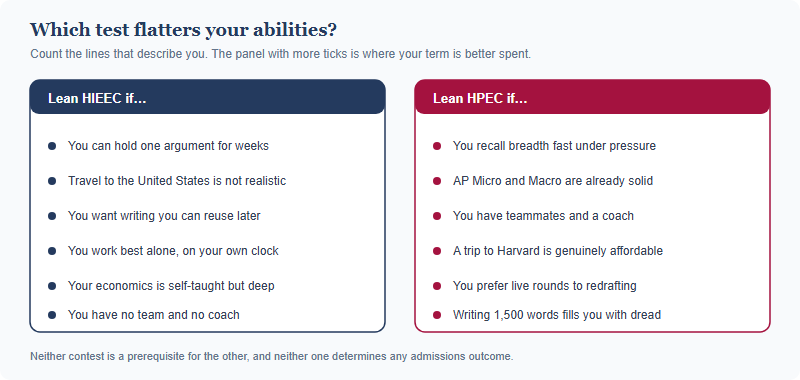
One pattern is worth naming because we see it every cycle in China-based cohorts. Students who have taken AP Micro and Macro often assume that coursework makes them ready for the essay. It makes them ready for the quiz. The essay needs something the AP syllabus never asks for: choosing a defensible position, anticipating the strongest objection to it, and cutting your own best paragraph because the word limit is real. If that gap is yours, our guides to choosing a prompt by strength and building an argument inside 1,500 words are the two to read first.
If you want both, sequence them. For a Grade 10 or 11 student with the appetite, the natural order runs with the calendar rather than against it.
- Autumn: read for the essay and write it. This is the phase that cannot be compressed, because argument quality comes from redrafting and redrafting takes elapsed weeks.
- January: submit, then stop. Whether a later submission can replace an earlier one is not stated on the official page, so treat the file you send as final.
- February onward: switch to content coverage and timed practice with your team, if HPEC is realistic for your family. The reading you did in the autumn genuinely helps here — current economics and recent research are on HPEC's territory.
- Spring: compete, and expect HIEEC results in the same window.
What neither contest does is guarantee anything about university outcomes. They are two small inputs among many, they signal slightly different things — written analytical capability on one side, breadth and speed on the other — and both are worth doing mainly because economics is interesting enough to spend a term on. Anyone presenting either as an admissions lever is selling you something. Choose the one that matches how your mind actually works, confirm the current cycle's rules and costs on thehuea.org, and then do that one properly.
Frequently asked questions
Are HIEEC and HPEC run by the same people?
Yes. Both are high-school competitions listed by HUEA, a student-led Harvard undergraduate organisation, not by Harvard University itself.
Can I enter both in the same year?
Yes. HIEEC closes in January (the official page marks this tentative) and HPEC runs in the spring, so they do not clash. The real limit is your own workload.
Do I need to travel for HIEEC?
No. HIEEC is entered and judged remotely from anywhere. HPEC is described as an in-person quiz competition at Harvard.
Does AP Economics prepare me for HIEEC?
Partly. It supplies the theory, but not the argument-building and compression the 1,500-word essay is actually judged on.
This is an independent guide operated by Hanlin Education for China-based international-school students. We are not affiliated with, endorsed by, or sponsored by the Harvard Undergraduate Economics Association, the Harvard College Economics Review, or Harvard University. Formats, dates, fees, eligibility and judging arrangements are set by the organisers and change between cycles — confirm current details on thehuea.org before relying on anything here. Factual corrections are made within 7 working days.