A crypto and finance prompt is almost never asking whether digital money will succeed. It is asking what a specific instrument does to the plumbing: who owes whom, what happens under stress, and whose control over money changes. Essays that forecast prices read like newsletters. Essays that trace mechanisms read like economics. This is the toolkit for the second kind.
What this category actually asks
Crypto and finance is a theme that recurs in third-party summaries of past HIEEC cycles, but we could not verify any prompt list against a primary source, and the official page does not state how many prompts the coming cycle will carry. Exact wording is set by the organisers and released each autumn, and the past-year prompt attributions circulating on third-party guide sites are not verifiable, so treat any specific question you see quoted with caution and confirm the live prompts on thehuea.org when they appear. What is stable across cycles is the shape of the question, and shape is what you can prepare for now.
Questions in this area reduce to one of three forms. Working out which one you have been handed is the most valuable thing you can do in your first hour, because each form has a different centre of gravity.
- The monetary form. Is this thing actually money, and if so, what kind? Centre of gravity: the functions of money and the credibility of the claim behind it.
- The control form. What does adoption do to monetary policy, financial stability, or a state's capacity to manage its own currency? Centre of gravity: transmission and run risk.
- The access form. Who is included or excluded by the payment system, and at what cost? Centre of gravity: payment frictions, remittance costs and account ownership.
A prompt that says “evaluate the implications of” is usually the control form. A prompt that says “can X serve as” is the monetary form. A prompt mentioning developing economies or the unbanked is the access form. Diagnose it, then commit — a 1,500-word essay that tries to answer all three answers none. Our guide to choosing a prompt by strength covers how to make that call before you invest reading time.
Get the four objects straight before you write a word
This is the single most common failure in the category, and it is fatal because it is invisible to the writer. Students use “crypto” as one word covering four economically distinct things, then produce an argument that is true of one of them and false of the others. A judge who knows the difference stops trusting the essay immediately.
| Instrument | What it is | Who owes you | The real economic question | Where essays go wrong |
|---|---|---|---|---|
| Unbacked crypto-asset | A token with no issuer promise and no redemption claim | Nobody | Can something with no cash flows and volatile price serve as a unit of account? | Treating price appreciation as evidence of monetary usefulness |
| Stablecoin | A private claim promising redemption at a fixed value, backed by reserve assets | The issuer | Does the peg hold under stress, and what backs it? | Assuming the peg is a property of the design rather than of the reserves |
| Retail CBDC | Central bank money held directly by households and firms | The central bank | What happens to bank deposits and credit if the public can hold central bank money directly? | Describing it as “government crypto” and missing the disintermediation question |
| Wholesale CBDC or tokenised deposits | Settlement infrastructure between financial institutions | Central bank or the depository bank | Does faster settlement reduce counterparty and cross-border frictions? | Confusing an interbank plumbing upgrade with a consumer product |
One sentence early in the essay — “this essay concerns fiat-referenced stablecoins, not unbacked crypto-assets, because the redemption promise is what generates the stability question” — buys you enormous credibility for eleven words of word budget. It tells the reader you know the terrain has boundaries.
The mechanism you must be able to draw, and where the evidence lives
Whatever form your prompt takes, the control question runs through one chain, and you should be able to sketch it from memory. Monetary policy works because a central bank rate changes bank funding costs, which changes credit conditions, which changes spending, investment and eventually prices. Commercial bank deposits are the pressure point in the middle. Both stablecoins and retail CBDCs act on that same point, from opposite directions.
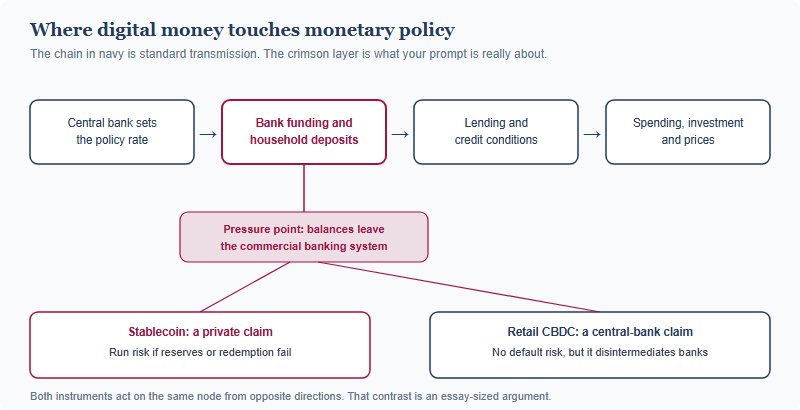
Three specific mechanisms are worth having at your fingertips, because each turns a vague worry into a stated economic claim.
Run risk. A claim redeemable on demand at a fixed value, backed by assets that are not perfectly liquid, is a structure economists have understood since the classic work on bank runs: if enough holders redeem at once, the issuer must sell reserves into a falling market, and the expectation of that outcome is itself a reason to redeem first. This is why “what backs it, and how liquid is the backing?” is a sharper question than “is it regulated?”
Currency substitution. If residents of a small open economy hold savings and make payments in a foreign-currency-denominated instrument, the domestic central bank's rate has less purchase on domestic conditions, and the state earns less from issuing its own money. This is an old phenomenon with a new delivery mechanism, and treating it as an old phenomenon is a mark of sophistication.
Disintermediation. If households can hold central bank money directly, deposits may migrate out of commercial banks, which fund lending. Design choices — holding caps, whether balances pay interest, tiered remuneration — exist precisely to manage that risk. An essay that names a design parameter and explains what it is for is doing real analysis; an essay that says a CBDC is “more efficient” is not.
Where the evidence actually lives. This category punishes casual sourcing more than most, because the loudest available material is promotional or speculative. Go where institutions with no position to talk up have written things down.
- Bank for International Settlements — annual report chapters and committee work on payments and digital money; the standard starting point for the control form.
- International Monetary Fund — financial stability reporting and country surveillance, useful when your prompt concerns a specific economy or dollarisation.
- Individual central banks — the European Central Bank, Bank of England and others have published extensive design work. Cite the design document rather than press coverage of it.
- World Bank Global Findex — account ownership and payment behaviour, which is where the access form gets its numbers.
- Public CBDC trackers — useful for the status of projects, but check the methodology and date, and prefer a central bank's own statement about its own project.
Two disciplines make the difference. Date every figure, because this field moves fast and an undated number is worthless. And never cite an exchange price as evidence about policy: the price of an asset tells you what traders expect, not whether an instrument is good money or a monetary system is stable.
Spending 1,500 words on it
The word limit is the real constraint, and this category tempts you to spend 600 words explaining how the technology works. Resist that. Assume a reader who knows what a ledger is; spend your budget on the economics.
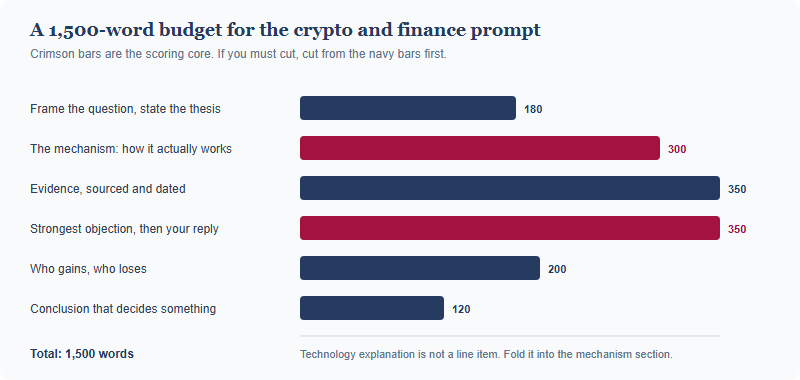
The objection section is where this prompt is won. Every strong position here has a real counter: stablecoins genuinely do lower payment costs, and CBDCs genuinely do raise privacy questions. State the best version of the argument against you, in its own strongest form, and then answer it on the evidence. Method for that paragraph, and for holding the whole structure inside the limit, is in our guide to writing the 1,500-word essay.
Three traps that sink this category
The forecast essay. Any sentence predicting adoption levels or valuations in 2030 is a hostage you have handed the reader. You cannot support it, and it converts an analytical essay into speculation. Write about mechanisms and conditions: “if adoption reaches a level at which deposit funding is materially affected, then…” is defensible; a number is not.
The ideology essay. Framing the question as freedom versus state control feels substantial and is almost entirely assertion. Judges in economics reward trade-offs with named costs and identified bearers. If you find yourself writing about what money “should” be, convert it: who bears the cost of the arrangement you prefer, and how would we observe whether you are right?
The category slip. Starting an essay about stablecoin stability and drifting into unbacked crypto-assets by paragraph four is the error the table above exists to prevent. Reread your draft asking one question of every claim: is this true of the specific instrument I said I was analysing? A surprising number of confident sentences will fail that test.
One last point on framing. If your prompt invites a national case, you are allowed to write about the economy you know best, and doing so well is a genuine advantage over an entrant writing about somewhere they have only read about. Keep it analytical rather than political, use published sources for every factual claim, and remember that the essay is judged as economics. For how the contest is structured and judged before you commit a term to it, start with our overview of HIEEC.
Frequently asked questions
Do I need technical knowledge of blockchains?
No. You need to explain who owes what to whom under stress. The economics of the claim matters far more than the technology.
Is it safe to write about a recent crash or depegging?
Yes, if you explain the mechanism rather than narrate events, and cite dated primary sources for every factual claim.
Can I argue that crypto is bad money?
Yes. Either direction can score. What matters is that you test it against the functions of money and answer the strongest objection.
Will the crypto prompt appear in the next cycle?
Unknown. Prompts are released by the organisers each autumn, so confirm the live set on thehuea.org rather than assuming last cycle repeats.
This is an independent guide operated by Hanlin Education for China-based international-school students. We are not affiliated with, endorsed by, or sponsored by the Harvard Undergraduate Economics Association, the Harvard College Economics Review, or Harvard University. Prompt areas, wording, word limits and rules are set by the organisers and change each cycle — confirm current details on thehuea.org. Nothing here is investment advice. Factual corrections are made within 7 working days.