Eligibility for HIEEC is stated in terms of school grade, not coursework: the official description opens the contest to high-school students in grades 9–12 worldwide, with no economics course listed as a requirement. If your school starts economics in the final year, or you are in a science stream that never offers it, you are not excluded. You are simply starting from a different place.
Eligibility is set by grade, not coursework
Start with what is actually stated. The HUEA pages describe HIEEC as open to high-school students in grades 9–12, anywhere in the world. Judging is described as a two-tier process: the board reads entries, and the strongest go to a Harvard economics professor. Nothing we could find on those pages conditions entry on having studied economics, and the full rules for the 2026-27 cycle had not been published at the time of writing — so confirm the current eligibility wording on thehuea.org before you commit, and treat any third-party claim about prerequisites as unverified.
Now the limit of that fact. Being eligible is not the same as being competitive. The stated eligibility asks nothing about your transcript, but a professor reading your essay will notice within a paragraph whether you can operate an economic idea or only recite one. The rest of this article is about closing that specific gap, which is much narrower than a two-year syllabus.
This is a common situation in Chinese international schools. Economics often appears only in the IB Diploma years or as a single AP option, and students in a science-heavy track may never encounter it in a timetable. Meanwhile the students who do take it often arrive with exam habits that a competition punishes, and it shows in the drafts we edit — a point we cover in our guide on the structure and judging context of HIEEC.
A 1,500-word essay cannot contain a syllabus. It contains one claim, one mechanism, some evidence and one objection. That means the economics you need is not broad — it is five ideas you can use, defend and apply to a case that is not the textbook example.
| Idea | What you must be able to do with it | Signal that you have it |
|---|---|---|
| Opportunity cost | Name what is given up by a choice, in a case where the alternative is not obvious | You can price a decision that has no invoice attached to it |
| Marginal thinking | Ask what changes for the next unit, rather than arguing about the total | Your sentences say “one more” rather than “in general” |
| Incentives and response | Predict who changes behaviour, in which direction, and how fast | You can name the actor, not just the outcome |
| Elasticity | Explain why the same policy lands on different people depending on substitutability | You can say who bears a cost and why, without arithmetic |
| Market failure | Identify the specific failure — externality, information gap, public good, market power — before proposing anything | You never say “the government should” without naming what is broken |
Notice what is absent: no econometrics, no formal modelling, no macro identities. You can write a strong essay without any of them. What you cannot do is use them badly — a regression you do not understand or a model you cannot defend is worse than no model, because it converts an honest gap into a visible error.
An eight-week build
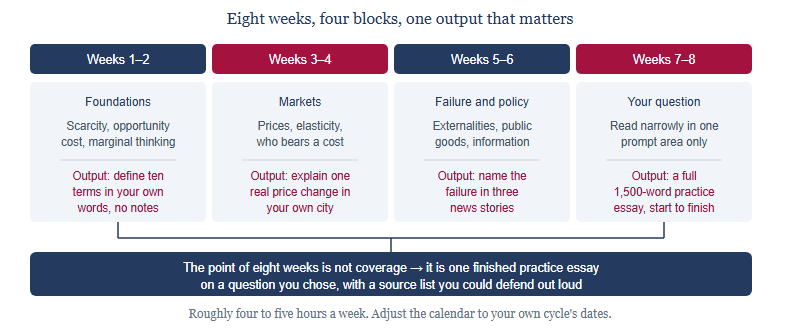
Two design choices in that plan are deliberate. The first is that every block ends in an output rather than a chapter finished. Reading creates a comfortable illusion of understanding; writing destroys it in about ten minutes, which is exactly what you want it to do while there is still time. The second is that you narrow in week seven, not week one. Self-taught students routinely pick a topic first and then read only what supports it, which produces an essay with a conclusion and no reasoning behind it.
For what to read in weeks one to six, we keep a separate reading roadmap on this site; the short version is one accessible introductory text read slowly, plus a serious weekly economics publication read for how arguments are built rather than for facts to quote.
Three ways self-taught essays go wrong
Across drafts we edit each season, students without formal coursework tend to fail in three recognisable ways. Each has a fix that costs nothing but attention.
- The textbook-summary essay. Having just learned the material, the writer explains it — five hundred words defining externalities before the argument starts. The reader already knows. Fix: assume your reader teaches this. Delete every sentence whose purpose is to prove you understand a term, and keep only sentences that apply it to your case.
- The podcast-opinion essay. Strong views absorbed from commentary, expressed with confidence and no mechanism underneath. It reads fluent and evaporates under one question. Fix: after every claim, write “because” and finish the sentence with who responds to what. If you cannot, the claim is borrowed.
- The terminology-cosplay essay. Technical vocabulary used as decoration — “deadweight loss”, “asymmetric information”, “rent-seeking” — in positions where the writer could not define them under questioning. This is the most damaging, because it invites a specialist reader to test exactly the thing you cannot defend. Fix: a hard rule — no term appears in your essay unless you can explain it to a classmate in one sentence without notes.
The third failure has a mirror image worth naming: some self-taught writers over-correct into plain language so cautious it says nothing. The target is precision, not simplicity. “A tax on the input raises costs for every firm downstream that uses it” is plain and precise. “Taxes affect the economy” is plain and empty.
Picking a question that plays to your position
Having no coursework changes which questions are good for you, and this is the practical decision that most affects your outcome. Choose a prompt area where the binding constraint is reasoning rather than accumulated technical machinery, and where you can reach primary evidence without specialist tools.
- Favour questions about incentives, policy design, market failure, or the distribution of a cost. These reward careful thinking and are readable from public data.
- Approach carefully questions that reward formal modelling or empirical identification — not forbidden, but you will be competing against students who have the machinery, on their ground.
- Use your actual advantage. A science-stream student who genuinely understands a technology, an energy process or a biological constraint has domain knowledge most economics students lack. Applied to an economic question, that is a real edge rather than a compensation.
Our guide to choosing your prompt by strength works through that judgement in detail, and it applies with more force when you are self-taught, because the wrong prompt costs you weeks you do not have.
The readiness check, and the calendar
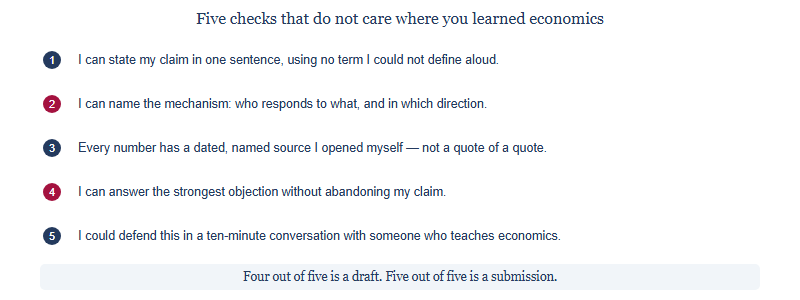
Check five is the one that separates entrants. A student who has taken two years of economics and cannot survive ten minutes of questioning is in a worse position than a self-taught student who can, because the essay is read by people who will notice which is which. Coursework buys vocabulary and exam technique. Neither is what is being marked.
The practical constraint is not ability, it is calendar. HIEEC has historically closed for submissions in January, and the official page currently presents that January timing as tentative for the coming cycle — confirm the dates on thehuea.org once the rules are posted. Work backwards from whatever date is published rather than from this article.
Against a January-shaped deadline, an eight-week build starting in early autumn finishes well before prompts, drafting and revision compete with school assessments and, for older students, application deadlines. Starting the build in December does not work: you would be learning the ideas and using them in the same fortnight, which produces exactly the textbook-summary essay described above. If you are reading this later in the season with the deadline close, the honest advice is to build properly and enter the following cycle rather than submit something thin. Once you have the foundations in place, our guide to writing the 1,500-word essay covers the drafting sequence itself.
Frequently asked questions
Can I enter HIEEC without studying economics?
The stated eligibility is grades 9–12 worldwide, with no course listed as a requirement. Confirm the current wording on thehuea.org.
How much economics do I actually need?
Five usable ideas: opportunity cost, marginal thinking, incentives, elasticity and market failure. Depth in these beats broad terminology.
Will judges know I am self-taught?
The judging description mentions only the essay, not your transcript. What shows is whether you can operate an idea — which is learnable outside a classroom.
Is eight weeks really enough?
Enough to write a defensible essay, if each block ends in something you wrote. It is not enough to fake technical machinery you have not learned.
This is an independent guide operated by Hanlin Education for China-based international-school students. We are not affiliated with, endorsed by, or sponsored by the Harvard Undergraduate Economics Association, the Harvard College Economics Review, or Harvard University. Eligibility, deadlines, fees, word limits and rules are set by the organisers and change each cycle — confirm current details on thehuea.org. Entering a competition does not guarantee any admissions or academic outcome. Factual corrections are made within 7 working days.