An HIEEC result occupies one of two very short fields in a university application, and it is read against everything else in your file. HUEA states that finalists and Highly Commended entrants are recognised by name — that naming is what makes an honours line honest rather than decorative. What follows is which field, what to write in it, and what the line cannot do on its own.
What HUEA states about recognition — and what it does not
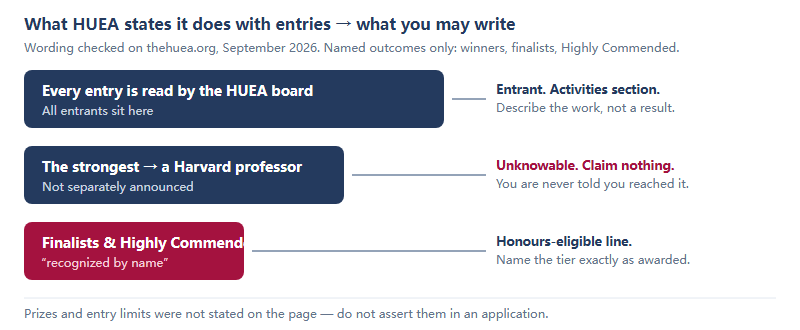
Start with the wording, because your application line has to survive being checked against it. When we read the competition page on thehuea.org in September 2026, it described HIEEC as open to high-school students in grades 9–12, anywhere in the world, asked for an essay of around 1,500 words answering one prompt chosen from a set, and gave the submission deadline only as January, without a date or a time zone. On judging it stated that every entry is read by the HUEA board, and the strongest are judged by a Harvard economics professor, and noted that past judges have included Oliver Hart, the 2016 Nobel laureate. On outcomes it stated one thing that matters enormously for an application: finalists and Highly Commended are recognized by name.
Now the more useful half — what the page did not state. It gave no prize list, no entry fee, no citation style, no exact deadline or time zone, and no statement about how many entries one student may submit; it does state that winning essays are published there with the author’s permission. Various third-party pages assert values for several of these. We could not verify them against the organiser, so we do not repeat them as fact, and neither should your application. Confirm every cycle-specific detail on thehuea.org before you rely on it.
That distinction is not pedantry. An application line is a factual claim made to a university under a signed statement of accuracy. “Highly Commended” is a claim you can make because HUEA names people at that level. “Top 3% internationally” is not, because no such figure is published. If you are unclear on what the competition itself involves before you write about it, our overview of what HIEEC is and how it runs sets out the shape of the thing you are describing.
The two fields a result can occupy
Most students think of this as one decision — “do I put HIEEC on my application?” — when it is actually two different fields doing two different jobs. An honours entry reports a result awarded by someone else. An activities entry reports work you did, and it is available to you whether or not you were named. Entering a competition and not placing is still a legitimate activities entry; it is not an honour.
On the Common Application, the Activities section takes up to ten entries, with a 50-character field for your position or role, 100 characters for the organisation name, and 150 characters for the description of what you did, including honours won. The Education section carries a separate, much shorter set of honour slots. Common App adjusts its fields between cycles, so confirm the current counts and character limits inside the live application rather than trusting any guide, including this one.
| Where it can go | What it can hold | Discipline | What it actually proves |
|---|---|---|---|
| Honours entry | A named recognition only — winner, finalist or Highly Commended, as awarded | A short title. No sentences, no adjectives, no invented percentiles | An external body, not you, judged the work worth naming |
| Activities entry | The work itself: research, drafting, revision — available to every entrant | ~150 characters, verbs first, one concrete number if you have one | You sustained independent academic work outside a syllabus |
| Personal or “why this subject” essay | The thinking the essay produced — a question you could not drop | Prose. Name the idea, not the trophy | The interest is yours rather than assembled |
| UCAS personal statement | The reasoning and reading it forced you into | Prose, and the same text goes to every course choice | Academic suitability for a specific subject |
| Teacher or counsellor reference | Third-party confirmation that the work was yours | Not yours to write — but it is yours to make possible | Corroboration, which is the strongest form of all |
Writing the line: 150 characters, and the name you must get right
The single most common error we see in drafts of these fields is not brevity. It is attribution. HIEEC is run by the Harvard Undergraduate Economics Association, a student organisation, together with the Harvard College Economics Review. It is not run by Harvard University, and an admissions officer — the one profession most likely to know exactly which Harvard entities are which — will notice if your line implies otherwise. Use the organiser’s own current name for the contest and attribute it to HUEA.
Consider two activities descriptions. Both fit inside 150 characters. Only one survives a reader who checks.
- Fails at exactly 150 characters: “I participated in the Harvard Economics Essay Competition, which is a very prestigious competition run by Harvard University for high school students.” It spends its whole budget on an adjective and a false attribution, and describes nothing you did.
- Works at 142 characters: “Wrote and submitted a 1,500-word argued economics essay to HUEA’s international contest; built the source base and revised across four drafts.”
The second version works because every clause is checkable and every clause is yours. It names a scale (1,500 words), a genre (argued, not summarised), a process (source base, four drafts) and an organiser you have got right. Notice that it makes no claim about a result, which means a student who entered and was not named can write it truthfully.
For an honours line, keep it to the award, the contest and the year, and nothing else: Highly Commended, Harvard International Economics Essay Contest (HUEA), 2027 runs to 76 characters and leaves nothing to query. Resist the urge to append “out of thousands of entries worldwide” — no entrant count is published, so that phrase is an invention dressed as data.
The cross-check: how the line is read against the rest of your file
An admissions reader does not evaluate a competition line in isolation, and understanding this changes what you should optimise. The line is checked against the transcript, the rest of the activity list, the essays and the references. Where those agree, the whole file becomes more believable; where they contradict each other, the weakest element drags on the strongest.
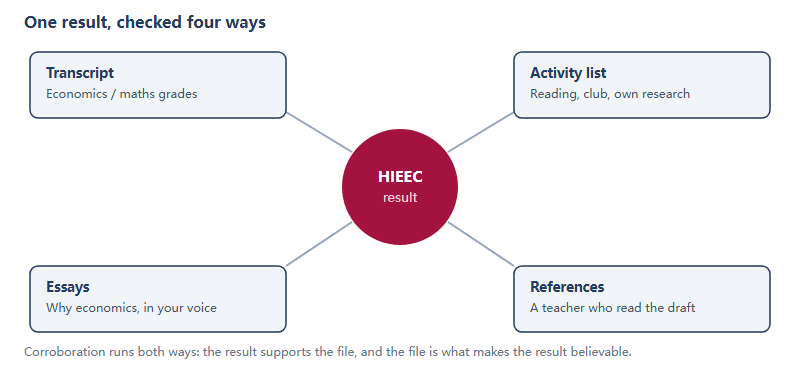
This is why the sequencing advice most students receive is backwards. They are told to collect a result and then write about it. In practice the result is the easiest element to add and the least informative on its own, because it is a single word supplied by strangers. What makes it register is the surrounding agreement: an economics grade that matches, a reading habit that predates the entry, an essay that returns to the same question in your own sentences, a teacher who can say the argument was yours before it was polished.
The practical implication is that the strongest version of this line is usually built months before you write it, by choosing a question you actually care about rather than the one you think looks impressive. Our guide to choosing your prompt by strength rather than by topic appeal is written for the essay, but it doubles as application advice for exactly this reason.
What the line cannot do, and which document can still receive it
Three limits, stated plainly. First, no competition result guarantees an admissions outcome, and any source telling you otherwise is selling something. Second, an unnamed entry is not an honour, and quietly upgrading “I entered” into “I was recognised” is the kind of error that, if checked, damages far more than the line itself. Third, one result cannot carry a file that says nothing else about economics; a single competition against an otherwise unrelated profile reads as an accessory rather than evidence.
Then there is timing, which catches Grade 12 students in particular. HUEA states the deadline as January without a specific date. Early-round applications in the northern-hemisphere cycle close well before that, and many regular-round deadlines fall around the turn of the year, so a result from the current cycle will usually not exist when your application is submitted. What that leaves you is the activities entry, written truthfully as work in progress or work completed, and any mid-year report or update channel a university offers — different institutions treat updates very differently, so check each one rather than assuming. Younger students are in a better position here, which is the real reason to enter early rather than in the final year.
None of this changes what you should actually spend your autumn on. The line is a by-product; the essay is the thing. If you are still building the essay itself, our walkthrough of structuring and writing to the 1,500-word limit is where that work happens.
Frequently asked questions
Can I list HIEEC if I entered but was not named?
Yes, as an activities entry describing the work you did. It is not an honour, and it must not be phrased as one.
Should I write “Harvard” in the line?
Attribute it to HUEA, a Harvard student organisation. Implying Harvard University runs the contest is inaccurate and easy to check.
Can I claim a percentile or entrant count?
No. No entrant numbers or percentile bands were stated on the competition page when we checked. Do not invent them.
Will a Grade 12 result arrive before my applications?
Usually not. The deadline is stated only as January, which falls after most early rounds and near many regular ones.
This is an independent guide operated by Hanlin Education for China-based international-school students. We are not affiliated with, endorsed by, or sponsored by the Harvard Undergraduate Economics Association, the Harvard College Economics Review, or Harvard University. Eligibility, deadlines, fees, word limits, recognition tiers and rules are set by the organisers and change each cycle — confirm current details on thehuea.org, and confirm application field limits inside the live Common Application or UCAS. Factual corrections are made within 7 working days.