You reach the end of a 1,500-word economics essay with roughly 150 words in hand. Most students spend them restating the introduction and then recommending a policy. Both moves cost you: one adds nothing a reader did not already have, and the other opens a new argument you have no room left to defend. There is a better use for that budget.
Where the ending actually falls in the word budget
HUEA’s competition page describes the essay as around 1,500 words answering one prompt chosen from a set. Note the word “around” — the page did not state whether that is a hard cap when we checked it in September 2026, and no penalty schedule was published. Plan to the number rather than gambling on the hedge, and confirm the current wording on thehuea.org before you submit.
Once you commit to that number, the ending stops being a stylistic question and becomes an allocation problem. An essay that has done its job will have spent most of its budget establishing a mechanism and testing it against evidence and an objection. What is left over is small, fixed and late — and it is the last thing a reader sees before forming a judgement.
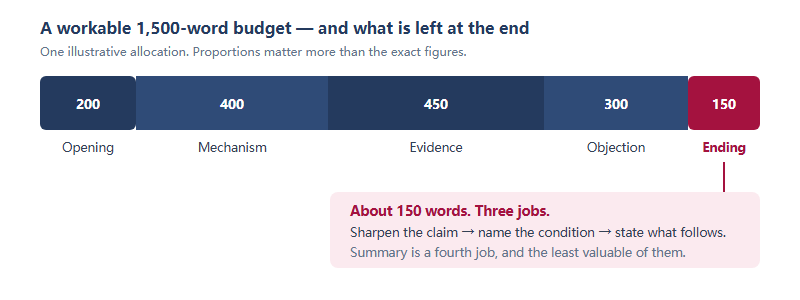
Four things an ending can do — only one of them is summary
A reader arriving at your final paragraph already knows what you argued; they have just read it. The question is what they still lack. Usually it is not a recap. It is a sense of how far the claim reaches, and whether you know that yourself.
| Move | What it does | What it signals to a judge | Worth the words? |
|---|---|---|---|
| Summarise | Repeats the claim and the steps at the same resolution as the introduction | That you can restate. Nothing about whether you understand | Rarely — 15 words at most, as a hinge |
| Sharpen | States the claim again at higher resolution, now carrying the qualifier the body earned | That the argument developed rather than merely unfolded | Yes — this is the core move |
| Bound | Names the condition under which the claim stops holding | Authorial control. You know where your own argument ends | Yes — and it is the rarest move in student work |
| Consequence | Says what changes if the claim is right, or what evidence would settle it | That you were reasoning, not performing a position | Yes — it is what makes an ending feel forward-facing |
| Recommend policy | Introduces a new normative claim in the final sentences | Usually that you ran out of argument and reached for a reflex | No, unless the prompt demands it — see below |
The reason the middle three moves work is that each of them tells the reader something they could not have written themselves from your body text. A summary is reconstructible from what came before; a boundary condition is not. That difference is exactly what an experienced reader is testing for.
The “governments should” trap
The most common ending in economics competition writing is a policy recommendation, and it fails for four separate reasons. It is worth being precise about them, because students who understand only the first reason tend to write a slightly hedged recommendation and call it fixed.
- It smuggles in a new claim you cannot defend. A recommendation is a normative statement. Justifying it needs a welfare criterion, a distributional judgement and some account of feasibility. In 40 words you can assert those but not argue them, so the essay ends on its weakest sentence.
- It often contradicts the objection paragraph you just wrote. If you have honestly conceded that the mechanism is uncertain, recommending the policy anyway tells the reader that the concession was decorative.
- It flattens a positive analysis into advocacy. An essay that spends 1,300 words explaining how something works and then 200 saying what should be done has changed genre in the last paragraph, and readers notice the seam.
- It is the most predictable thing you can write. A board that reads every entry, as HUEA states it does, can anticipate it from the third paragraph. Predictability is not a moral failing; it is just a wasted opportunity in the one place that is guaranteed to be read closely.
There is a genuine exception. Some prompts are explicitly normative — they ask what should be done, not what does happen. HUEA states that entrants choose one prompt from a set, and the set differs by cycle, so read yours carefully before deciding which register you are in. If the prompt is normative, the recommendation is not an add-on; it is the thesis, and it belongs in the body with its criteria attached, argued across several hundred words. The ending still does the three moves. Working out which register a prompt is written in is part of the selection decision, which is why our guide to choosing a prompt by strength spends time on question type rather than topic appeal.
A three-move ending, in about 125 words
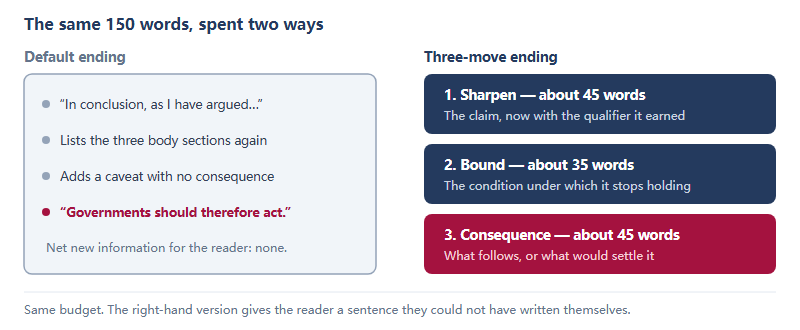
Here is the shape in practice, on a deliberately ordinary topic so that the machinery is visible rather than the subject matter. This is an illustration written for this article, not an extract from any entry:
The argument here is narrower than it first appears: a minimum wage raises employment only where employers already hold wage-setting power, and reduces it where they do not. That is why the same policy produces opposite results in a concentrated rural labour market and a competitive urban one. The claim rests on one condition — that workers cannot easily move between employers, which is an empirical question rather than a theoretical one. Where mobility is high, the monopsony mechanism described above does not operate, and the disemployment result returns. If that is right, the useful question is no longer whether minimum wages destroy jobs, but how to measure employer concentration well enough to predict where they will.
That is about 115 words. Read it against the three moves. Sentences one and two sharpen — the claim is no longer “minimum wages can raise employment” but a conditional statement with the condition named. Sentences three and four bound it, and notice that the boundary is stated as something checkable rather than as a vague “of course, other factors matter.” The final sentence draws the consequence: it does not recommend a wage floor, it redirects the reader to the measurement problem that the whole argument now depends on. No new source is cited, no new evidence is introduced, and nothing is asserted that the body has not already supported.
Three tests before you submit
Endings are hard to judge from the inside, because you finish writing them at the point of maximum fatigue and minimum objectivity. Use mechanical tests instead of instinct.
- The deletion test. Delete the final paragraph and read the essay again. If nothing has been lost except tidiness, the paragraph was summary and those 150 words are available for something better.
- The transplant test. Could your ending sit unchanged under a different essay on the same broad topic? If yes, it is generic. A properly sharpened ending should be impossible to move, because it carries the specific qualifier your specific body established.
- The bookend test. Put the last sentence of your introduction next to the first sentence of your conclusion. If they say the same thing at the same resolution, the essay has travelled in a circle. The conclusion sentence should be strictly more precise — more conditional, more specific, or both.
One further practical point about the reader. HUEA states that every entry is read by its board and that the strongest are then judged by a Harvard economics professor. In any process shaped like that, it is likely that at some stage someone describes your essay to someone else in a sentence or two. Your ending is where you can supply that sentence. An essay that concludes with a sharp conditional claim hands the reader their summary; an essay that concludes with “governments should act” forces them to write one for you, and they will write a blander one than you would have.
Finally, resist the temptation to fix a weak ending by making it longer. If the close feels thin, the problem is almost always upstream — a mechanism that was never fully specified, or an objection you gestured at instead of engaging. Endings are a diagnostic. For the architecture that makes a strong close possible in the first place, see our walkthrough of structuring and writing to the 1,500-word limit, and our overview of what HIEEC asks for for the wider context the essay sits in.
Frequently asked questions
How long should an HIEEC conclusion be?
Roughly 120–160 words in a 1,500-word essay. Long enough for three moves, short enough that none of them is padded.
Can I recommend a policy at the end?
Only if the prompt is normative. Even then the recommendation belongs in the body with its criteria, not smuggled into the last sentences.
Can I cite a new source in the conclusion?
No. A citation the body never used reads as an afterthought and invites the question of why it was not integrated.
Is a rhetorical question a good ending?
Almost never. It asks the reader to do the work you were being judged on. State the open question instead of performing it.
This is an independent guide operated by Hanlin Education for China-based international-school students. We are not affiliated with, endorsed by, or sponsored by the Harvard Undergraduate Economics Association, the Harvard College Economics Review, or Harvard University. Word limits, prompts, deadlines and judging arrangements are set by the organisers and change each cycle — confirm current details on thehuea.org. Factual corrections are made within 7 working days.