One of the most common reasoning failures in HIEEC essays is collapsing efficiency and fairness into a single argument. Judges regularly see candidates claim that a policy is “good for welfare” when the writer has only shown it reallocates resources, or vice versa. This article works through the precise distinction with two hypothetical teaching illustrations, identifies a frequent shortcut mistake, and offers a usable practice decision you can apply to your own draft.
Why the Distinction Matters for HIEEC
The Harvard International Economics Essay Competition (HIEEC), organized by the Harvard Undergraduate Economics Association (HUEA), asks students to construct rigorous economic arguments under tight word limits. Welfare analysis is a recurring prompt theme. A submission that conflates efficiency gains with fairness improvements wastes analytical space and signals incomplete understanding. The teaching observation from past preparation work is clear: candidates who explicitly separate the two dimensions score higher on logical structure, even when their final policy recommendation combines both.
This guide is independent and not affiliated with, endorsed by, or sponsored by Harvard University or HUEA. For students beginning their preparation, see HIEEC Essay Preparation Without School Economics: Where to Start. For confirmed information about the current season, see What HIEEC Has Confirmed for 2026-27 (and Four Claims We Could Not Verify).
Case A: When Efficiency and Fairness Point the Same Way
Imagine a hypothetical island economy with a single polluting factory. The factory generates 6 million in health costs on nearby residents. A carbon tax equal to the marginal external cost forces the factory to internalize the damage. After the tax, the factory reduces output. Its pre-tax profit falls to 4 million in tax, and its after-tax profit is $5 million. Residents’ health costs fall to $2 million because of the reduced pollution, and the government collects $4 million in tax revenue.
Efficiency claim: The tax corrects a market failure. The pre-tax outcome was inefficient because social cost exceeded private cost. The post-tax outcome moves toward the socially optimal quantity. Total surplus rises from 10 million pre-tax profit minus $6 million health costs) to $7 million (2 million health costs). The $4 million tax is a transfer within society, from the firm to the government, so it does not reduce total surplus.
Fairness claim: The $4 million in tax revenue could fund healthcare for affected residents. This is a separate distributional argument about who gains and who loses.
The key move: In a strong HIEEC essay, you would first prove the efficiency gain using a deadweight-loss framework, then introduce the fairness claim as a second, conditional benefit. The efficiency argument stands even if revenue were returned lump-sum to the factory owner. The fairness argument depends on your chosen distribution rule.
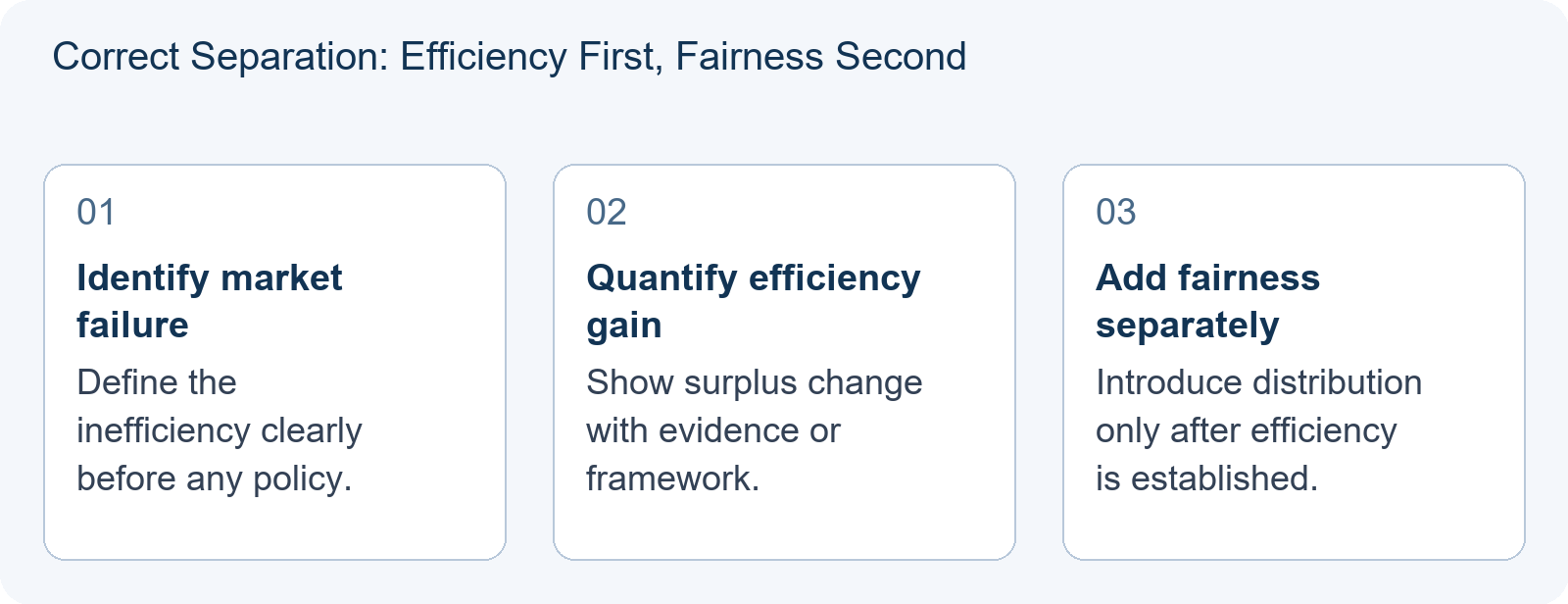
Define the inefficiency clearly before any policy.
Show surplus change with evidence or framework.
Introduce distribution only after efficiency is established.
Case B: When the Shortcut Fails
Now consider a hypothetical universal basic income (UBI) proposal in the same economy. The UBI is funded by a progressive income tax. Proponents argue it “increases welfare.”
A common student shortcut is to cite the transfer as welfare-improving because recipients are better off. But this conflates two questions:
- Does the UBI plus tax system improve efficiency? (Likely no: distortionary taxes create deadweight loss; unconditional transfers may reduce labor supply.)
- Does the UBI improve fairness? (Possibly yes: it reduces income inequality by a chosen metric.)
If you only argue fairness but label it welfare improvement, you have committed the error this article targets. The efficiency question requires analyzing behavioral responses, tax distortions, and fiscal costs. The fairness question requires defending your chosen inequality metric and justifying why redistribution is normatively desirable.
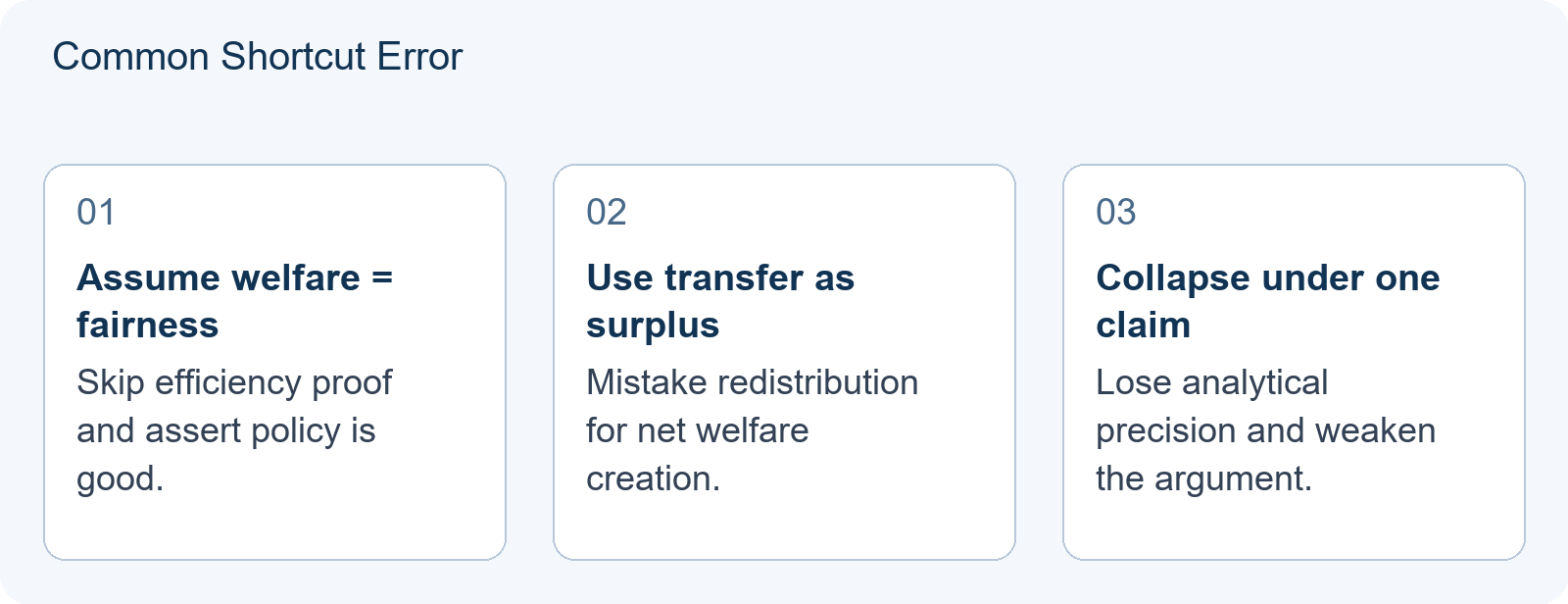
Skip efficiency proof and assert policy is good.
Mistake redistribution for net welfare creation.
Lose analytical precision and weaken the argument.
Diagnostic Table: Efficiency vs. Fairness
| Question to ask | Efficiency lens | Fairness lens |
|---|---|---|
| What is the benchmark? | Pareto or Kaldor-Hicks optimal allocation | Chosen distributional principle (equality, priority, sufficiency) |
| What evidence matters? | Deadweight loss, market failure, behavioral response | Gini coefficient, poverty gap, opportunity differentials |
| Can the claim stand alone? | Yes: “The policy corrects a market failure” | No: “The policy is fairer” requires defended normative premise |
| Typical HIEEC mistake | Ignoring distortion costs | Confusing transfers with surplus creation |
The Specific Skill You Should Demonstrate
After working through these teaching illustrations, you should be able to: state an efficiency claim and a fairness claim separately; identify which evidence supports which; and explain whether your policy recommendation requires both to succeed or only one. This skill is particularly valuable given HIEEC’s emphasis on analytical precision over broad opinion.
For guidance on handling deadlines and submission planning, see HIEEC Late Submission: Planning Your Next Essay After Missing a Deadline. For strategies on building original arguments, see How to Build an Original Economic Argument for HIEEC (Stop Writing the Obvious Answer), 2026.
Targeted Practice Sequence
Try this three-step sequence on your current draft:
- Highlight every sentence in your welfare analysis. Label each “E” (efficiency), “F” (fairness), or “U” (unclear).
- For every “U,” rewrite as two separate sentences or choose the single lens that actually applies.
- Verify: can you remove all “F” sentences and still have a coherent efficiency argument? If not, your efficiency claim may depend on smuggled fairness assumptions.
This exercise is suggested as a teaching tool, not derived from official HIEEC marking criteria.
Frequently Asked Questions
Can I ever combine efficiency and fairness in one sentence?
Only if the sentence explicitly signals both dimensions, e.g., ‘The policy improves efficiency by correcting the externality and improves fairness by directing revenue to low-income households.’ Even here, the reader must see two distinct claims with separate support.
Does HIEEC require me to address both dimensions?
Prompts vary. Some invite normative evaluation where both matter; others focus on a specific market mechanism where efficiency dominates. The skill is knowing which applies and not substituting one for the other.
What if my policy has no efficiency gain but strong fairness benefits?
State this explicitly. A candid argument that ‘this policy reduces efficiency but is justified on fairness grounds’ is stronger than one that disguises the trade-off. Defend your normative premise directly.