Direct answer: better or worse for whom?
The 2026-27 HIEEC globalization prompt asks whether recent caps on international-student numbers or new charges on the universities that enroll them leave Canada, Australia and the UK better or worse off. The defensible short answer is conditional: a cap can lower measured university surplus or export revenue while raising resident welfare if the congestion or local public-service cost per student removed exceeds the surplus lost. It can lower resident welfare if universities are largely resident-owned and congestion relief is small. A strong essay therefore names the resident group, the welfare measure and the time horizon before it evaluates the policy.
This is an independent preparation guide, not an official statement from the competition. It is not affiliated with Harvard University, HUEA or HCER. HIEEC is identified in the supplied Hanlin Courses note as jointly organized by the Harvard Undergraduate Economics Association and the Harvard College Economics Review.
What the 2026-27 globalization prompt asks
Hanlin Courses, in its 28 October 2026 note on the 2026-27 HIEEC questions, reproduces the globalization question as follows:
Category title as reproduced: Globalization
Question as reproduced: Canada, Australia and the UK, which each earn billions from international students, have recently capped their numbers or announced new charges on universities that enroll them. Will these limits leave the host countries better or worse off?
The same note reports that the 2026-27 essay limit is 1,500 words including footnotes but excluding references; that the file must be a single PDF no larger than 10MB; that review is anonymous, so no author or school name should appear; and that the submission deadline is 5 January 2027, 11:59 p.m. ET. It also states that both grade divisions answer the same questions. The supplied note did not reproduce the complete English shared instructions, so this article does not paraphrase them; before submission, obtain or verify the complete official instructions and prompt wording against the official source. If you do not have that source text or file, request it before relying on this article for format compliance.
Build a welfare baseline before arguing
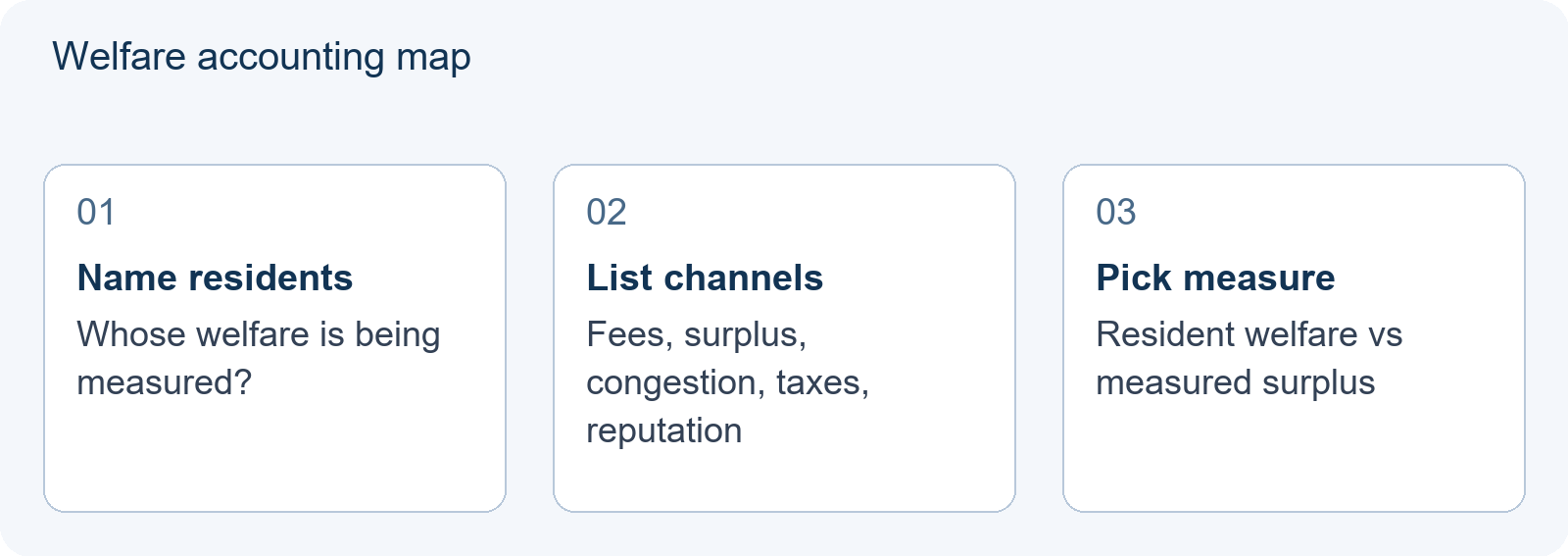
A cap is not one effect. It changes enrollments, tuition revenue, university costs, government charges, local congestion and possibly long-run reputation. The table separates channels that first drafts may merge.
| Channel | What changes | Whose welfare it affects |
|---|---|---|
| Resident households | Housing, transport, health, classrooms and local amenity pressure | Residents who bear congestion; benefit depends on local incidence and elasticities |
| Universities | Tuition revenue minus teaching and facility costs | Resident or non-resident owners, staff and local suppliers |
| Government budget | New charges on universities, taxes, public spending | Taxpayers and users of public services; a charge is first a transfer |
| International students | Access and price of study | Not the same as host-country welfare, though relevant to global welfare |
| Long-run capacity | Reputation, export demand, stranded facilities, course mix | Future residents, future students and university towns |
A useful draft states whether it is measuring resident welfare, national income, university surplus, government revenue or global welfare. These measures can move in different directions. The HIEEC Welfare Analysis: Distinguishing Efficiency Gains From Fairness Claims is a useful companion for keeping those labels separate.
The two easy answers that stall
The first easy answer says caps reduce export income, so host countries lose. That is incomplete: tuition is a transfer from students to universities, and the relevant loss is university surplus net of teaching costs, not gross fee revenue. The second easy answer says caps relieve local pressure, so host countries gain. That is also incomplete: congestion relief must be compared with lost surplus, and the gain may accrue to particular residents rather than the whole country.
Neither answer addresses the prompt unless it specifies a welfare measure. A cap that reduces measured university surplus can still raise resident welfare if congestion costs are large. A cap that relieves congestion can still lower resident welfare if universities are resident-owned and the lost surplus is larger than the relief. The rest of this article builds that comparison.
A labelled teaching illustration
The following is a teaching illustration, not Canada, Australia or UK data. It uses round hypothetical numbers to show the accounting logic.
| Assumption | Value |
|---|---|
| International students before cap | 100,000 |
| Enrollment after cap | 90,000 |
| Students removed by cap | 10,000 |
| Tuition per international student | 25,000 per year |
| University marginal cost per student | 15,000 per year |
| University surplus per student | 10,000 per year |
| Congestion cost per student to residents | 12,000 per year |
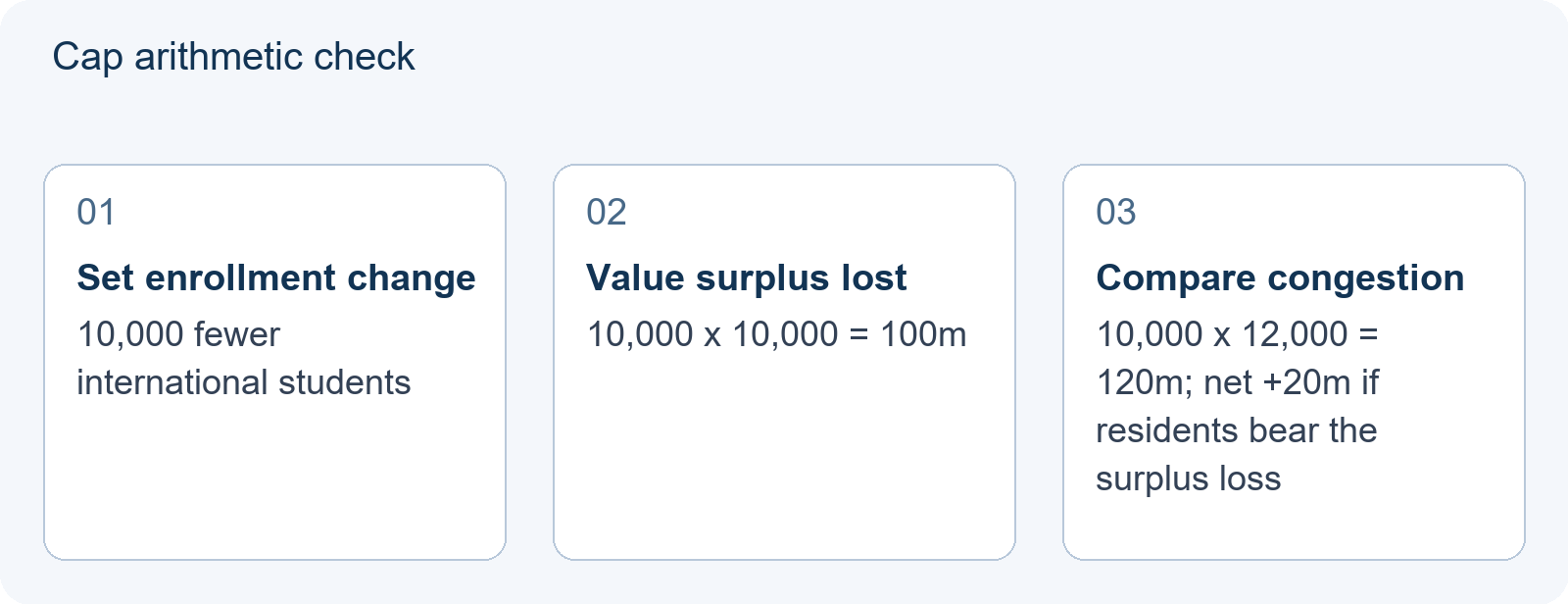
Lost university surplus is 10,000 removed students multiplied by 10,000 surplus per student, or 100 million per year. Congestion relief is 10,000 multiplied by 12,000, or 120 million per year. If resident welfare counts the lost university surplus as a resident cost, net resident welfare rises by 20 million per year: 120 million relief minus 100 million lost surplus. If the university surplus accrues mainly to non-residents, resident welfare rises by the full 120 million while measured university surplus located in the host country still falls by 100 million.
The threshold is transparent: with a 10,000 surplus per removed student, the cap raises resident welfare only if congestion cost per removed student exceeds 10,000 in this simplified accounting and holding other effects constant. If congestion cost were 8,000 instead, congestion relief would be 80 million and net resident welfare would fall by 20 million when surplus is counted. The same arithmetic shows why a narrow income measure that counts university surplus but ignores congestion can fall while a broader resident-welfare measure rises.
A new charge follows a similar logic. Suppose the government charges universities 5,000 per international student and, for the arithmetic, enrollment stays at 100,000. That is a 500 million transfer from universities to government. Resident welfare rises only if the government uses the money in ways residents value and if the university surplus would otherwise accrue to non-residents or be lightly valued. If residents own the universities, the transfer largely nets out before administrative costs. A charge is not free money for the host country simply because it appears in the budget.
Distribution inside the host country
The prompt says host countries, but host countries contain groups with opposing interests. Homeowners in university towns may gain from lower rental pressure; landlords may lose. Residents who use crowded transport or health services may gain; university staff and local suppliers may lose. National taxpayers may gain from charge revenue; students and university owners may lose. A draft that says residents gain without naming which residents is too coarse.
Government savings should also be treated carefully. A charge that fills a budget hole is a transfer, not a resource gain, unless it changes spending or behaviour. If the revenue funds additional housing or teaching capacity, the welfare effect depends on the value of that spending, not on the size of the transfer. The Writing Trade and Industrial Policy Practice for HIEEC: Tariffs, Subsidies and Supply Chains in 1,500 Words addresses a different prompt; it is not evidence about student caps.
Short run versus long run
One intake year is not a permanent equilibrium. Universities may raise fees for remaining students, reduce course offerings, defer maintenance or shift capacity toward domestic students. A cap can also damage reputation and future export demand, which may reduce surplus further. Conversely, if the cap forces universities to use capacity more efficiently, the long-run loss may be smaller than the first-year arithmetic suggests.
The counterargument paragraph should state when a cap could raise resident welfare even if measured surplus falls. That case is strongest when congestion or local public-service costs are real, universities are foreign-owned or surplus accrues to non-residents, and the cap targets genuinely scarce local amenities. The evidence needed includes local housing elasticities, health and transport capacity, university ownership, the share of students in rented housing, and the fee response of universities. Without that evidence, the essay should present a conditional thesis rather than a universal verdict.
Diagnostic and thesis template
Apply this test to your own draft: does it say better off for whom, on which measure, over what horizon? A complete thesis can follow this shape: Although a cap on international students reduces measured university surplus by [channel], it makes [resident group] better off over [horizon] if [congestion or public-service benefit] exceeds [lost surplus or export income]; this does not establish that [other group] is better off.
Then check five points. First, is tuition counted as a benefit without subtracting teaching costs? Second, is congestion counted without saying who bears it? Third, is a government charge treated as a resource gain rather than a transfer? Fourth, is one intake year treated as a permanent equilibrium? Fifth, does the essay answer the host-country question rather than global welfare? If your draft drifts into a general trade-policy essay, return to the host-country welfare measure and delete claims that do not change it.
Before requesting feedback
Prepare a one-page memo before asking a teacher or reviewer for comments: the prompt as you have verified it, your thesis, your welfare measure, a table of channels, two evidence needs and one counterargument. Include the exact prompt text you verified, because a reviewer cannot check fidelity against a paraphrase. This lets a reviewer test your logic rather than rewrite your prose. If you are considering structured preparation, use the memo to check fit: ask whether the reviewer will challenge your welfare measure and assumptions, not whether they will promise a particular result. The How to Get Feedback on Your HIEEC Draft: A Two-Round Critique System That Works explains how to use comments without outsourcing the argument.
General event background is available at Event background.
Frequently Asked Questions
Does the HIEEC 2026-27 globalization prompt require a simple yes or no answer?
No. The prompt asks whether limits leave host countries better or worse off. A strong answer specifies the resident group, the welfare measure and the time horizon, then states the conditions under which the sign changes. A conditional thesis is more defensible than a universal verdict.
Can I use evidence from Canada, Australia and the UK only?
The Hanlin Courses note dated 28 October 2026 reports that candidates may use evidence from any country, including their own, and that the examples in each question are starting points rather than limits. Use evidence that matches your welfare measure and state its year and population.
Which welfare-accounting mistake should I check for?
Counting gross tuition revenue as a host-country benefit without subtracting university teaching costs, or counting government charges as free money without recognising that they are transfers. A second check is to avoid ignoring congestion costs or assuming that all residents share the same gain.