For the 2026-27 HIEEC, the own-question route is real: the prompt set includes “Your own question,” with the instruction “Pose and answer an economics question of your choosing.” The practical answer is narrower. A self-set question is viable only if it can survive four tests before drafting: mechanism, evidence, counterargument and scope. If a question fails two or more tests, choose a supplied prompt. If it passes all four, self-setting can be a strong route because you can build the essay around a mechanism you understand rather than around a topic you merely find interesting.
This guide is independent and is not affiliated with, endorsed by, or sponsored by Harvard University or the Harvard Undergraduate Economics Association (HUEA). It treats the supplied Hanlin Courses report as a preparation source, not as official scoring guidance.
2026-27 Own-Question Prompt and Shared Requirements
According to Hanlin Courses’ WeChat report published 28 October 2026, the 2026-27 prompt set includes the following own-question option:
Your own question. Pose and answer an economics question of your choosing.
The same report lists these shared requirements:
- The essay limit is 1,500 words including footnotes but excluding references.
- The file must be a single PDF no larger than 10MB.
- The PDF must not contain the author’s name or school name.
The report also gives the 2026-27 deadline as 11:59 p.m. US Eastern Time on 5 January 2027. It describes the judging rubric as covering analysis, creativity, research and structure, each scored out of 5. That rubric description is a source fact; it is not a promise about how any particular essay will be marked.
Test 1: Does the question have an economic mechanism?
A feasible HIEEC question does not need to be technically advanced, but it must contain a chain of economic reasoning. Something changes, people or firms face an altered constraint, they adjust a choice, and an outcome moves. If you cannot state that chain in two sentences, the question is probably a topic rather than an essay question.
As a teaching illustration, “Is immigration good for the economy?” is a topic. It contains several possible mechanisms, several outcomes and no settled criterion for “good.” A more workable question narrows the chain: “How does a rise in the local minimum wage affect hours worked by teenage workers in a single labour market?” That question names a policy, a group, a margin of adjustment and an outcome. It still needs evidence and a counterargument, but the mechanism is visible.
The mechanism test also protects against moral framing. As a teaching illustration, a question such as “Should rich countries give more aid?” may be important, but it can collapse into a normative assertion unless you specify what aid changes: saving, investment, government capacity, prices or migration incentives. For HIEEC, a self-set question should let a reader see which economic behaviour is doing the explanatory work.
Test 2: Is evidence accessible and contestable?
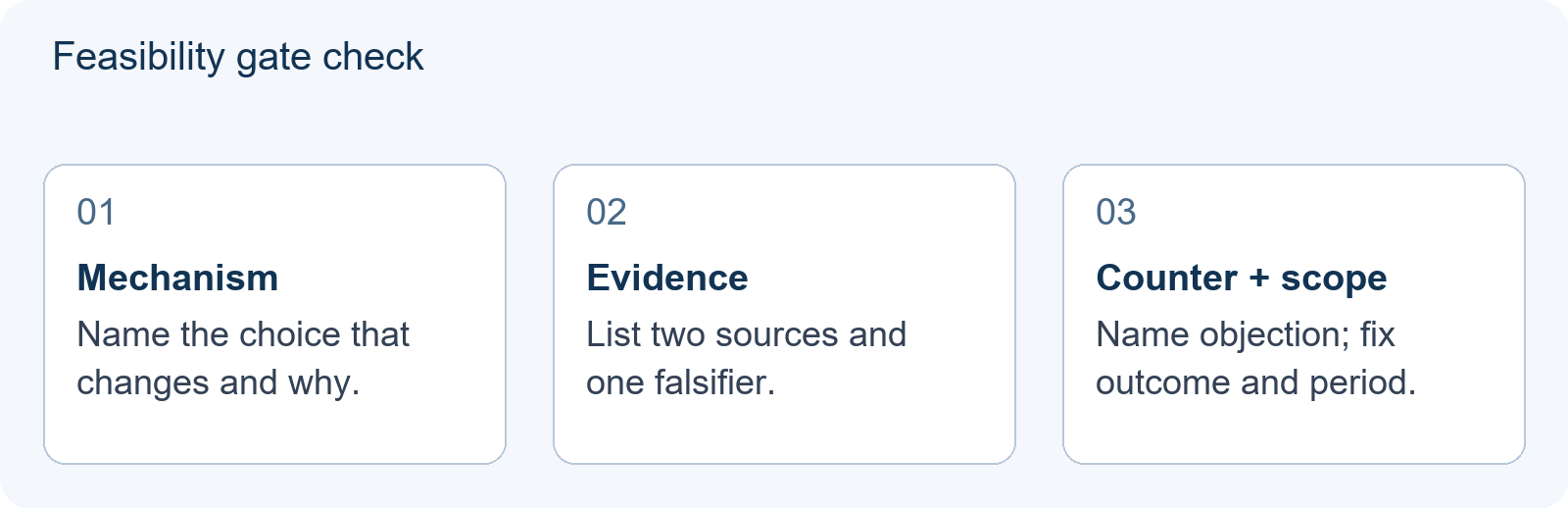
The second test is evidence. You do not need original data, and the supplied source lists no original-research requirement. But you do need to know what kinds of evidence could support, qualify or weaken your answer. A question that requires confidential firm records or a survey you cannot run is not feasible for a 1,500-word essay. A question that can be answered only by repeating a moral preference is not an economics essay either.
Ask three things. First, what public data, published study, policy evaluation or cross-country comparison would you use? Second, what source would a sceptical reader expect you to address? Third, what finding would make you change your conclusion? If the answer to the third question is “nothing,” the question is probably too closed to reward analysis. The HIEEC literature-review guidance on HIEEC Literature Review: Organise Economic Evidence Around a Disagreement is useful here because it forces the writer to identify what the evidence is disagreeing about, rather than collecting citations that all point one way.
Accessibility matters more than volume. Two strong sources used precisely can be better than ten sources that merely decorate the introduction. The evidence test is passed when you can name the source type, the comparison, and the limitation before you write the first paragraph.
Test 3: Can you state the strongest counterargument?
A good self-set question has a serious objection built into it. If no reasonable economist could disagree, the question is likely tautological or definitional. If the only counterargument is “some people may disagree,” the question is too vague.
For a congestion charge, the strongest objection is not simply that drivers dislike paying. It is that the measured fall in car trips may reflect simultaneous bus improvements, a recession, fuel prices or boundary effects; that low-income drivers may bear a larger share of the charge; and that retail activity may shift rather than disappear. Those objections come from the same mechanism, which makes them useful in a short essay. The HIEEC counterfactual guide on HIEEC Essay Counterfactuals: State What Would Have Happened Without the Policy is relevant because a counterargument often turns on the missing comparison case.
The counterargument test is passed when you can say, in one sentence, what would have to be true for your answer to reverse. If you cannot identify that condition, your question may be too broad or too safe.
Test 4: Is the scope small enough for 1,500 words?
Scope is where most own-question plans fail. A question can be economically sound and still be unanswerable in 1,500 words because it asks about three outcomes, several countries and a century of history. A feasible question usually fixes one outcome, one population or place, one time window, and one policy or shock.
Anonymous review raises the cost of vague scope. Because the PDF must not contain your name or school name, the question must be self-contained. A reader cannot fill in “my city” or “my school’s survey” unless you define the setting inside the essay. If the question depends on local knowledge that an anonymous reader cannot verify, either provide the context or narrow the claim.
| Test | Question to ask | Pass signal | Fail signal |
|---|---|---|---|
| Mechanism | What changes, and why do choices move? | One clear chain from policy or shock to outcome | Only a broad topic or moral label |
| Evidence | What source would change my mind? | Named data, study or comparison | No accessible evidence or no falsifier |
| Counterargument | What is the strongest objection? | Objection arises from the same model | No serious disagreement possible |
| Scope | Can one outcome be explained in 1,500 words? | One outcome, place, period and policy | Several outcomes and global scope |
Worked teaching illustration: from a broad question to a workable one
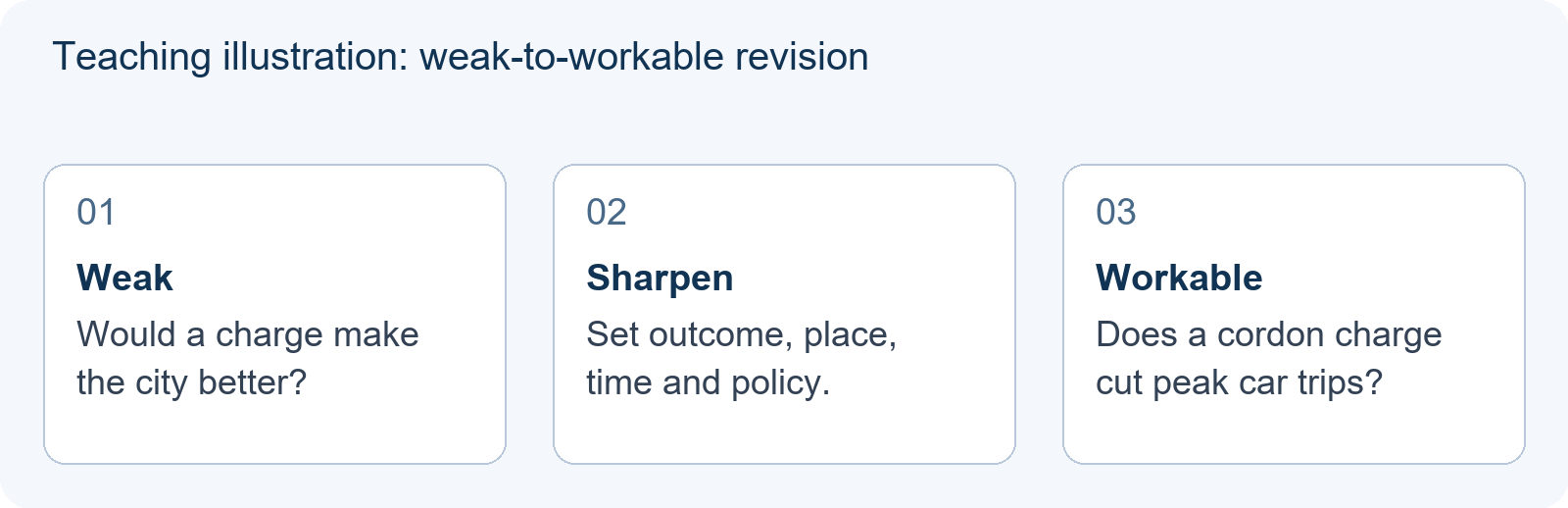
This is a teaching illustration, not an official HIEEC prompt or scoring example. Suppose a student proposes: “Would a congestion charge make a city better?” The question feels relevant, but it fails the planning tests. “Better” could mean less traffic, lower emissions, more revenue, fairer transport or stronger retail activity. The mechanism is multiple, the evidence could come from anywhere, the counterargument is everything, and the scope is a whole city and an undefined future.
A revised question might be: “To what extent does a cordon charge on cars entering a city centre between 7 and 10 a.m. reduce peak-hour car trips when bus fares are held constant?” The revision is not perfect, but it is workable. The mechanism is that the charge raises the marginal cost of driving at peak times, so some drivers switch to buses, travel off-peak or cancel trips; holding bus fares constant helps isolate the charge from one obvious confounder. The evidence could include traffic counts, travel surveys, transit ridership and published evaluations of cordon schemes. The counterargument is that high-value drivers may keep driving, retail trips may shift, and boundary effects may displace traffic rather than remove it. The scope is one city, one cordon, one morning window and one outcome.
The revised question also fits the word limit. In 1,500 words, a writer can state the mechanism, present one or two evidence claims, answer the strongest objection and conclude without pretending to settle every transport question. The original question would require a book. The revised question requires an essay.
Anonymous review and the creativity criterion
Anonymous review changes how you should phrase a self-set question. You cannot rely on your school, your city or a personal experience to supply the missing context. Define the setting, the policy and the outcome in the question or the first paragraph. If your question is creative because it connects two unexpected markets, make the connection explicit enough that a reader without your background can follow it.
The creativity criterion in the supplied rubric should not be read as a demand for a novelty trick. A creative question can be a familiar policy applied to an unusual margin, a standard model tested against a different group, or two literatures placed in tension. But creativity without a mechanism becomes a slogan. The safest planning judgment is this: use creativity to sharpen the question, not to hide the absence of evidence.
Decision rule: self-set or choose a supplied prompt?
Use the own-question option only if you can complete four sentences in one line each. First: “The mechanism is ____, because ____ changes ____.” Second: “The best evidence is ____, and the evidence that would weaken my answer is ____.” Third: “The strongest objection is ____, and it would reverse my conclusion if ____.” Fourth: “The essay covers ____ as the outcome, ____ as the place or population, ____ as the period, and ____ as the policy or shock.”
If you cannot complete three of the four sentences, choose a supplied prompt. If you can complete all four but the question still needs a paragraph of definitions before it makes sense, narrow the outcome rather than adding more ambition. If you are already midway through a draft and the question keeps expanding, the decision logic in When to Abandon Your HIEEC Draft and Switch Prompts: A Decision Rule for the Autumn Term is a useful check on sunk cost. If your question contains two or three sub-questions, split them or simplify before drafting; a supplied multi-part prompt is a different decision.
Preparing a feasibility review request
If you want a second read before committing weeks to reading, prepare a short feasibility packet rather than sending a vague topic. Include your proposed question in one sentence, the mechanism in one sentence, two source types you could actually access, the strongest objection you can already see, and the scope you intend to cover. That packet lets a reviewer test the question against the four gates without rewriting your idea for you. It is also a useful self-check: if you cannot fill the packet, the question is not ready for a full draft.
A feasibility review can comment on whether the question is answerable in the format and where the evidence burden lies. It cannot promise acceptance, a particular score or an award. HUEA’s public page, retrieved on 2 November 2026, describes the 2026-27 contest as open; that confirms activity, not the details above. The details in this article come from the supplied Hanlin Courses report dated 28 October 2026 and should be checked against the latest competition materials before submission.
Frequently Asked Questions
Is the HIEEC own-question option available for 2026-27?
Yes. The supplied Hanlin Courses report dated 28 October 2026 lists “Your own question” with the instruction “Pose and answer an economics question of your choosing.” The same source states a 1,500-word limit including footnotes but excluding references, a single PDF no larger than 10MB, no author or school name in the PDF, and a deadline of 11:59 p.m. US Eastern Time on 5 January 2027.
How do I know my own question is not too broad for 1,500 words?
Fix one outcome, one place or population, one time window and one policy or shock. If the question needs several paragraphs of definitions before it becomes answerable, it is too broad. A useful test is whether you can state the mechanism, the evidence type, the strongest objection and the scope in four short sentences.
Does a self-set question need original data or a new theory?
The supplied source lists no original-data requirement. As a planning judgment, you should be able to name accessible published evidence and say what finding would weaken your answer. A question that requires confidential data or cannot be contested is not a good fit for this essay format.