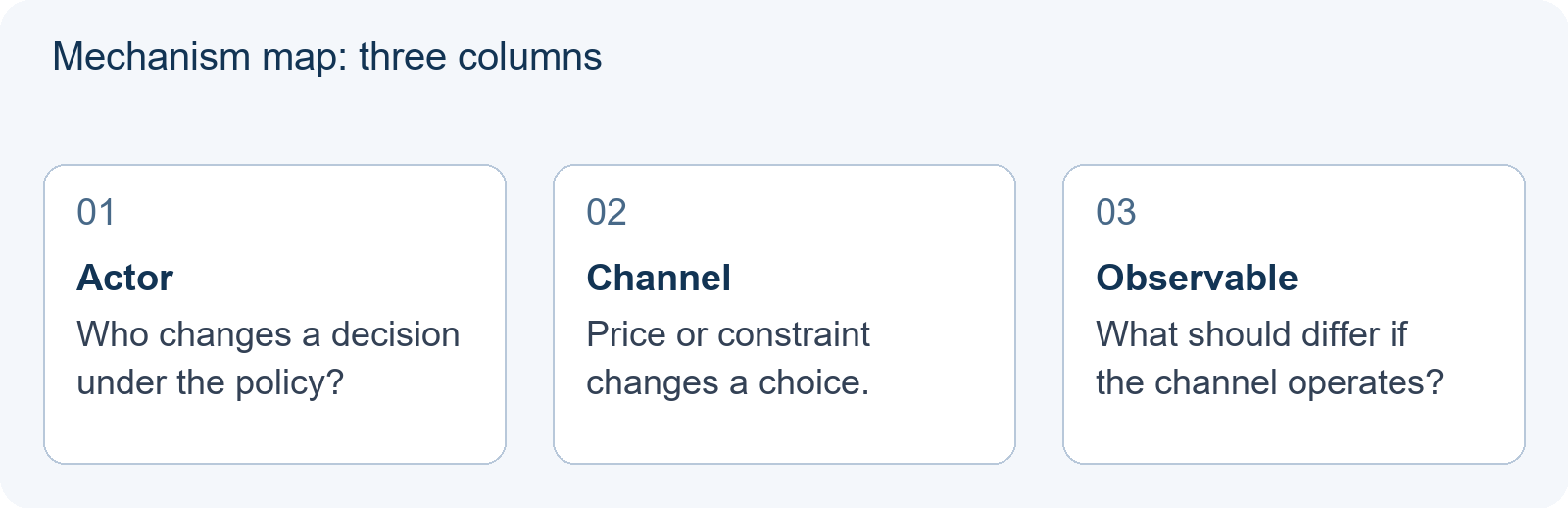
For the 2026–27 HIEEC, build your argument as a mechanism map: name the affected actor, the channel through which the policy or shock changes that actor’s decision, and the observable implication that would appear if the channel is real. The 1,500-word limit makes a short causal chain more useful than a long list of effects, and the map gives you a falsification test before drafting.
A mechanism is not a list of effects
Hanlin Courses’ 2027 Harvard HIEEC question-analysis note, published on 12 November 2026, recommends three questions for the current season: who is affected, through what mechanism, and what evidence is needed to judge the claim. That is a coaching method, not an official scoring rule. It is useful because a draft can answer only the first question. It may say that a policy affects students, renters, workers or firms, then add several expected outcomes. A mechanism instead explains the decision that connects the policy to the outcome.
Write the chain in one sentence before you collect evidence: policy or shock → change in a price, constraint or information set → actor compares options → actor changes a decision → aggregate outcome. If any arrow is missing, the paragraph is probably describing a correlation. This is different from the HIEEC Essay Counterfactuals: State What Would Have Happened Without the Policy, which asks what would have happened without the policy. The mechanism asks why the policy would move the outcome at all. It is also narrower than an HIEEC Economic Models: Writing the Assumption That Could Reverse Your Conclusion: the map shows the channel, while the assumption check asks whether the channel survives a changed condition.
Question 1: who is affected, and at which margin?
“Who is affected” is too broad if it becomes a list of everyone. Split the affected population by the constraint that governs their response. A commuter with flexible hours can change departure time; a worker with a fixed start time may only change mode or pay. A local business can retime deliveries or absorb the charge. These are different margins of adjustment, and they may produce different observable effects.
The congestion-charge tables in this section are a teaching illustration, not an HIEEC prompt.
| Affected actor | Constraint that matters | Margin of adjustment |
|---|---|---|
| Peak driver with flexible hours | Time and schedule | Leave earlier or later, change mode, or pay |
| Driver with fixed hours and tight budget | Work start time, liquidity | Pay, change mode, or reduce trips |
| Local business receiving deliveries | Delivery windows, costs | Retime deliveries, absorb cost, or pass it on |
For each actor, write the constraint and the margin. If an actor has no margin, the policy may transfer a cost rather than change behaviour. That distinction matters for welfare: a burden is not the same as a failed incentive. The table also stops you from claiming that “drivers respond” when only drivers with substitutes can respond.
Question 2: through what channel?
The channel element of your map should name a channel, not a slogan. “Higher costs reduce demand” is not yet a mechanism; it becomes one when you state which cost changes, for whom, and what substitute is available. In price channels, the policy changes a marginal cost. In constraint channels, it changes eligibility, time, information or access. In information channels, it changes beliefs. The channel must imply a direction of movement and a group that should move more.
Elasticity is the discipline here. If demand is inelastic and substitutes are weak, a charge may raise revenue and burden some actors without changing quantity much. The HIEEC Essay Elasticity: Explain Why a Policy Works Differently Across Markets page develops that point. A mechanism map should therefore include a premise: “This channel predicts a larger response where a close substitute exists.” If the essay cannot state that premise, the channel remains untestable. A strong paragraph does not merely assert that people will adjust; it says which people, facing which constraint, have a reason and an ability to adjust.
Question 3: what evidence would show it?
Turn the channel into an observable implication: a difference we should see if the mechanism operates, compared with a rival explanation. A useful implication has a unit, a comparison and a timing. “People will be unhappy” is not an observable implication. “Peak entries into the charged zone should fall relative to a similar uncharged area after enforcement begins, while transit boardings on affected corridors rise” is.
| Observable implication | Rival to rule out | Discriminating test |
|---|---|---|
| Charged-zone peak entries fall and transit boardings rise | A general slowdown cuts all traffic | Compare with a similar uncharged area and check timing |
| Traffic shifts toward boundary times | Roadworks or weather | Check dates, exemptions, and enforcement |
| Response is larger where substitutes exist | All drivers face the same constraint | Compare groups with different access to transit |
Evidence should be used as a consistency check, not a proof. A literature review organised around a disagreement can help you find studies that test competing channels, but the map tells you what to look for. If a study measures a different population or a different outcome, it may not discriminate between your channel and the rival.
Teaching illustration: a congestion charge
The following is a hypothetical teaching illustration, not an HIEEC prompt. Suppose a city charges cars entering a central zone on weekday mornings. Assume enforcement is real, some drivers have flexible schedules, and public transit is available on the main corridors. The policy does not mechanically “reduce congestion.” It raises the marginal cost of peak entry. Drivers compare the charge with the cost of leaving earlier or later, paying and continuing, or switching to transit. Some change time or mode. The aggregate prediction is that peak entries into the charged zone fall relative to a similar uncharged area, and transit boardings rise on affected corridors.
The map also shows who may bear costs without changing behaviour. A driver with a fixed start time and no good transit option may pay the charge. That is a burden, not evidence that the price channel failed. A business may absorb the charge or pass it to customers. These are separate implications, and they should not be merged into a single “welfare” sentence. If the essay needs to judge efficiency or fairness, that is a separate question from whether the mechanism operates.
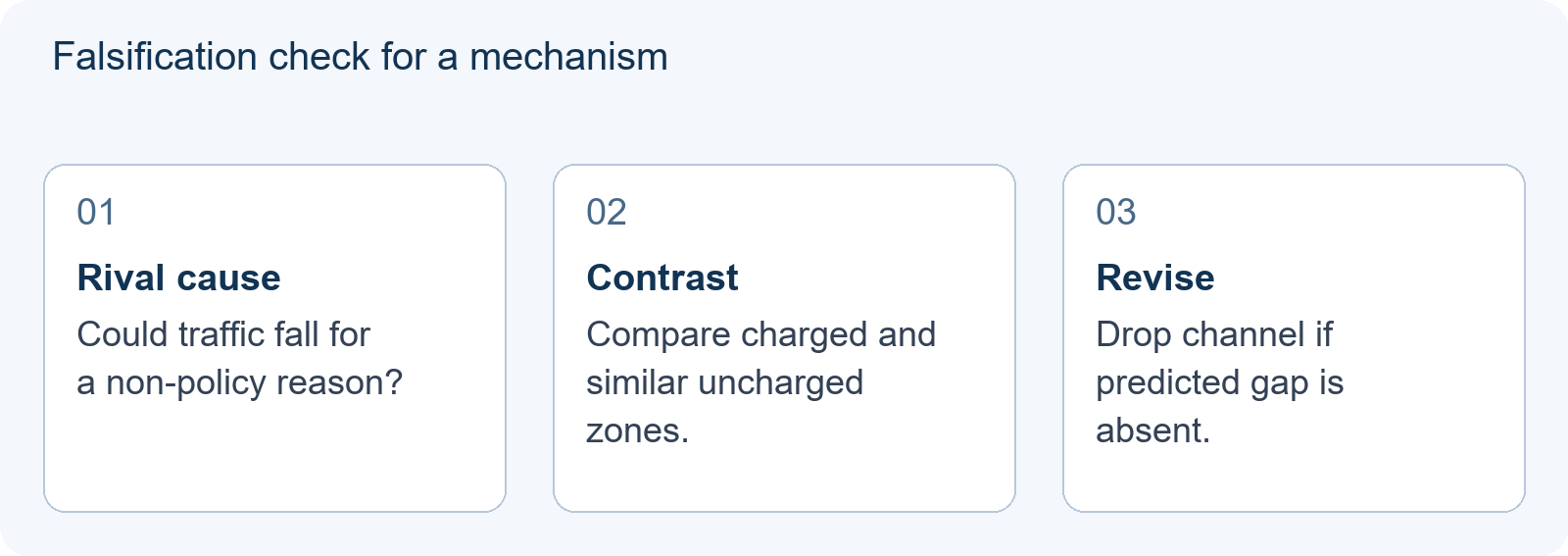
Falsification: what would make you revise?
A mechanism is useful only if some result would count against it. For the congestion illustration, the price channel predicts a relative fall in charged-zone peak entries when the charge is high, enforcement is visible and substitutes exist. If entries fall equally in the uncharged comparison area, a general slowdown is a better explanation. If entries and transit boardings do not move despite those premises, the channel is weak, or an omitted constraint is binding.
This is not a proof requirement. HIEEC essays are short, and you will rarely settle a causal question. The point is to tell the reader what evidence would change your mind. That sentence improves analysis because it separates your claim from a rival. It also improves structure: the reader can see the map, the evidence and the revision in the same order. A falsification check also prevents the move of listing a policy, listing an outcome, and assuming the first caused the second.
Compress the map into a 150-word paragraph
One failure mode is to build a large map and then write a paragraph that lists actors without the chain. Compression is a test. If you cannot state actor, channel, observable implication and rival in about 150 words, the mechanism is probably not clear enough. The paragraph below reuses the same illustration.
“Suppose a city charges cars entering a central zone on weekday mornings. The mechanism is not ‘congestion falls’; it is a chain. The charge raises the marginal cost of peak entry. Drivers with flexible hours compare the charge with the cost of leaving earlier or later; drivers with good transit access compare it with fares and travel time. Some therefore shift time or mode, so peak entries into the charged zone should fall relative to a similar uncharged area, and transit boardings should rise on affected corridors. The claim is limited: if entries fall equally outside the zone, a general slowdown is a better explanation; if charge, enforcement and substitutes are present but entries and transit do not move, the price channel is weak. The map does not prove the policy is fair or efficient; it tests one causal link.”
That paragraph is about 140 words. It keeps the policy, the actors, the channel, two observable implications and a rival. It does not include every possible affected group. That is acceptable because the paragraph is testing one link, not summarising the essay. In a full draft, the remaining space can be used for a second channel or a source comparison, not for another list of effects.
Rubric link and feedback preparation
HUEA’s current HIEEC page, accessed on 16 November 2026, states that judges assess analysis, creativity, research and structure, each worth five points for a total of 20. Mechanism clarity cannot guarantee points, but it gives the analysis section a causal claim and the structure section a visible order. The same page lists a maximum of 1,500 words including footnotes but excluding references, so the map must earn its space. If a table or diagram does not change the reader’s understanding of the channel, cut it.
Before asking for feedback or discussing course fit, prepare a one-page packet: your chosen topic area; a three-row mechanism map; one rival explanation; two sources you have actually read; and your current word count. Do not ask a reviewer to invent a mechanism for you. The useful question is whether the channel is clear, whether the observable implication follows, and whether the evidence could distinguish your explanation from the rival. This is also a fair way to judge whether a course or coaching conversation fits your needs; no provider can promise an award, score or admission outcome.
HIEEC is organised by HUEA and HCER; this guide is not affiliated with either. For the 2026–27 season, use the current HUEA page for requirements and your own verified reading for evidence.
Frequently Asked Questions
What is a HIEEC mechanism?
A HIEEC mechanism is the causal channel that connects a policy or shock to an outcome through an affected actor’s decision. It should state who responds, what price or constraint changes, and what observable difference would appear if the channel operates.
How is a mechanism map different from a counterfactual?
A counterfactual asks what would have happened without the policy. A mechanism map asks why the policy would change behaviour and which evidence would distinguish that explanation from a rival. The two tools are complementary, but they answer different questions.
Can a mechanism map fit inside the word limit?
Yes. A compact map can be reduced to one causal chain with one or two observable implications and one rival. HUEA lists a maximum of 1,500 words including footnotes but excluding references for the 2026–27 competition, so anything that does not clarify the channel should be cut.