HIEEC asks for a strict 1,500-word essay in Chicago or APA style, submitted as a PDF — and referencing is the one requirement strong writers most often treat as an afterthought. Getting it right does two things at once: it signals academic seriousness to an expert economist reader, and it protects you from the originality problems that disqualify entries. This guide explains which style to choose, how to cite the sources economics essays actually use (data sets, working papers, news), and the formatting mistakes that quietly mark an essay as rushed.
Chicago or APA — which should you choose?
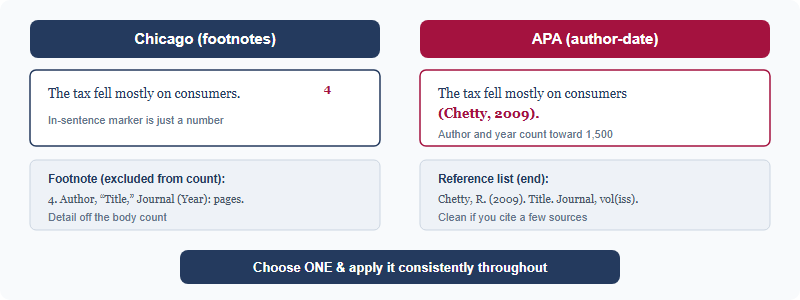
HIEEC permits either Chicago or APA; you choose one and apply it consistently. They are both respected academic systems, and neither is “preferred” by the competition — but they behave differently in the body of an essay, which matters when every word counts. The practical trade-off:
| Feature | Chicago (notes-bibliography) | APA (author-date) |
| In-text marker | Superscript number → footnote | (Author, Year) in the sentence |
| Effect on word count | Citation detail sits in footnotes (excluded from the 1,500) | Author and year sit in the body text |
| Reading flow | Clean main text; eye drops to notes | Citations visible inline; can feel busier |
| Best when… | You cite often and want a clean argument line | You cite a few key sources and value transparency |
| End matter | Bibliography | Reference list |
A useful rule of thumb: because the 1,500-word limit excludes references, footnotes, titles and headers, Chicago’s footnote system keeps citation text out of your body count, which can be an advantage if you cite heavily. APA puts the author and year inside the sentence, so it is cleaner if you lean on a small number of sources. Either way, the decisive factor is consistency — a judge notices a mixed system instantly. Pick one before you start writing, not after. For how this fits the wider drafting process, see our guide to writing the 1,500-word essay.
How to cite the sources economics essays actually use
School referencing guides assume you are citing books and journal articles. An economics essay leans on three source types that students often format incorrectly: data sets, working papers, and news/policy reports. The principles below hold across both styles; for exact punctuation and order, always check the current Chicago Manual of Style or APA manual, because details are revised periodically.
- Statistical data (World Bank, IMF, national statistics, OECD). Cite the organisation as author, the data set or indicator name, the year of the data, and the access date if it is an online database. Do not cite a number with no source — an unattributed figure is treated as unsupported.
- Working papers (NBER, IMF working papers, SSRN). These are not yet peer-reviewed journal articles, so label them as working papers and include the series number where given. Using one is fine and often impressive; misrepresenting it as a published article is the error.
- News and policy reports (the Economist, FT, central-bank publications). Cite the outlet, the article title, the author if named, and the date. For a fast-moving topic, the date matters — it tells the reader how current your evidence is.
- Textbooks and lecture material. Fine for defining a model, but lean on primary data and studies for evidence. A judge wants to see you engage with sources, not just a textbook.
A simple discipline ties this together: every claim that is not common knowledge gets a citation, and every citation in the text appears in the bibliography or reference list — and vice versa. Mismatches between the two are among the easiest weaknesses for a careful reader to spot. The diagram below turns that discipline into a quick gate you can apply to any sentence as you write.
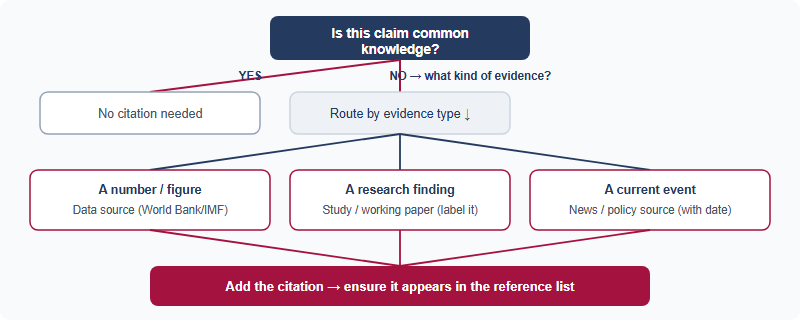
“Common knowledge” is narrower than students assume. That GDP is the value of output, or that the 2008 crisis happened, is common knowledge; a specific growth rate, an elasticity estimate, or a claim about why something happened is not. When the line is unclear, the safe move is to cite — over-citing costs you nothing under the limit, since references sit outside the 1,500-word count, while an unattributed figure reads as a gap in your evidence.
What counts toward the 1,500 words — and what does not
This is where referencing and the word limit collide. HIEEC’s limit is strict, and material over it is simply truncated, so you must know exactly what is inside the count. Based on the competition’s stated rule that the limit excludes references, footnotes, titles and headers:
| Element | Counts toward 1,500? | Notes |
| Body paragraphs (your argument) | Yes | This is the count that matters |
| APA in-text citations (Author, Year) | Yes (they sit in the sentence) | A reason some heavy citers prefer Chicago |
| Chicago footnotes | No (excluded) | Citation detail stays off the body count |
| Bibliography / reference list | No (excluded) | Full source list does not count |
| Title and headers | No (excluded) | Per the stated rule |
| Footnotes used for argument (not citation) | Confirm officially | Do not hide analysis in notes to dodge the count |
One warning the table implies: do not use footnotes to smuggle argument out of the word count. If a footnote carries reasoning rather than a citation, an experienced reader will see it, and it works against you. Footnotes are for sources; the argument belongs in the 1,500. Because exact counting conventions can vary, confirm the current rule on the official site and, when unsure, keep your body comfortably under the limit so a counting difference never costs you. Our overview of HIEEC covers the full set of format rules.
Referencing, originality, and AI — the overlap that disqualifies
Referencing is not only a formatting task; it is how you stay on the right side of originality. Two failure modes matter. The first is plagiarism: using a source’s words or ideas without attribution. Careful citation is the cure — when in doubt, cite. The second, increasingly relevant, is AI-generated text. Competitions of this kind expect your own analysis, and AI tools are known to fabricate citations — inventing plausible-looking authors, titles, and page numbers for sources that do not exist. If you draft with any AI assistance, the non-negotiable rule is to verify every single reference against the real source, because a fabricated citation is both an originality failure and an instant credibility loss with an expert reader. The safest path is to do your own reading and your own writing, and use referencing to show exactly where your evidence comes from. Always confirm the competition’s current rules on originality and permitted assistance on the official site.
Style-specific slips that catch non-native writers
A few mechanical details trip up strong students writing in English as an additional language. None is hard once you know it, and each is the kind of small error a meticulous reader registers:
- Alphabetical order, by surname. Both Chicago bibliographies and APA reference lists are ordered alphabetically by the first author’s surname — not by the order you cited them, and not by date. A list in citation order is an immediate tell.
- Author name format differs by style. The two systems present names differently, and APA uses initials rather than full first names. Do not mix the conventions; follow your chosen manual exactly.
- Hanging indents. Entries in both styles use a hanging indent (first line flush, later lines indented). It is a formatting setting, not manual spacing — set it once so the list looks professional in the PDF.
- One consistent date format. Whatever your style, write dates the same way throughout. Mixing “Jan 2024” and “January 5, 2024” signals a list assembled in a hurry.
- URLs and access dates for online sources. Online data and reports need a stable link and, where the style requires, an access date — particularly for databases whose figures update.
The umbrella principle behind all five is the same: pick the current manual for your chosen style and follow it literally, rather than half-remembering school habits. Because both Chicago and APA revise their rules periodically, the version that matters is the latest one — confirm the specifics there, not from an old worksheet.
A pre-submission referencing checklist
Before you export the PDF, run this list — it catches the errors that mark an entry as rushed:
- One style (Chicago or APA) applied consistently from first citation to last.
- Every in-text citation has a matching entry in the bibliography or reference list — and none is orphaned.
- Every data figure is attributed to a named source with a year.
- Working papers are labelled as working papers, not as published articles.
- If you used any AI assistance, every reference has been checked against the real source.
- Footnotes carry citations, not argument.
- Body word count sits at or safely under 1,500; the bibliography is excluded.
- The file is a clean PDF, with your formatting intact after export.
Frequently asked questions
Does my bibliography count toward the 1,500 words?
No. HIEEC's limit excludes references, footnotes, titles and headers. Your body argument is what counts. Confirm the exact rule on the official site if unsure.
Is Chicago or APA better for a HIEEC essay?
Neither is preferred. Chicago keeps citation detail in footnotes (off the word count); APA puts author and year in the sentence. Pick one and apply it consistently.
How do I cite a statistic from the World Bank or IMF?
Treat the organisation as the author and include the indicator or data-set name, the data year, and an access date for online databases. Never cite a figure with no source.
Can I use AI to format my references?
Confirm the competition's rules on AI first. AI tools often invent fake citations, so verify every reference against the real source — a fabricated citation is a serious credibility problem.
This is an independent guide to the Harvard International Economics Essay Competition, operated by Hanlin Education for China-based international-school students. We are not affiliated with, endorsed by, or sponsored by the Harvard Undergraduate Economics Association, the Harvard College Economics Review, or Harvard University. Referencing conventions, word-count rules, originality policy and dates change by year and by style manual — always confirm the current details on the official HUEA site and the latest Chicago or APA manual. Confirmed errors are corrected within 7 working days.